Curriculum
AP Physics C: Mechanics
1. Kinematics
0/11
2. Force and Translational Dynamics
0/21
-
2. Force and Translational Dynamics
 Preview
-
2.1 Systems and Center of Mass
Preview
-
2.1 Systems and Center of Mass - Check yourself
 Preview
-
2.2 Forces and Free-Body Diagrams
Preview
-
2.2 Forces and Free-Body Diagrams - Check yourself
Preview
-
2.3 Newton’s Third Law
Preview
-
2.3 Newton’s Third Law - Check yourself
Preview
-
2.4 Newton’s First Law
Preview
-
2.4 Newton’s First Law - Check yourself
Preview
-
2.5 Newton’s Second Law
Preview
-
2.5 Newton’s Second Law - Check yourself
Preview
-
2.6 Gravitational Force
Preview
-
2.6 Gravitational Force - Check yourself
Preview
-
2.7 Kinetic and Static Friction
Preview
-
2.7 Kinetic and Static Friction - Check yourself
Preview
-
2.8 Spring Forces
Preview
-
2.8 Spring Forces - Check yourself
Preview
-
2.9 Resistive Forces
Preview
-
2.9 Resistive Forces - Check yourself
Preview
-
2.10 Circular Motion
Preview
-
2.10 Circular Motion - Check yourself
Preview
3. Work, Energy, and Power
0/11
4. Linear Momentum
0/9
5. Torque and Rotational Dynamics
0/13
6. Energy and Momentum of Rotating Systems
0/13
7. Oscillations
0/11
Text lesson
2.3 Newton’s Third Law
2.3 Newton’s Third Law — AP PHYSICS C: MECHANICS (CALCULUS-BASED) notes: You will be able to describe the interaction of two objects using Newton’s third law and paired forces, explain why internal forces do not change the motion of a system’s center of mass, and analyse the tension in ideal and nonideal strings and ideal pulleys.
1
If object A exerts a force on object B, then object B exerts a force on object A that has the same magnitude, acts along the same line, and points in the opposite direction.
2
In vector form, FAB = −FBA.
3
Both forces are of the same type, so a gravitational pull is paired with a gravitational pull, and a contact push is paired with a contact push.
4
The two forces in a pair act on different objects, and this is the reason they never cancel each other on a single free-body diagram.
5
Each force appears on the diagram of the object it acts on.
6
A common error is to take a stationary object, such as a book on a table, and call its weight and the normal force a third law pair.
7
They are not a pair.
8
The weight is the Earth’s pull on the book, and its paired force is the book’s pull on the Earth.
9
The normal force from the table on the book has its paired force from the book on the table.
10
The third law does not depend on the masses of the objects.
11
A heavy truck and a small car that collide exert equal and opposite forces on each other, even though their accelerations are very different.
12
The accelerations differ because Newton’s second law, taught in topic 2.5, relates the force to the mass of the object that receives it.
13
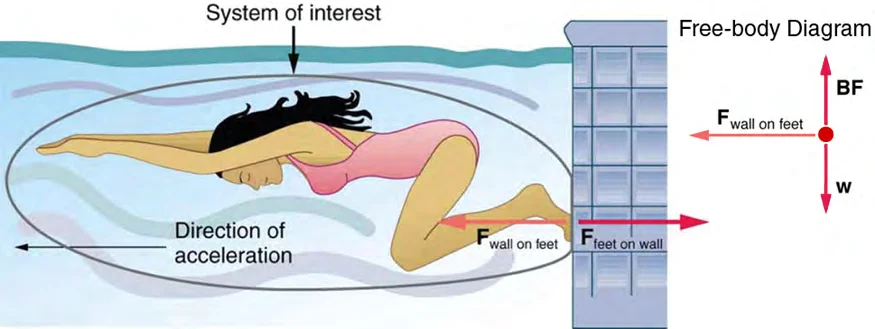
A swimmer pushes on the wall and the wall pushes back on her feet.
14
Image: OpenStax, College Physics for AP Courses, CC BY 4.0.: Paired forces in an interaction
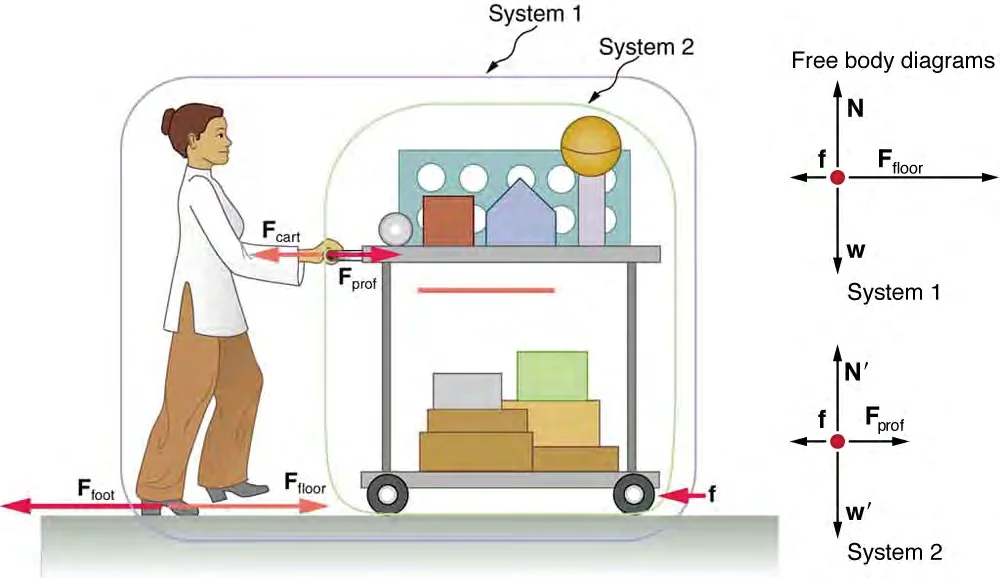
A system can be chosen so that the forces within it are internal forces, which are the forces between objects inside the system, and the forces from outside the system are external forces.
Internal forces, paired by the third law, do not influence the motion of the system’s center of mass.
Two skaters pushing away from each other at the centre of a rink exert forces on one another, but if the rink exerts no external horizontal force, the centre of mass of the two skaters does not move.
Only external forces can change the velocity of a system’s center of mass.
This is the basis for choosing a system that includes all the objects that interact with the object of interest, so that the forces that matter appear as external forces.
Choosing a system carefully, as in topic 2.1, makes it possible to ignore the internal forces completely.
1
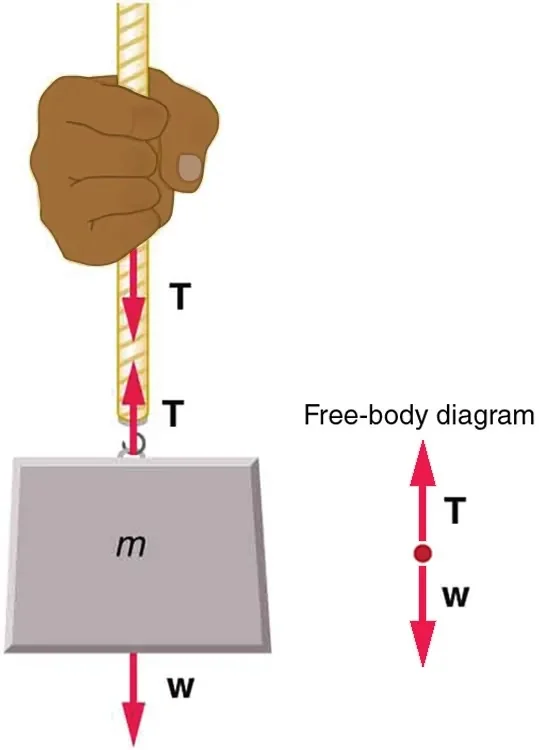
Tension is the macroscopic net result of the forces that infinitesimal segments of a string, cable, chain or similar system exert on each other in response to an external pull.
2
A string under tension pulls on the objects attached to its ends, and each small piece of string pulls on its neighbours.
3
A string is taken to be ideal when its mass is negligible and it does not stretch when under tension.
4
For an ideal string, the tension is the same at all points within the string, so the tension at one end equals the tension at the other end.
5
When the mass of the string is not negligible, the tension may not be the same at all points.
6
A segment of rope that must accelerate with the rest of the rope needs a net force, so the tension changes along the rope.
7
The tension at any point equals the force needed to accelerate all the mass beyond that point.
8
Tension is always directed along the string, away from the object it pulls on, and it is a force measured in newtons.
1
A string passing over an ideal pulley changes direction but not tension, so an ideal pulley is used to make a force act in a different direction without changing its magnitude.
2
The force that the pulley’s axle exerts on the pulley must be found separately, and it is generally not equal to the tension in one rope segment, because two rope segments pull on the pulley.
Example 1
Person standing on a bathroom scale
1
The weight of the person is mg = (60 kg)(9.8 m/s2) = 588 N downward, exerted by the Earth on the person.
2
The paired force is 588 N upward, exerted by the person on the Earth.
3
Since the person is at rest, the scale exerts a normal force of 588 N upward on the person.
4
The paired force is the person’s push of 588 N downward on the scale, so the scale reads 588 N, or 60 kg in mass units.
Answer
The pairs are: Earth on person 588 N downward and person on Earth 588 N upward; scale on person 588 N upward and person on scale 588 N downward. Each pair has equal magnitude and opposite direction, and the person’s weight and the normal force are not a pair.
Example 2
Rope of non-negligible mass pulling a block
1
Treat the rope and block together as one system.
2
The total mass is 4.0 kg, so the acceleration is a = F/M = 12 N/4.0 kg = 3.0 m/s2.
3
The tension at the block end is the force needed to accelerate only the block: Tblock = (3.0 kg)(3.0 m/s2) = 9.0 N.
4
At the midpoint, the tension must accelerate the block and the half of the rope between the midpoint and the block, a total mass of 3.5 kg.
5
The other half of the rope, on the free-end side, is pulled by the 12 N force and by this tension.
6
The tension at the midpoint is Tmid = (3.0 kg + 0.5 kg)(3.0 m/s2) = 10.5 N.
Answer
The block accelerates at 3.0 m/s2. The tension is 9.0 N at the block end and 10.5 N at the midpoint, and it is 12 N at the free end where the force is applied. The tension is not constant because the rope has mass.
Example 3
Force on a pulley held by its support
1
The hanging mass is at rest, so the tension supports its weight: T = (2.0 kg)(9.8 m/s2) = 19.6 N.
2
The string is ideal, so the tension is the same throughout, and the pulley only changes its direction.
3
The string pulls on the pulley with 19.6 N along the horizontal segment and 19.6 N along the vertical segment, at right angles to each other.
4
Their resultant has magnitude √(19.62 + 19.62) N = 19.6√2 N = 27.7 N, directed at 45° between the two segments.
Answer
The tension is 20 N (19.6 N). The string exerts a force of 28 N (27.7 N) on the pulley, which is greater than the tension because two segments of the string pull on the pulley together. The pulley exerts an equal and opposite force on the string.
Calling the weight of a resting object and the normal force a third law pair
They act on the same object and are not an interaction pair.
Saying that paired forces cancel
They act on different objects, so they cannot cancel on a single free-body diagram.
Assuming the larger object exerts the larger force
The paired forces are always equal in magnitude, whatever the masses.
Saying that internal forces change the velocity of a system’s center of mass
Only external forces do this.
Assuming the tension is the same everywhere in a rope with mass
It is the same only for an ideal string.
Setting the force on a pulley’s support equal to the tension
When a string wraps over a pulley, two segments pull on it, and their vector sum must be used.