Curriculum
AP Physics C: Mechanics
1. Kinematics
0/11
2. Force and Translational Dynamics
0/21
3. Work, Energy, and Power
0/11
4. Linear Momentum
0/9
-
4. Linear Momentum
 Preview
-
4.1 Linear Momentum
Preview
-
4.1 Linear Momentum - Check yourself
 Preview
-
4.2 Change in Momentum and Impulse
Preview
-
4.2 Change in Momentum and Impulse - Check yourself
Preview
-
4.3 Conservation of Linear Momentum
Preview
-
4.3 Conservation of Linear Momentum - Check yourself
Preview
-
4.4 Elastic and Inelastic Collisions
Preview
-
4.4 Elastic and Inelastic Collisions - Check yourself
Preview
5. Torque and Rotational Dynamics
0/13
6. Energy and Momentum of Rotating Systems
0/13
7. Oscillations
0/11
Text lesson
4.4 Elastic and Inelastic Collisions
4.4 Elastic and Inelastic Collisions — AP PHYSICS C: MECHANICS notes: You will be able to decide whether a collision is elastic or inelastic from the kinetic energy before and after it, identify a perfectly inelastic collision, and use momentum and kinetic energy together to find the velocities after one-dimensional collisions.
1
Because p = mv, the kinetic energy can also be written as K = p2/(2m).
2
Kinetic energy is a scalar, so the kinetic energy of a system is the sum of the kinetic energies of its objects, and it does not depend on direction.
3
Momentum is conserved in every interaction when the net external force is zero, but kinetic energy is not always conserved.
4
Two quantities are therefore needed to describe a collision momentum, which is always conserved in the absence of a net external force, and kinetic energy, which tells whether the collision is elastic.
5
Both are used together to solve for the velocities after a collision.
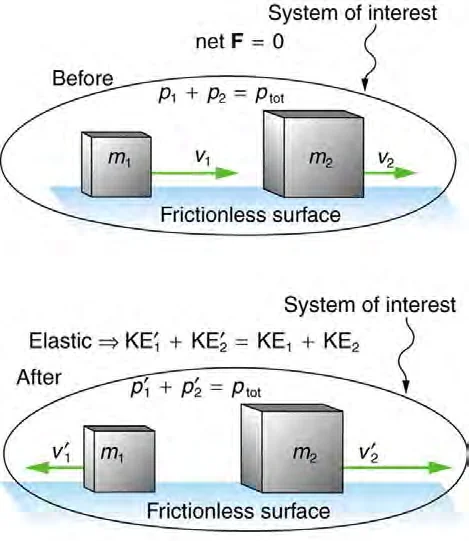
Written as an equation, ΣKinitial = ΣKfinal.
Kinetic energy is restored completely, so no energy is transformed into thermal energy, sound, or permanent deformation during the interaction.
In an elastic collision, the kinetic energy of each individual object may change, even though the total does not.
For example, in a head-on elastic collision between two objects of unequal mass, the lighter object may rebound and the heavier object may move forward more slowly.
Collisions between billiard balls and between atoms in an ideal gas are often modelled as elastic.
For a one-dimensional elastic collision in which the target object of mass m2 is at rest before the collision and the projectile of mass m1 moves at v1i, the two conservation laws give the final velocities v1f = [(m1 − m2)/(m1 + m2)]v1i and v2f = [2m1/(m1 + m2)]v1i.
Each velocity is in metres per second, and the signs show the direction of motion.
The result comes from combining momentum conservation with the statement that the relative speed of approach equals the relative speed of separation.
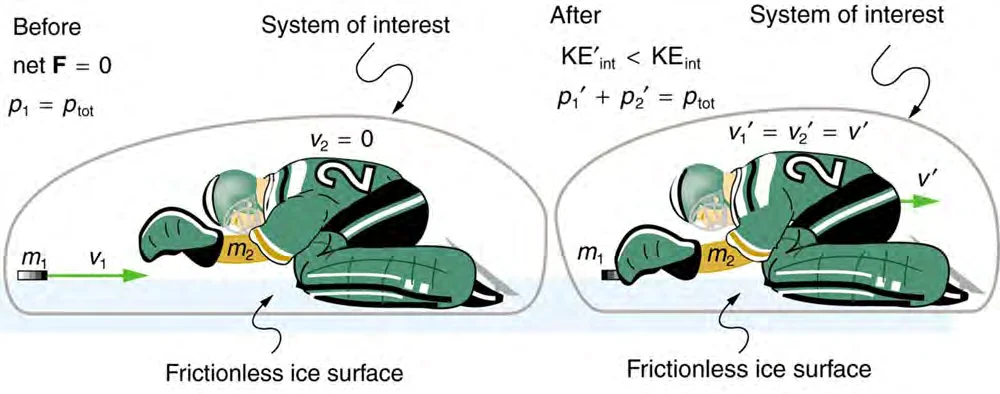
1
An inelastic collision between objects is one in which the total kinetic energy of the system decreases.
2
Some of the initial kinetic energy is not restored to kinetic energy, but is transformed by nonconservative forces into other forms of energy, such as thermal energy, sound, and the energy used to deform the objects.
3
The total momentum of the system is still conserved if the net external force is zero.
4
In a perfectly inelastic collision, the objects stick together and move with the same velocity after the collision.
5
For two objects with a common final velocity vf, momentum conservation gives m1v1i + m2v2i = (m1 + m2)vf.
6
The kinetic energy lost in a perfectly inelastic collision is the largest that momentum conservation allows for a given pair of masses and velocities.
7
The fraction of kinetic energy lost depends on the masses.
8
A perfectly inelastic collision between two equal masses, one of which is at rest, leaves the kinetic energy at half of its initial value.
9
A collision between a very heavy object and a very light one loses little kinetic energy, because the heavy object barely changes its velocity.
1
If the two totals are equal, the collision is elastic.
2
If the total after is smaller, the collision is inelastic.
3
A collision is never classified by momentum alone, because momentum is conserved in both cases.
4
A kinetic energy that increases in an interaction, such as an explosion driven by stored energy, is not a collision of the type described here.
5
Once the type of collision is known, the solution method is set.
6
For an elastic collision, both momentum and kinetic energy equations are written and solved together.
7
For an inelastic collision where the objects stick together, only the momentum equation is needed, since the common velocity is unknown and the kinetic energy loss is then calculated afterwards.
1
Using the one-dimensional elastic formulas with m1 = m2, v1f = (2.0 − 2.0)/(2.0 + 2.0) × 4.0 m/s = 0, and v2f = 2(2.0)/(4.0) × 4.0 m/s = 4.0 m/s.
2
Check the momentum before is 8.0 kg·m/s and after is 0 + (2.0)(4.0) = 8.0 kg·m/s
3
The kinetic energy before is ½(2.0)(4.0)2 = 16 J, and after is ½(2.0)(4.0)2 = 16 J
Answer
The first object stops, and the second moves at 4.0 m/s exchanging its velocity
1
v1f = (3.0 − 1.0)/(3.0 + 1.0) × 4.0 m/s = 2.0 m/s. v2f = 2(3.0)/(4.0) × 4.0 m/s = 6.0 m/s
2
Momentum before: 12 kg·m/s
3
After: (3.0)(2.0) + (1.0)(6.0) = 12 kg·m/s
4
Kinetic energy before: ½(3.0)(4.0)2 = 24 J
5
After: ½(3.0)(2.0)2 + ½(1.0)(6.0)2 = 6.0 + 18 = 24 J.
Answer
The 3.0 kg object continues forward at 2.0 m/s, and the 1.0 kg object moves at 6.0 m/s. The total kinetic energy is 24 J both before and after.
1
Momentum conservation gives (1000 kg)(20 m/s) = (2000 kg)vf, so vf = 10 m/s
2
The kinetic energy before is ½(1000)(20)2 = 2.0 × 10⁵ J
3
After it is ½(2000)(10)2 = 1.0 × 10⁵ J
4
The kinetic energy lost is 1.0 × 10⁵ J, which is 50% of the initial value.
Answer
The cars move together at 10 m/s, and 1.0 × 10⁵ J of kinetic energy is transformed into other forms.
1
Before the collision, K = ½(1.0 kg)(4.0 m/s)2 = 8.0 J.
2
After it, K = ½(1.0)(2.0)2 + ½(1.0)(2.48)2 = 2.0 + 3.07 = 5.07 J.
3
The kinetic energy lost is 8.0 − 5.07 = 2.9 J, which is 37% of the initial value.
4
Because the total kinetic energy decreased, the collision is inelastic.
5
It is not perfectly inelastic, because the two pucks do not move together.
Answer
The kinetic energy falls from 8.0 J to 5.1 J, a loss of 2.9 J (37%), so the collision is inelastic.
Classifying a collision by momentum
Momentum is conserved in elastic and inelastic collisions alike, so only the kinetic energy before and after decides the type.
Assuming that every collision in which the objects stick together is elastic
Sticking together is a perfectly inelastic collision, and it always loses kinetic energy unless the objects already share the same velocity before the collision, so there is no relative motion to lose energy from.
Using the elastic formulas for an inelastic collision
Those formulas assume that kinetic energy is conserved, so they give wrong answers when kinetic energy is lost.
Writing the kinetic energy with the wrong velocity or without squaring it
Kinetic energy depends on the square of the speed, so doubling the velocity multiplies the kinetic energy by four.
Assuming that the kinetic energy of each object must be the same before and after an elastic collision
Only the total kinetic energy is conserved, and individual objects may gain or lose energy.
Forgetting the signs of the velocities in the elastic formulas
A projectile that rebounds has a negative final velocity, and the formula gives it with that sign.