Curriculum
AP Physics C: Mechanics
1. Kinematics
0/11
2. Force and Translational Dynamics
0/21
3. Work, Energy, and Power
0/11
4. Linear Momentum
0/9
5. Torque and Rotational Dynamics
0/13
-
5. Torque and Rotational Dynamics
 Preview
-
5.1 Rotational Kinematics
Preview
-
5.1 Rotational Kinematics - Check yourself
 Preview
-
5.2 Connecting Linear and Rotational Motion
Preview
-
5.2 Connecting Linear and Rotational Motion - Check yourself
Preview
-
5.3 Torque
Preview
-
5.3 Torque - Check yourself
Preview
-
5.4 Rotational Inertia
Preview
-
5.4 Rotational Inertia - Check yourself
Preview
-
5.5 Rotational Equilibrium and Newton’s First Law in Rotational Form
Preview
-
5.5 Rotational Equilibrium and Newton’s First Law in Rotational Form - Check yourself
Preview
-
5.6 Newton’s Second Law in Rotational Form
Preview
-
5.6 Newton’s Second Law in Rotational Form - Check yourself
Preview
6. Energy and Momentum of Rotating Systems
0/13
7. Oscillations
0/11
Text lesson
5.1 Rotational Kinematics
5.1 Rotational Kinematics — AP PHYSICS C: MECHANICS notes: You will be able to describe the rotation of a rigid system using angular displacement, angular velocity and angular acceleration, relate these quantities through derivatives and integrals, and use the constant-angular-acceleration equations.
1Angular position and angular displacement2Angular position and angular displacement
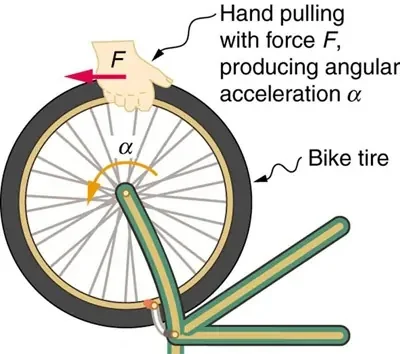
A force on the rim of a bike wheel producing an angular acceleration. Image: OpenStax, College Physics 2e, CC BY 4.0.
Angular velocity and angular acceleration
 ⤢ Enlarge
Angular velocity and angular acceleration
The average angular velocity over a time interval Δt is ωavg = Δθ/Δt. The instantaneous angular velocity is the rate at which angular position changes with respect to time, ω = dθ/dt. Its SI unit is radians per second (rad/s).
The angular acceleration is the rate at which angular velocity changes with respect to time, α = dω/dt = d2θ/dt2, in radians per second squared (rad/s2).
A rotating system speeds up when ω and α have the same sign, and it slows down when they have opposite signs.
A system with zero angular velocity can still have a nonzero angular acceleration
because the angular velocity may be changing at that instant.
Rotation about one fixed axis is analogous to motion along one line. Replacing position by angular position, velocity by angular velocity and acceleration by angular acceleration gives the same mathematical relationships, as the table shows.
| Linear quantity (1D) | Rotational quantity | Unit |
|---|---|---|
| Position x | Angular position θ | rad |
| Velocity v = dx/dt | Angular velocity ω = dθ/dt | rad/s |
| Acceleration a = dv/dt | Angular acceleration α = dω/dt | rad/s2 |
1Constant angular acceleration2Constant angular acceleration
Graphs and calculus of rotational motion
1
On an angular position–time graph, the slope at any instant is the angular velocity. On an angular velocity–time graph, the slope is the angular acceleration, and the area between the curve and the time axis gives the angular displacement during that interval. A straight-line velocity–time graph therefore describes constant angular acceleration.
2
When the angular acceleration is a function of time, the velocity and position are found by integration:
3
ω(t) = ω0 + ∫0t α(t′) dt′ and θ(t) = θ0 + ∫0t ω(t′) dt′
4
The constants ω0 and θ0 are the initial conditions and must always be included. Differentiating the result of an integration checks it: the derivative of θ(t) must give back ω(t), and the derivative of ω(t) must give back α(t).
1Example 1: Constant angular acceleration from rest2Example 2: Angular velocity and acceleration from an angular3Example 2: Angular velocity and acceleration from an angular4Example 3: Stopping a wheel with constant deceleration
Key terms
| Term | Meaning |
|---|---|
| Rigid system | A system whose parts keep the same distances from one another, so that all its points rotate together about an axis. |
| Angular position θ | The angle, measured in radians, between a reference line fixed in the rotating system and a fixed reference direction. |
| Radian | The SI unit of angle, equal to the arc length divided by the radius of the circle (θ = s/r). |
| Angular displacement Δθ | The change in angular position of a rotating system during a time interval. |
| Angular velocity ω | The rate of change of angular position with respect to time, equal to the derivative dθ/dt. |
| Angular acceleration α | The rate of change of angular velocity with respect to time, equal to the derivative dω/dt. |
| Revolution | One complete turn of a rotating system, equal to 2π rad. |
| Constant angular acceleration equations | The four kinematic relations that link angular position, angular velocity, angular acceleration and time when angular acceleration does not change. |
| Initial conditions | The known angular position and angular velocity at the start, needed to fix the constants of integration. |
1Avoid these mistakes2Avoid these mistakes3Avoid these mistakes4Avoid these mistakes