Curriculum
AP Physics C: Mechanics
1. Kinematics
0/11
2. Force and Translational Dynamics
0/21
3. Work, Energy, and Power
0/11
-
3. Work, Energy, and Power
 Preview
-
3.1 Translational Kinetic Energy
Preview
-
3.1 Translational Kinetic Energy - Check yourself
 Preview
-
3.2 Work
Preview
-
3.2 Work - Check yourself
Preview
-
3.3 Potential Energy
Preview
-
3.3 Potential Energy - Check yourself
Preview
-
3.4 Conservation of Energy
Preview
-
3.4 Conservation of Energy - Check yourself
Preview
-
3.5 Power
Preview
-
3.5 Power - Check yourself
Preview
4. Linear Momentum
0/9
5. Torque and Rotational Dynamics
0/13
6. Energy and Momentum of Rotating Systems
0/13
7. Oscillations
0/11
Text lesson
3.2 Work
3.2 Work — AP PHYSICS C: MECHANICS notes: You will be able to calculate the work done by a constant or variable force using the dot product and integrals, apply the work–energy theorem, and distinguish conservative forces from nonconservative forces.
1
Work is a scalar quantity.
2
It is positive when the force transfers energy into the system, negative when the force transfers energy out of the system, and zero when no energy is transferred.
3
Work is measured in joules (J), the same unit as energy.
4
A force of one newton that moves its point of application through one metre in the direction of the force does one joule of work.
5
The force that does work must be exerted on the system.
6
A force that is exerted on the surroundings, or that does not move its point of application, does not change the energy of the system.
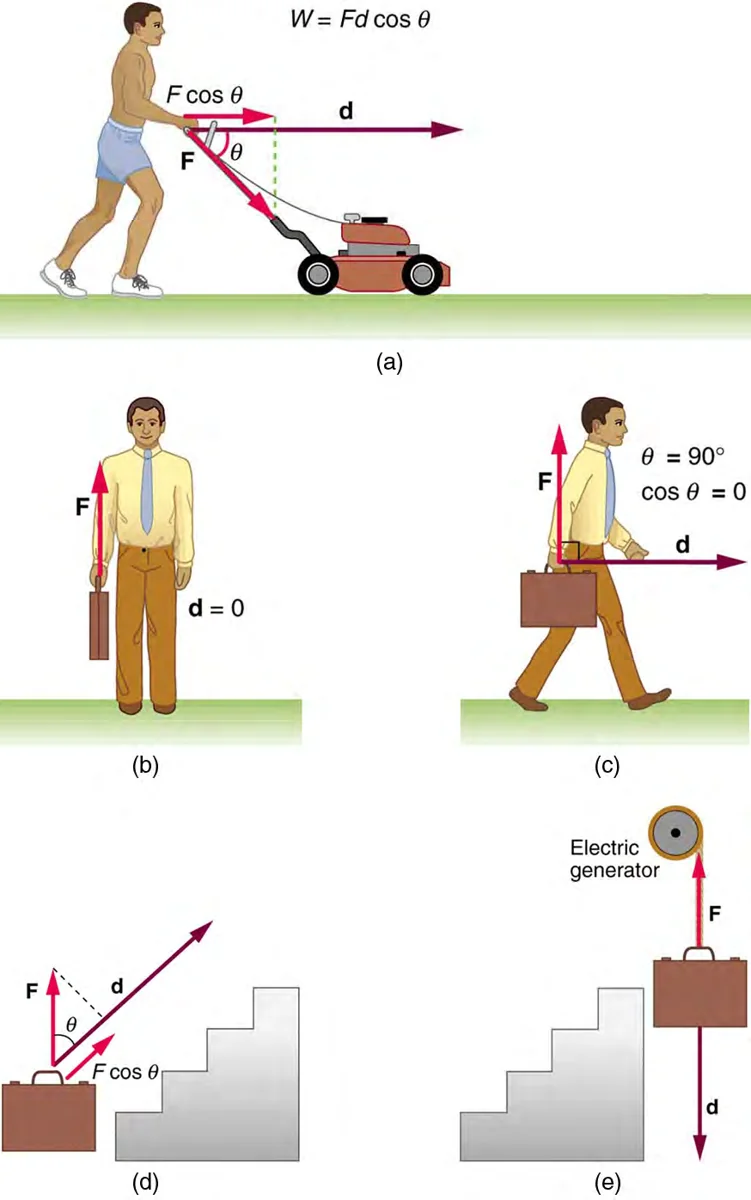
For a force F that acts on a point that moves along a path, the work done is the integral of the force along the path, W = ∫ab F·dr, where the integral is taken over the path from point a to point b.
Here F is the force in newtons (N), dr is a small displacement along the path in metres (m), and the dot product F·dr is a scalar.
Only the part of the force parallel to the path contributes.
The dot product of two vectors A and B is A·B = AB cos θ, where θ is the angle between the two vectors.
If θ is 90°, the dot product is zero, so a force perpendicular to the displacement does no work.
It can change the direction of the motion, but it does not change the kinetic energy of the object.
For a constant force, the integral reduces to a product.
If the component of the force parallel to the displacement is F∥, then W = F∥Δx = FΔx cos θ, where Δx is the displacement in metres and θ is the angle between the force and the displacement.
For a variable force that acts along one dimension, the work is W = ∫xixf F∥(x) dx, which is the area under the graph of F∥ against x.
1
The work–energy theorem states that the change in an object’s kinetic energy equals the net work done on the object by all the forces acting on it: Wnet = ΔK = ½mvf2 − ½mvi2.
2
Here Wnet is the net work in joules, and vi and vf are the initial and final speeds in metres per second.
3
The net work can be found by adding the work of each force, or by finding the work of the net force.
4
A force that is exerted on an object can change the configuration of a system as well as its kinetic energy.
5
When the centre of mass of a system and the point of application of the force move the same distance, the system can be modelled as a single object, and only its kinetic energy changes.
6
Friction is the most common case where energy leaves the object, and it is typically associated with the force of friction multiplied by the length of the path along which the friction acts.
7
Friction and air resistance are nonconservative forces.
8
For a kinetic friction force of magnitude fk acting along a path of length L, the energy dissipated is fkL.
9
This energy usually appears as thermal energy or sound, and in this course it is treated as energy leaving the mechanical energy of the system.
1
The work done by a conservative force around a closed path, which returns the system to its initial configuration, is zero.
2
Gravity, the force of an ideal spring and electrostatic forces are conservative.
3
A nonconservative force is one for which the work depends on the path taken.
4
Friction and air resistance are the most common nonconservative forces.
5
Because the work depends on the path, a potential energy cannot be defined for a nonconservative force.
6
Potential energies are associated only with conservative forces.
Example 1
Work done by a constant force at an angle
1
The displacement is horizontal, so the angle between the force and the displacement is θ = 30°.
2
W = FΔx cos θ = (50 N)(4.0 m) cos 30° = (50)(4.0)(0.866) J = 173 J.
Answer
1.7 × 10² J. Only the horizontal component of the force, 43 N, does work on the box.
Example 2
Work from the area under a force graph
1
W = ∫03.0 4.0x dx = [2.0x2]03.0 = 2.0(3.0)2 − 0 = 18 J.
2
The same answer is found from the area of the triangle under the graph: ½ × 3.0 m × 12 N = 18 J.
Answer
18 J
Example 3
Work–energy theorem with friction
1
The work by the applied force is Wapplied = (30 N)(5.0 m) = +150 J.
2
The friction force opposes the motion, so Wfriction = (−10 N)(5.0 m) = −50 J.
3
The net work is Wnet = 150 J − 50 J = +100 J.
4
By the work–energy theorem, ½mvf2 − 0 = 100 J, so vf2 = 2(100 J)/(5.0 kg) = 40 m2/s2 and vf = 6.3 m/s.
Answer
The net work is 100 J, and the final speed is 6.3 m/s. The friction force has removed 50 J of energy from the crate’s motion as thermal energy.
Using the full magnitude of a force when the force is at an angle to the displacement
Only the component parallel to the displacement does work, so W = FΔx cos θ.
Taking work to be positive for every force
A friction force acts opposite to the motion and gives negative work.
Saying a force that is perpendicular to the motion does work
A centripetal force or the normal force on a horizontal surface does no work in those cases.
Forgetting that the work of a nonconservative force depends on the path
The same friction force over a longer path dissipates more energy.
Reading a variable force integral without the limits
The limits must match the initial and final positions, and the result is in joules.