Curriculum
AP Physics C: Mechanics
1. Kinematics
0/11
2. Force and Translational Dynamics
0/21
3. Work, Energy, and Power
0/11
4. Linear Momentum
0/9
-
4. Linear Momentum
 Preview
-
4.1 Linear Momentum
Preview
-
4.1 Linear Momentum - Check yourself
 Preview
-
4.2 Change in Momentum and Impulse
Preview
-
4.2 Change in Momentum and Impulse - Check yourself
Preview
-
4.3 Conservation of Linear Momentum
Preview
-
4.3 Conservation of Linear Momentum - Check yourself
Preview
-
4.4 Elastic and Inelastic Collisions
Preview
-
4.4 Elastic and Inelastic Collisions - Check yourself
Preview
5. Torque and Rotational Dynamics
0/13
6. Energy and Momentum of Rotating Systems
0/13
7. Oscillations
0/11
Text lesson
4.2 Change in Momentum and Impulse
4.2 Change in Momentum and Impulse — AP PHYSICS C: MECHANICS notes: You will be able to relate the net external force to the rate of change of momentum, calculate impulse as the integral of a force over time, and apply the impulse–momentum theorem to find changes in momentum and average forces.
1
Here Fnet is the net external force in newtons (N), and dp/dt is the derivative of momentum with respect to time, in kg·m/s2 (equal to N).
2
This is the form of Newton’s second law that applies to any system, including one whose mass changes.
3
For a system of constant mass, the product rule is not needed: d(mv)/dt = m dv/dt = ma, so Fnet = ma.
4
The familiar form of Newton’s second law is therefore a special case of the momentum form.
5
The momentum form also describes systems where the velocity is constant but the mass changes, which the ordinary form cannot handle.
6
The direction of the rate of change of momentum is the direction of the net force.
7
If the net force on an object points along the positive x-axis, its momentum increases along that axis, and if the net force is negative, its momentum decreases along that axis.
For a net force that changes with time, the impulse is J = ∫t1t2 Fnet(t) dt.
Its SI unit is the newton-second (N·s), which is the same as kg·m/s.
Impulse is a vector quantity and has the same direction as the net force.
If the force is constant, the integral is simply the force multiplied by the time interval, J = FnetΔt.
In general, however, the force varies with time.
The impulse delivered by a varying force is then the area under the curve of a graph of the net external force against time, measured between the two times.
Areas below the time axis are negative and give an impulse in the negative direction.
The average net force over an interval is the impulse divided by the time interval: Favg = J/Δt = (1/Δt)∫F(t) dt.
This average is the height of a rectangle of width Δt that has the same area as the force–time graph.
1
The impulse–momentum theorem links impulse to momentum change.
2
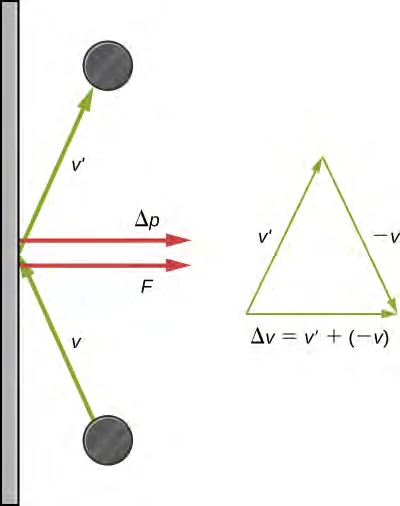
The impulse exerted on an object equals the object’s change in momentum, J = Δp = pfinal − pinitial.
3
Change in momentum is the difference between the final and initial momentum.
4
It has the same direction as the impulse, and it is measured in kg·m/s.
5
The theorem follows directly from the momentum form of Newton’s second law, since integrating Fnet = dp/dt over time gives ∫Fnet dt = Δp.
6
It is useful because it allows the change in motion to be found without knowing the details of the motion during the interval.
7
A large impulse can be produced by a large force for a short time or by a small force for a long time, and both produce the same change in momentum.
8
Applied to the two sides of a single interaction, the theorem explains why a longer contact time reduces the average force for the same change in momentum.
9
A padded surface increases the stopping time and lowers the average force, while the impulse stays the same.
1
A conveyor belt that receives sand at a steady rate is an example.
2
The momentum of the system is p = mv, so when the velocity is constant, dp/dt = (dm/dt)v.
3
The net external force is therefore Fnet = (dm/dt)v.
4
Here dm/dt is the rate at which mass is added to the system, in kg/s.
5
In general, when both the mass and the velocity change, the product rule gives dp/dt = m dv/dt + v dm/dt.
6
The first term is the mass times the acceleration, and the second term is the velocity times the rate at which mass is added.
7
This is why the momentum form is needed for systems such as a rocket that burns fuel.
The slope of the momentum–time graph at any instant equals the net external force at that instant, because the slope is the derivative dp/dt.
The change in momentum over an interval equals the area under the force–time graph and also equals the difference of the momentum values at the ends of the interval.
A student who reads a momentum graph should therefore use the slope to find force, and the difference between two values to find the impulse.
Confusing these two operations is a frequent source of error in free-response questions.
1
J = ∫03.0 4.0t dt = [2.0t2]03.0 = 2.0(3.0)2 − 0 = 18 N·s
2
The average force is Favg = J/Δt = 18 N·s/3.0 s = 6.0 N.
Answer
The impulse is 18 N·s in the direction of the force, and the average force is 6.0 N.
1
The initial velocity is −40 m/s and the final velocity is +50 m/s. Δp = m(vf − vi) = (0.145 kg)(50 m/s − (−40 m/s)) = (0.145 kg)(90 m/s) = 13 kg·m/s.
2
By the impulse–momentum theorem, J = 13 N·s.
3
The average force is Favg = 13 N·s/(1.0 × 10−3 s) = 1.3 × 10⁴ N.
Answer
The impulse is 13 N·s away from the batter, and the average force is 1.3 × 10⁴ N, also away from the batter.
1
The velocity of the belt is constant, but the mass of the sand on it increases, so Fnet = (dm/dt)v
2
The sand is dropped with zero horizontal velocity, so its horizontal momentum must be brought up to the belt speed
3
The force is F = (2.0 kg/s)(3.0 m/s) = 6.0 N.
Answer
6.0 N in the direction of the belt’s motion.
1
The net force is F = dp/dt = 8.0t N.
2
At t = 2.0 s, F = 16 N.
3
The impulse is J = ∫02.0 8.0t dt = [4.0t2]02.0 = 16 N·s.
4
Check p(2.0 s) − p(0) = 4.0(4.0) − 0 = 16 kg·m/s, which equals the impulse.
Answer
The net force at 2.0 s is 16 N, and the impulse over the first 2.0 s is 16 N·s, equal to the change in momentum.
Using the average force as if it were the force at every instant
The average force is the impulse divided by the time, while the force itself may change throughout the interval.
Ignoring signs when computing a change in momentum
For a ball that reverses direction, Δp = m(vf − vi) with vi negative, so the change is larger than mvf alone.
Using dm/dt with the wrong sign or ignoring the velocity term
For variable mass with a constant velocity, the force is (dm/dt)v, not ma.
Mixing up the two graph operations
The slope of a momentum–time graph gives the net force, and the area under a force–time graph gives the impulse; the slope of a velocity–time graph gives acceleration, not momentum.
Stating that a larger impulse always means a larger force
Impulse depends on both force and time, so a force applied for a longer time can produce the same impulse with a smaller average force.
Avoid
Finding impulse from the value of the force at one instant instead of integrating over the time interval, or taking the area under a graph without including the sign of the force