Curriculum
AP Physics C: Mechanics
1. Kinematics
0/11
2. Force and Translational Dynamics
0/21
3. Work, Energy, and Power
0/11
4. Linear Momentum
0/9
5. Torque and Rotational Dynamics
0/13
-
5. Torque and Rotational Dynamics
 Preview
-
5.1 Rotational Kinematics
Preview
-
5.1 Rotational Kinematics - Check yourself
 Preview
-
5.2 Connecting Linear and Rotational Motion
Preview
-
5.2 Connecting Linear and Rotational Motion - Check yourself
Preview
-
5.3 Torque
Preview
-
5.3 Torque - Check yourself
Preview
-
5.4 Rotational Inertia
Preview
-
5.4 Rotational Inertia - Check yourself
Preview
-
5.5 Rotational Equilibrium and Newton’s First Law in Rotational Form
Preview
-
5.5 Rotational Equilibrium and Newton’s First Law in Rotational Form - Check yourself
Preview
-
5.6 Newton’s Second Law in Rotational Form
Preview
-
5.6 Newton’s Second Law in Rotational Form - Check yourself
Preview
6. Energy and Momentum of Rotating Systems
0/13
7. Oscillations
0/11
Text lesson
5.4 Rotational Inertia
5.4 Rotational Inertia — AP PHYSICS C: MECHANICS notes: You will be able to describe the rotational inertia of a rigid system about a given axis, calculate it for point masses and for standard solids (including by integration), and use the parallel axis theorem for an axis that does not pass through the centre of mass.
1
It depends on the mass of the system and on how that mass is distributed relative to the axis of rotation.
2
Mass far from the axis contributes much more than mass close to it.
3
For a single particle of mass m at a perpendicular distance r from the axis, the rotational inertia is I = mr2.
4
Its SI unit is kilogram metre squared (kg·m2).
5
The rotational inertia of a collection of particles about an axis is the sum of the rotational inertias of the individual particles about that same axis: I = Σmiri2.
6
Two objects with equal mass and different shapes can have very different rotational inertias, because the squared distance from the axis is what counts.
7
A ring of mass M and radius R has more rotational inertia about its central axis than a solid disk of the same mass and radius, since all of the ring’s mass is at distance R.
The rotational inertia is then I = ∫ r2 dm, where the integral covers the whole body.
To evaluate it, dm is written in terms of one coordinate using the density.
Thin uniform rod about its centre. Let the rod have mass M and length L, and let the axis pass through its centre perpendicular to its length.
The mass per unit length is λ = M/L, so dm = λ dx, and r = x.
Then I = ∫−L/2L/2 x2 λ dx = λ[x3/3] from −L/2 to L/2 = λ · L3/12 = ML2/12.
Thin uniform rod about one end. The limits change to 0 and L: I = ∫0L x2 λ dx = λ L3/3 = ML2/3. The end axis gives four times the rotational inertia of the centre axis, because the mass is farther from the axis on average.
Thin uniform disk about its central axis. Let the disk have mass M and radius R.
Its surface density is σ = M/(πR2), and a thin ring of radius r and width dr has dm = σ(2πr) dr.
Then I = ∫0R r2 σ(2πr) dr = 2πσ[r4/4] from 0 to R = (π σR4)/2 = ½MR2.
Thin ring, hoop or cylindrical shell about its central axis. Every element is at distance R from the axis, so I = R2 ∫ dm = MR2.
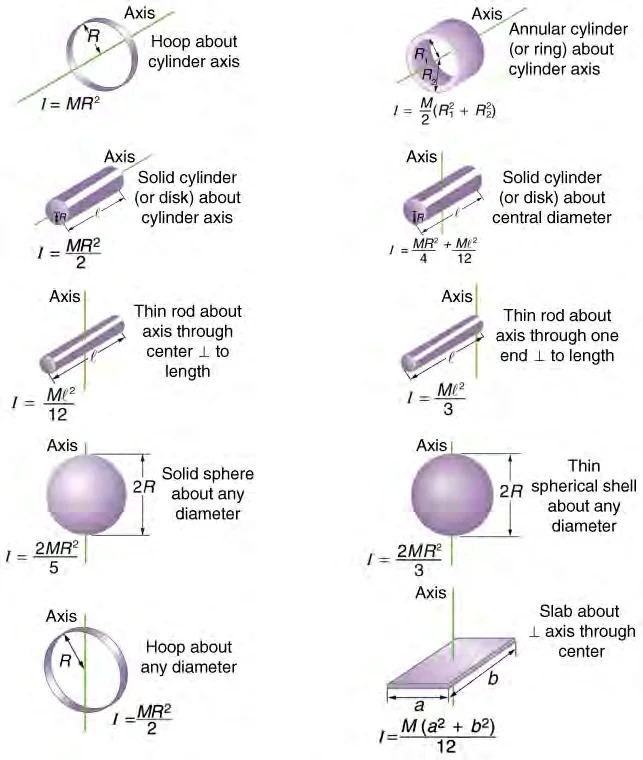
1
The results of the calculations are summarised in the table.
2
They should be known, because they appear in many AP problems, and each one should be checked by considering the mass distribution.
3
A hoop and a solid disk of the same mass and radius have the same size and mass, yet the hoop has twice the rotational inertia.
4
This is a qualitative result that students should be able to explain: the hoop’s mass is all at the rim, and the disk’s mass is spread between the centre and the rim.
Object (mass M)
Thin ring, hoop or cylindrical shell (radius R)
Axis
Central axis
Rotational inertia
MR2
Object (mass M)
Solid disk or solid cylinder (radius R)
Axis
Central axis
Rotational inertia
½MR2
Object (mass M)
Thin rod (length L)
Axis
Through its centre, perpendicular to the rod
Rotational inertia
ML2/12
Object (mass M)
Thin rod (length L)
Axis
Through one end, perpendicular to the rod
Rotational inertia
ML2/3
1
The term Md2 is the rotational inertia the system would have if all its mass were concentrated at the centre of mass and moved in a circle of radius d about the new axis.
2
Because Md2 is never negative, the rotational inertia of a rigid system in a given plane is at a minimum when the axis passes through its centre of mass.
3
Moving the axis away from the centre of mass always increases the rotational inertia.
4
This is why a baton is easier to spin about its centre than about one end, and why a figure skater’s spin changes when the arms are pulled in: the mass moves closer to the axis.
1
Each particle is 0.25 m from the centre, so r2 = (0.25 m)2 = 0.0625 m2
2
The rod is light, so only the particles contribute
3
I = Σmr2 = 2(2.0 kg)(0.0625 m2) = 0.25 kg·m2.
Answer
The rotational inertia is 0.25 kg·m2.
1
About the centre, Icm = ML2/12 = (3.0)(1.2)2/12 = (3.0)(1.44)/12 = 0.36 kg·m2.
2
The end is d = 0.60 m from the centre, so I = Icm + Md2 = 0.36 + (3.0)(0.60)2 = 0.36 + 1.08 = 1.44 kg·m2. centre
3
Check ML2/3 = (3.0)(1.44)/3 = 1.44 kg·m2
Answer
The rotational inertia about one end is 1.44 kg·m2, which is four times the value about the centre.
1
Disk: I = ½MR2 = ½(4.0 kg)(0.50 m)2 = ½(4.0)(0.25) = 0.50 kg·m2
2
Hoop: I = MR2 = (4.0)(0.25) = 1.0 kg·m2.
Answer
The disk has rotational inertia 0.50 kg·m2 and the hoop has 1.0 kg·m2. The hoop is harder to spin up, because its mass is farther from the axis, so it needs twice the torque to reach the same angular acceleration.
Writing ½MR2 for a hoop
A hoop has all its mass at the rim, so its rotational inertia is MR2.
Using the parallel axis theorem with d measured from the wrong point
The distance d is measured from the centre of mass to the new axis.
Thinking that a larger mass always means a larger rotational inertia
Two objects of equal mass can differ greatly, depending on how far the mass lies from the axis.
Avoid
Using the distance from the centre of the object instead of the perpendicular distance from the axis of rotation in I = mr2
Avoid
Using the formula for the central axis when the axis is at an end, or in the parallel axis theorem, without adding Md2