Curriculum
AP Physics C: Mechanics
1. Kinematics
0/11
2. Force and Translational Dynamics
0/21
-
2. Force and Translational Dynamics
 Preview
-
2.1 Systems and Center of Mass
Preview
-
2.1 Systems and Center of Mass - Check yourself
 Preview
-
2.2 Forces and Free-Body Diagrams
Preview
-
2.2 Forces and Free-Body Diagrams - Check yourself
Preview
-
2.3 Newton’s Third Law
Preview
-
2.3 Newton’s Third Law - Check yourself
Preview
-
2.4 Newton’s First Law
Preview
-
2.4 Newton’s First Law - Check yourself
Preview
-
2.5 Newton’s Second Law
Preview
-
2.5 Newton’s Second Law - Check yourself
Preview
-
2.6 Gravitational Force
Preview
-
2.6 Gravitational Force - Check yourself
Preview
-
2.7 Kinetic and Static Friction
Preview
-
2.7 Kinetic and Static Friction - Check yourself
Preview
-
2.8 Spring Forces
Preview
-
2.8 Spring Forces - Check yourself
Preview
-
2.9 Resistive Forces
Preview
-
2.9 Resistive Forces - Check yourself
Preview
-
2.10 Circular Motion
Preview
-
2.10 Circular Motion - Check yourself
Preview
3. Work, Energy, and Power
0/11
4. Linear Momentum
0/9
5. Torque and Rotational Dynamics
0/13
6. Energy and Momentum of Rotating Systems
0/13
7. Oscillations
0/11
Text lesson
2.10 Circular Motion
2.10 Circular Motion — AP PHYSICS C: MECHANICS (CALCULUS-BASED) notes: You will be able to describe the centripetal and tangential accelerations of an object moving in a circle, relate speed, period and frequency, identify the forces that supply the centripetal acceleration in common situations, and describe circular orbits with Kepler’s third law.
1
For an object moving in a circle of radius r with tangential speed v, its magnitude is the ratio of the speed squared to the radius:
Here ac is in metres per second squared (m/s2), v is the tangential speed in m/s, and r is the radius of the path in metres.
The centripetal acceleration is always directed toward the centre of the circle, even though the speed may be constant.
The velocity is tangent to the path, and the acceleration points inward, so the direction of the velocity changes continuously while its magnitude may stay the same.
The centripetal acceleration can result from a single force, from more than one force, or from components of forces.
The net force in the inward direction must equal the mass times the centripetal acceleration, Fnet,c = mv2/r.
Centripetal acceleration is not a new kind of force.
It is the name given to the inward net force that the real forces must supply.
Describing a rider who feels pushed outward as experiencing a “centrifugal force” is a description from a rotating frame, and it is not a force acting in an inertial frame.
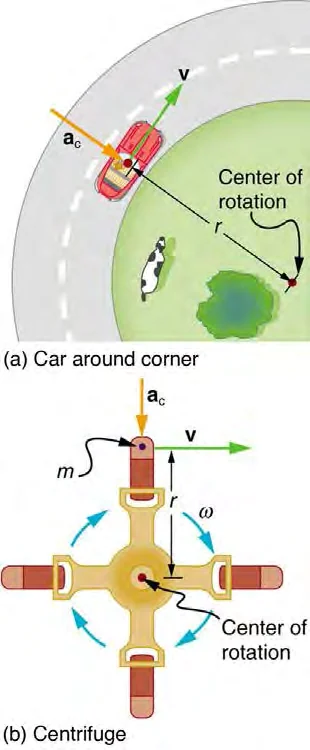
Uniform circular motion is the revolution of an object around a circular path at constant speed.
Its period T is the time to complete one full circular path, one full rotation, or one full cycle of an oscillatory motion, measured in seconds.
Its frequency f is the rate at which the object completes revolutions, measured in hertz (Hz), and the two are related by
1
For an object travelling at constant speed in a circle of radius r, the distance in one revolution is 2πr, so the period is T = 2πr/v.
2
Substituting this into the centripetal acceleration gives ac = 4π2r/T2, which shows that the acceleration depends on the radius and the period.
What the symbols mean
T = period, the time for one complete wave (s) · f = frequency (Hz)
1
On a flat, level curve, the friction force between the tyres and the road is the only horizontal force, and it supplies the centripetal force.
2
The maximum static friction is μsFN = μsmg, so the largest speed for which the car can turn without slipping is vmax = √(μsgr).
3
The mass of the car does not appear in this result.
4
At the top of a vertical circular loop, the object requires a minimum speed to stay on the path.
5
At this point the normal force from the track is zero, so the only force that provides the centripetal acceleration is gravity.
Setting mg = mv2/r gives the minimum speed
v = √(gr)
1
At higher speeds, the track must also push down on the object, adding a normal force to the gravitational force at the top.
2
On a banked curve, the normal force and static friction both have components that contribute to the centripetal force.
3
Taking the banking angle as θ, the normal force has a horizontal component FN sin θ toward the centre and a vertical component FN cos θ.
4
If friction acts down the slope, it adds f cos θ toward the centre and f sin θ downward.
5
For an ideal banked curve with no friction, the speed is given by v2 = rg tan θ.
6
For a conical pendulum, a mass moves in a horizontal circle on a string that makes an angle θ with the vertical.
7
A component of the tension supplies the centripetal force, so T sin θ = mv2/r, while the vertical component balances the weight, T cos θ = mg.
8
Here T is the tension in newtons.
1
It is found from the speed by calculus at = dv/dt.
2
If the speed is constant, the tangential acceleration is zero, and the motion is uniform.
3
When the speed changes, a tangential component of the net force is required.
4
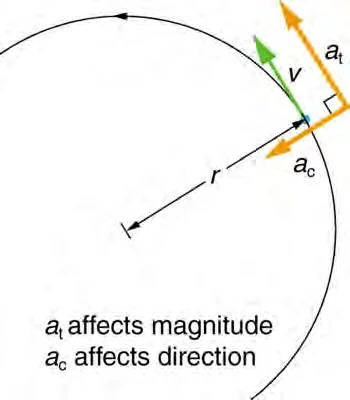
The net acceleration of an object moving in a circle is the vector sum of the centripetal and tangential accelerations.
5
Since the two are perpendicular, the magnitude of the net acceleration is
The net acceleration is not directed toward the centre unless the tangential acceleration is zero.
This is why an object whose speed is increasing does not accelerate directly toward the centre of its circle.
For a satellite in a circular orbit around a central body of mass M, the centripetal acceleration is caused only by gravitational attraction.
Setting the gravitational force equal to the centripetal force gives GMm/r2 = mv2/r, so the orbital speed is v = √(GM/r).
The period is then T = 2πr/v, and eliminating the speed gives
1
This is Kepler’s third law for circular orbits.
2
The period and radius of the orbit are related to the mass of the central body, and the period does not depend on the mass of the satellite.
3
The boundary of the course excludes Kepler’s first and second laws, so only this relation is required.
Example 1
Car turning on a flat curve
1
The centripetal acceleration is ac = v2/r = (15 m/s)2/(50 m) = 4.5 m/s2.
2
The friction force must supply the centripetal force, so f = mac = (1200 kg)(4.5 m/s2) = 5.4 × 10³ N.
3
The maximum static friction is μsmg = (0.60)(1200 kg)(9.8 m/s2) = 7.1 × 10³ N.
4
Since 5.4 × 10³ N is less than 7.1 × 10³ N, the static friction is sufficient.
Answer
The centripetal acceleration is 4.5 m/s2, the friction force is 5.4 × 10³ N, and the car can turn without slipping. The maximum safe speed is √(0.60 × 9.8 × 50) m/s = 17 m/s.
Example 2
Minimum speed at the top of a vertical loop
1
The minimum speed occurs when the normal force is zero, so gravity alone supplies the centripetal force: mg = mv2/r, giving v = √(gr) = √(9.8 × 2.0) m/s = 4.4 m/s.
2
At 6.0 m/s, both gravity and the normal force point toward the centre at the top
3
Their sum supplies the centripetal force: N + mg = mv2/r, so N = (0.50)(6.0)2/2.0 − (0.50)(9.8) = 9.0 − 4.9 = 4.1 N
Answer
The minimum speed at the top is 4.4 m/s. At 6.0 m/s the track pushes down on the ball with a normal force of 4.1 N
Example 3
Period of a satellite in circular orbit
1
The product GM = (6.67 × 10⁻¹¹)(6.0 × 1024) = 4.0 × 10¹⁴ m3/s2.
2
The orbital speed is v = √(GM/r) = √((4.0 × 10¹⁴)/(7.0 × 106)) m/s = 7.6 × 10³ m/s.
3
The period from Kepler’s third law is T = 2π√(r3/GM) = 2π√((3.43 × 10²⁰)/(4.0 × 1014)) s = 2π(926 s) = 5.8 × 10³ s.
Answer
The orbital speed is 7.6 × 10³ m/s and the period is 5.8 × 10³ s, which is about 97 minutes. The satellite’s own mass does not affect either result.
Example 4
Net acceleration with a changing speed
1
The tangential acceleration is at = dv/dt = 2.0 m/s2, which is constant.
2
At t = 2.0 s, the speed is v = 4.0 m/s, so the centripetal acceleration is ac = (4.0 m/s)2/(4.0 m) = 4.0 m/s2.
3
The magnitude of the net acceleration is √(4.02 + 2.02) m/s2 = √20 m/s2 = 4.5 m/s2.
Answer
The tangential acceleration is 2.0 m/s2, the centripetal acceleration is 4.0 m/s2, and the net acceleration is 4.5 m/s2, directed between the centre and the tangent, not toward the centre.
Drawing a separate centripetal force on a free-body diagram
The centripetal acceleration is supplied by the real forces, which must add up to the inward net force.
Assuming that the net acceleration points toward the centre when the speed is changing
A tangential component makes the net acceleration point between the centre and the tangent.
Claiming that a rider pushed outward is acted on by a real outward force in an inertial frame
The outward effect is a description from a rotating frame.
Including the satellite’s mass in the period or orbital speed
These depend only on the mass of the central body and the radius.
Avoid
Using the diameter instead of the radius in ac = v2/r
Avoid
Applying the minimum-speed result v = √(gr) at the bottom of a loop or at points other than the top