Curriculum
AP Physics C: Mechanics
1. Kinematics
0/11
2. Force and Translational Dynamics
0/21
3. Work, Energy, and Power
0/11
4. Linear Momentum
0/9
5. Torque and Rotational Dynamics
0/13
-
5. Torque and Rotational Dynamics
 Preview
-
5.1 Rotational Kinematics
Preview
-
5.1 Rotational Kinematics - Check yourself
 Preview
-
5.2 Connecting Linear and Rotational Motion
Preview
-
5.2 Connecting Linear and Rotational Motion - Check yourself
Preview
-
5.3 Torque
Preview
-
5.3 Torque - Check yourself
Preview
-
5.4 Rotational Inertia
Preview
-
5.4 Rotational Inertia - Check yourself
Preview
-
5.5 Rotational Equilibrium and Newton’s First Law in Rotational Form
Preview
-
5.5 Rotational Equilibrium and Newton’s First Law in Rotational Form - Check yourself
Preview
-
5.6 Newton’s Second Law in Rotational Form
Preview
-
5.6 Newton’s Second Law in Rotational Form - Check yourself
Preview
6. Energy and Momentum of Rotating Systems
0/13
7. Oscillations
0/11
Text lesson
5.2 Connecting Linear and Rotational Motion
5.2 Connecting Linear and Rotational Motion — AP PHYSICS C: MECHANICS notes: You will be able to relate the linear arc length, speed and acceleration of a point on a rotating rigid system to its angular quantities, and explain why every point in a rigid system shares the same angular velocity and angular acceleration.
1
As the system turns through an angle θ, the point moves along a circle, and the distance it travels along the circle is the arc length s.
2
Because the angle is defined as θ = s/r, the arc length is s = rθ, where θ is in radians.
3
The arc length grows in proportion to the distance from the axis, so a point twice as far from the axis travels twice the distance for the same angle.
4
Differentiating s = rθ with respect to time gives the tangential speed, the speed along the circular path: vt = ds/dt = r dθ/dt, so vt = rω.
5
The tangential speed is measured in metres per second (m/s) when r is in metres and ω in rad/s.
6
Because the radius appears in the relation, a point at a larger radius on the same rigid system moves faster.
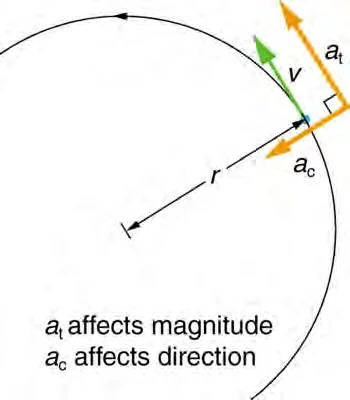
Its SI unit is m/s2.
A point moving on a circle also has a radial (centripetal) acceleration, which changes the direction of its velocity.
Its magnitude is ac = vt2/r = rω2, and it points towards the axis.
When the angular velocity is constant, the tangential acceleration is zero but the radial acceleration is not.
The magnitude of the total linear acceleration of the point is √(at2 + ac2), because the two components are perpendicular.
1
In a rigid system all points rotate about the same axis in the same time, so they all have the same angular position change the same angular velocity and the same angular acceleration.
2
The linear quantities do not share this property.
3
For a fixed angular velocity, the linear speed of a point is proportional to its distance from the axis, and the same is true of the tangential acceleration for a fixed angular acceleration.
4
Two points on one rotating rod therefore have the same ω and α but different v and a.
5
This is the reason that the rotational equations describe a whole system at once, while the linear equations describe a single point.
6
To find the linear motion of a particular point, first find the angular motion of the system, then multiply by that point’s radius.
1
The speed is v = rω = (0.30 m)(20 rad/s) = 6.0 m/s
2
The centripetal acceleration is ac = v2/r = (6.0 m/s)2/0.30 m = 36/0.30 = 120 m/s2
3
Check: rω2 = 0.30 × 400 = 120 m/s2.
Answer
The rim point moves at 6.0 m/s and has a centripetal acceleration of 120 m/s2 towards the axis. Its tangential acceleration is zero because the angular velocity is constant.
1
ω = αt = (2.0)(3.0) = 6.0 rad/s
2
θ = ½αt2 = ½(2.0)(9.0) = 9.0 rad
3
Arc length: s = rθ = (0.50 m)(9.0 rad) = 4.5 m
4
Tangential speed: vt = rω = (0.50)(6.0) = 3.0 m/s
5
Tangential acceleration: at = rα = (0.50)(2.0) = 1.0 m/s2.
Answer
The disk has turned 9.0 rad at 6.0 rad/s. The rim point has travelled 4.5 m, moves at 3.0 m/s and has a tangential acceleration of 1.0 m/s2.
1
For A: vA = (0.20)(5.0) = 1.0 m/s and atA = (0.20)(2.0) = 0.40 m/s2.
2
For B vB = (0.60)(5.0) = 3.0 m/s and atB = (0.60)(2.0) = 1.2 m/s2
3
The ratio of speeds is vB/vA = 3.0/1.0 = 3.0, the same as the ratio of radii, 0.60/0.20 = 3.0.
Answer
A moves at 1.0 m/s with tangential acceleration 0.40 m/s2; B moves at 3.0 m/s with tangential acceleration 1.2 m/s2. Both points have the same angular velocity and angular acceleration, and B moves three times as fast as A.
Writing s = θ instead of s = rθ
The angle in radians must be multiplied by the radius to give a length.
Using the diameter instead of the radius in v = rω or a = rα
Doubling the radius doubles the speed of a point on the rim.
Believing that points at different radii on one rigid system have different angular velocities
They share the same ω and α; only the linear quantities differ.
Using an angular velocity in rpm directly in v = rω
Convert to rad/s first, using 1 revolution = 2π rad and 1 min = 60 s.
Avoid
Forgetting the radial acceleration when asked for the total acceleration of a point on a rotating object at constant angular velocity