Curriculum
AP Physics C: Mechanics
1. Kinematics
0/11
2. Force and Translational Dynamics
0/21
3. Work, Energy, and Power
0/11
4. Linear Momentum
0/9
5. Torque and Rotational Dynamics
0/13
6. Energy and Momentum of Rotating Systems
0/13
-
6. Energy and Momentum of Rotating Systems
 Preview
-
6.1 Rotational Kinetic Energy
Preview
-
6.1 Rotational Kinetic Energy - Check yourself
 Preview
-
6.2 Torque and Work
Preview
-
6.2 Torque and Work - Check yourself
Preview
-
6.3 Angular Momentum and Angular Impulse
Preview
-
6.3 Angular Momentum and Angular Impulse - Check yourself
Preview
-
6.4 Conservation of Angular Momentum
Preview
-
6.4 Conservation of Angular Momentum - Check yourself
Preview
-
6.5 Rolling
Preview
-
6.5 Rolling - Check yourself
Preview
-
6.6 Motion of Orbiting Satellites
Preview
-
6.6 Motion of Orbiting Satellites - Check yourself
Preview
7. Oscillations
0/11
Text lesson
6.4 Conservation of Angular Momentum
6.4 Conservation of Angular Momentum — AP PHYSICS C: MECHANICS notes: You will be able to describe how the choice of system determines whether its angular momentum changes, apply conservation of angular momentum to systems with zero net external torque, and find the new angular speed when the rotational inertia of a nonrigid system changes.
1
Each part may be a particle, a rigid body or a collection of bodies, and its angular momentum is found with the methods of topic 6.3: Iω for a part rotating about the axis, and r × p for a part moving past it.
2
The sum must always use one axis.
3
Adding angular momenta measured about different axes gives a meaningless number.
4
The angular momentum of a system can change only through an interaction with its surroundings.
5
Forces and torques that two parts of the system exert on each other are internal.
6
By Newton’s third law, the angular impulse one part exerts on a second is equal and opposite to the angular impulse the second exerts on the first, so the internal angular impulses cancel in the total.
7
Angular momentum of a system therefore changes only by the angular impulse exerted on it by objects outside it.
In general, the change in the total angular momentum equals the angular impulse exerted on the system from outside, ΔLsys = ∫τext dt.
A system that has no external torque is called rotationally isolated.
Angular momentum is conserved in all interactions, but it is conserved within a given system only when the net external torque is zero.
The selection of the system is therefore decisive.
A person standing on a turntable walks outward along a radius.
Taken alone, the person’s angular momentum about the axis changes, because the turntable’s friction exerts a torque on the person.
Taken together with the turntable, the external torques are zero if friction at the axle is ignored, and the total angular momentum is constant, so the turntable slows as the person moves out.
The choice of system must be made before applying the conservation law.
A force that acts through the chosen axis has zero torque about that axis.
A pivot force on a rod, for example, produces no torque about the pivot, so the angular momentum of a rod and an object that strikes it is conserved about the pivot even though the linear momentum of the system is not conserved.
1
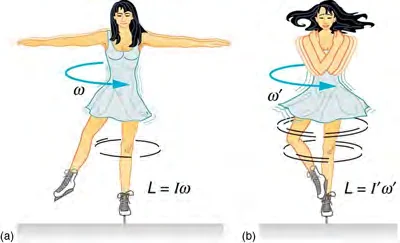
A nonrigid system can change its rotational inertia while its angular momentum stays the same.
2
If the system has no net external torque, Iiωi = Ifωf, so the angular speed scales inversely with rotational inertia.
3
Moving mass closer to the axis reduces I and increases ω.
4
Moving mass away from the axis increases I and reduces ω.
5
A skater who pulls in their arms spins faster for this reason, and the angular momentum does not change.
6
The kinetic energy of the system does change in such a process.
7
Since K = L2/(2I) when L is fixed, a smaller I means a larger kinetic energy.
8
The extra energy is supplied by the internal work done by the person or machine that moves the mass, and it does not come from any external torque on the total angular momentum.
9
When two rigid bodies that rotate about the same axis are brought into contact, the total angular momentum is conserved while the kinetic energy may decrease.
10
The final common angular speed is ωf = (IAωA + IBωB)/(IA + IB).
11
The energy lost is transferred to thermal energy in the frictional contact.
1
L is conserved: Iiωi = (2.0)(1.5) = 3.0 kg·m2/s
2
Then ωf = 3.0/0.80 = 3.75 rad/s
3
The initial kinetic energy is ½(2.0)(1.5)2 = 2.25 J and the final kinetic energy is ½(0.80)(3.75)2 = 5.6 J.
Answer
The new angular speed is 3.8 rad/s (3.75 rad/s). The kinetic energy rises by about 3.4 J, which the skater supplies through internal work.
1
The system is the rod plus putty.
2
The pivot force has zero torque about the pivot, so angular momentum about the pivot is conserved.
3
The putty’s angular momentum is Li = mvr = (0.10 kg)(8.0 m/s)(1.0 m) = 0.80 kg·m2/s.
4
The rod’s rotational inertia is ML2/3 = 1.0 kg·m2, and the putty adds mL2 = 0.10 kg·m2, so the total is I = 1.10 kg·m2.
5
Then ω = 0.80/1.10 = 0.73 rad/s.
Answer
The rod and putty turn at 0.73 rad/s just after the collision. Kinetic energy is not conserved in this inelastic collision.
1
Angular momentum is conserved: Li = (2.0)(6.0) = 12 kg·m2/s
2
The final angular speed is ωf = 12/(2.0 + 4.0) = 2.0 rad/s
3
The initial kinetic energy is ½(2.0)(6.0)2 = 36 J
4
The final kinetic energy is ½(6.0)(2.0)2 = 12 J.
Answer
The common angular speed is 2.0 rad/s. Angular momentum is conserved while kinetic energy falls from 36 J to 12 J, with the difference becoming thermal energy
Concluding that a system’s angular momentum is conserved without checking the net external torque
A system can have internal torques and still change its total angular momentum only if an external torque acts.
Assuming that kinetic energy is conserved when angular momentum is
In a collision or when a skater pulls in their arms, the kinetic energy changes.
Using forces that pass through the pivot as if they contribute a torque
A pivot force has zero torque about the pivot, so angular momentum about the pivot can be conserved even when linear momentum is not.
Assuming that the angular speed of a nonrigid system stays the same when its shape changes
Since L = Iω is fixed, a change in I changes ω.
Avoid
Forgetting the orbital angular momentum mvr of an object that strikes a rotating body, and using only Iω for the body
Avoid
Mixing axes, for example taking the rod’s angular momentum about its centre and the putty’s about its end