Curriculum
AP Physics C: Mechanics
1. Kinematics
0/11
-
1. Kinematics
 Preview
-
1.1 Scalars and Vectors in One Dimension
Preview
-
1.1 Scalars and Vectors in One Dimension - Check yourself
 Preview
-
1.2 Displacement, Velocity, and Acceleration
Preview
-
1.2 Displacement, Velocity, and Acceleration - Check yourself
Preview
-
1.3 Representing Motion
Preview
-
1.3 Representing Motion - Check yourself
Preview
-
1.4 Reference Frames and Relative Motion
Preview
-
1.4 Reference Frames and Relative Motion - Check yourself
Preview
-
1.5 Motion in Two or Three Dimensions
Preview
-
1.5 Motion in Two or Three Dimensions - Check yourself
Preview
2. Force and Translational Dynamics
0/21
3. Work, Energy, and Power
0/11
4. Linear Momentum
0/9
5. Torque and Rotational Dynamics
0/13
6. Energy and Momentum of Rotating Systems
0/13
7. Oscillations
0/11
Text lesson
1.2 Displacement, Velocity, and Acceleration
1.2 Displacement, Velocity, and Acceleration — AP PHYSICS C: MECHANICS notes: You will be able to describe the change in an object’s position, calculate average velocity and average acceleration over an interval, and find instantaneous velocity and acceleration by differentiating a position or velocity function of time.
1The object model and displacement2The object model and displacement3The object model and displacement4The object model and displacement5The object model and displacement6The object model and displacement
1Average velocity and average acceleration2Average velocity and average acceleration3Average velocity and average acceleration4Average velocity and average acceleration
1Instantaneous velocity and acceleration as derivatives2Instantaneous velocity and acceleration as derivatives3Instantaneous velocity and acceleration as derivatives4Instantaneous velocity and acceleration as derivatives5Instantaneous velocity and acceleration as derivatives
Instantaneous velocity and acceleration as derivatives
Instantaneous velocity and acceleration as derivatives
As the time interval used to calculate an average value shrinks towards zero, the average approaches the value of the quantity at that instant, called the instantaneous value.
1 / 5Next ▶
Instantaneous velocity and acceleration as derivatives
1
For a very small interval the average velocity is very close to the instantaneous velocity.
2
In the limit Δ
3
t
4
→ 0 the instantaneous velocity is the rate of change of position:
5
v
6
x
◀ Previous2 / 5Next ▶
Instantaneous velocity and acceleration as derivatives
Instantaneous velocity and acceleration as derivatives
= d
/d
.
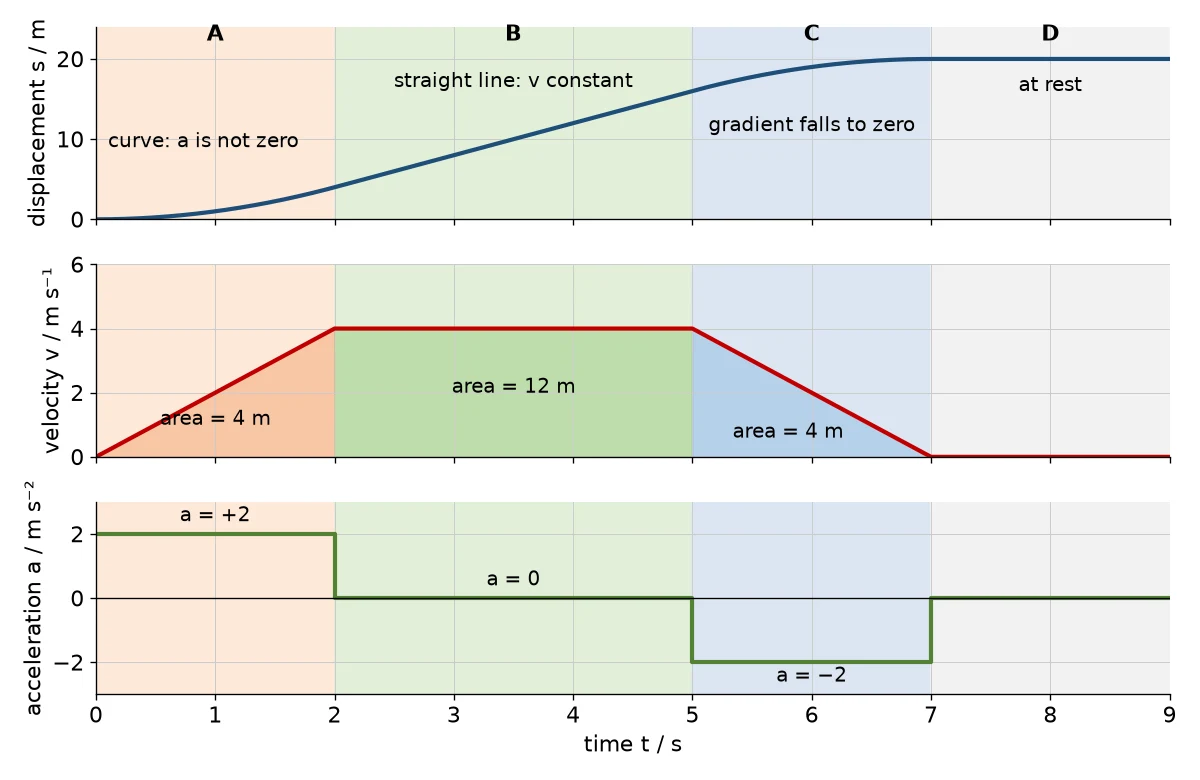
This is the derivative of position with respect to time, and graphically it is the slope of a tangent line to the position–time graph.
In the same way, the instantaneous acceleration is the rate of change of velocity: ax = dvx/dt = d2x/dt2.
In vector form,
◀ Previous3 / 5Next ▶
Instantaneous velocity and acceleration as derivatives
1
r
2
and
3
a
4
Each component of a vector can be differentiated separately
because the components are independent functions of time in the chosen coordinate system.
5
Two standard rules are used most often. If x = Ctn with constant C
then dx/dt = nCtn−1. The derivative of a constant is zero. Applying these rules to a position function gives the velocity, and applying them again gives the acceleration.
◀ Previous4 / 5Next ▶
Three stacked graphs of displacement, velocity and acceleration against time, with phases A to D shaded
Instantaneous velocity and acceleration as derivatives
◀ Previous5 / 5
1Finding functions by differentiation and integration2Finding functions by differentiation and integration3Finding functions by differentiation and integration4Finding functions by differentiation and integration
1Example 1: Average velocity and average acceleration · Examp2Worked examples3Worked examples4Worked examples5Example 3: Finding velocity and position by integration6Example 3: Finding velocity and position by integration7Example 3: Finding velocity and position by integration8Example 3: Finding velocity and position by integration
Key terms
| Term | Meaning |
|---|---|
| Object model | The approximation in which a body is treated as a single point that carries its mass and charge, with its size and internal structure ignored. |
| Displacement | The change in an object’s position, Δr = rf − ri, a vector measured in metres. |
| Average velocity | The displacement of an object divided by the time interval in which the displacement occurs. |
| Average acceleration | The change in velocity of an object divided by the time interval in which the change occurs. |
| Instantaneous velocity | The rate of change of position at a given instant, equal to the derivative dx/dt. |
| Instantaneous acceleration | The rate of change of velocity at a given instant, equal to the derivative dv/dt. |
| Derivative | The limit of an average rate of change as the time interval approaches zero, which gives the rate of change at an instant. |
| Integration | The process of summing small contributions, used to find velocity from acceleration and position from velocity. |
| Initial conditions | The known values of position or velocity at a starting time, needed to fix the constants of integration. |
1Avoid these mistakes2Avoid these mistakes3Avoid these mistakes