Curriculum
AP Physics C: Mechanics
1. Kinematics
0/11
2. Force and Translational Dynamics
0/21
-
2. Force and Translational Dynamics
 Preview
-
2.1 Systems and Center of Mass
Preview
-
2.1 Systems and Center of Mass - Check yourself
 Preview
-
2.2 Forces and Free-Body Diagrams
Preview
-
2.2 Forces and Free-Body Diagrams - Check yourself
Preview
-
2.3 Newton’s Third Law
Preview
-
2.3 Newton’s Third Law - Check yourself
Preview
-
2.4 Newton’s First Law
Preview
-
2.4 Newton’s First Law - Check yourself
Preview
-
2.5 Newton’s Second Law
Preview
-
2.5 Newton’s Second Law - Check yourself
Preview
-
2.6 Gravitational Force
Preview
-
2.6 Gravitational Force - Check yourself
Preview
-
2.7 Kinetic and Static Friction
Preview
-
2.7 Kinetic and Static Friction - Check yourself
Preview
-
2.8 Spring Forces
Preview
-
2.8 Spring Forces - Check yourself
Preview
-
2.9 Resistive Forces
Preview
-
2.9 Resistive Forces - Check yourself
Preview
-
2.10 Circular Motion
Preview
-
2.10 Circular Motion - Check yourself
Preview
3. Work, Energy, and Power
0/11
4. Linear Momentum
0/9
5. Torque and Rotational Dynamics
0/13
6. Energy and Momentum of Rotating Systems
0/13
7. Oscillations
0/11
Text lesson
2. Force and Translational Dynamics
Unit 2 Force and Translational Dynamics — AP PHYSICS C: MECHANICS (CALCULUS-BASED) notes: You will be able to connect the ten topics of Unit 2 by explaining how forces are interactions, how Newton’s laws relate net force to the acceleration of a system’s center of mass, how gravity, friction, springs and resistive forces are modelled, and how circular motion is produced by the net inward force.
1Systems, centers of mass and free-body diagrams2Systems, centers of mass and free-body diagrams
Systems, centers of mass and free-body diagrams
Systems, centers of mass and free-body diagrams
A system is the object or group of objects chosen for analysis, and its properties come from the interactions among its parts (topic 2.1).
1 / 2Next ▶
Net force and translational equilibrium: A vehicle moving at constant velocity with balanced forces and net force zero.
Systems, centers of mass and free-body diagrams
 ⤢ Enlarge
1
Its center of mass is the mass-weighted average position of the system, and a system can be treated as a single point located there.
2
Every force is an interaction between two objects
so a force on an object always has an agent (topic 2.2).
3
A free-body diagram shows the forces that the environment exerts on one object, with a dot at its center of mass and one straight arrow for each force.
◀ Previous2 / 2
1Newton’s laws: equilibrium, the third law and acceleration2Newton’s laws: equilibrium, the third law and acceleration3Newton’s laws: equilibrium, the third law and acceleration
1Gravity, weight and apparent weight2Gravity, weight and apparent weight3Gravity, weight and apparent weight
1Friction and springs as contact and elastic forces2Friction and springs as contact and elastic forces3Friction and springs as contact and elastic forces
1Resistive forces and motion described by differential equati2Resistive forces and motion described by differential equati3Resistive forces and motion described by differential equati
1Circular motion and orbits2Circular motion and orbits3Circular motion and orbits
Circular motion and orbits
Circular motion and orbits
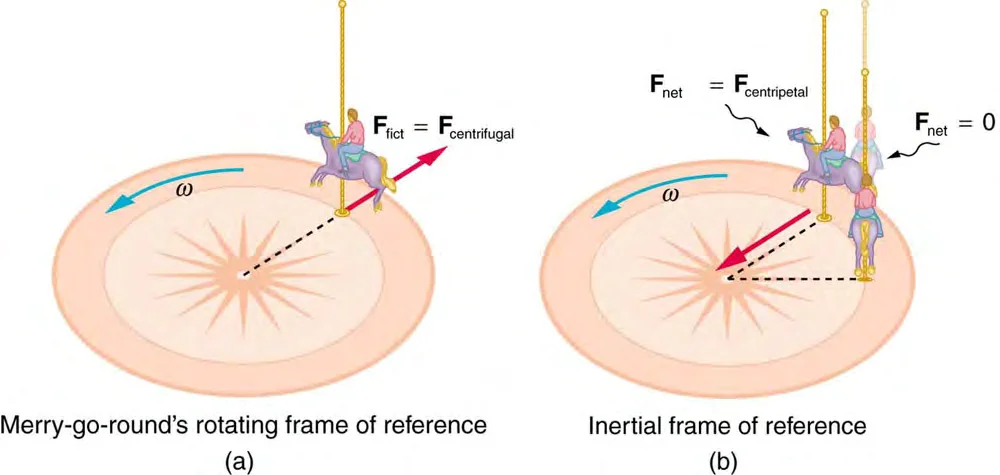
An object moving in a circle has a centripetal acceleration of magnitude v2/r directed toward the centre (topic 2.10).
1 / 3Next ▶
Circular motion and orbits
Circular motion and orbits
This acceleration is produced by real forces,
such as friction on a flat curve, the normal force and friction on a banked curve, a component of tension in a conical pendulum,
or gravity for a satellite.
A tangential acceleration,
dv
/
◀ Previous2 / 3Next ▶
Inertial reference frames: A merry-go-round rider seen from a rotating frame versus an inertial frame.
Circular motion and orbits
 ⤢ Enlarge
1
dt
2
, changes the speed and makes the net acceleration point between the centre and the tangent.
3
For a satellite in a circular orbit, gravity alone supplies the centripetal acceleration
which gives Kepler’s third law for circular orbits.
◀ Previous3 / 3
Key equations of Unit 2
| Topic | Equation | Symbols and SI units |
|---|---|---|
| 2.1 | xcm = Σmixi/Σmi; xcm = (1/M)∫x dm | Position in m; masses in kg; dm = λ dx, with λ in kg/m |
| 2.3 | FAB = −FBA | Paired forces in N; equal in magnitude, opposite in direction |
| 2.4 | ΣF = 0 (translational equilibrium) | Net force in N |
| 2.5 | ΣF = macm; F(t) = m dv/dt; v(t) = v0 + (1/m)∫F dt | Force in N; mass in kg; acceleration in m/s2; velocity in m/s; impulse in N·s |
| 2.6 | Fg = Gm1m2/r2; g = GM/r2; Fg = mg | G = 6.67 × 10⁻¹¹ N·m2/kg2; r in m; g in N/kg, with g = 9.8 N/kg near Earth |
| 2.6 | N = m(g ± a) for apparent weight; F = −(GMm/R3)r inside a uniform sphere | Normal force in N; a in m/s2; R and r in m |
| 2.7 | fk = μkFN; 0 ≤ fs ≤ μsFN | Friction and normal force in N; μ dimensionless |
| 2.8 | Fs = kΔx; 1/keq = Σ1/ki (series); keq = Σki (parallel) | k in N/m; Δx in m, from the relaxed length |
| 2.9 | Fr = −kv; m dv/dt = F − kv; vT = mg/k; τ = m/k | k in kg/s; τ in s; vT in m/s |
| 2.10 | ac = v2/r; T = 1/f; T = 2πr/v; at = dv/dt; a = √(ac2 + at2) | Acceleration in m/s2; r in m; T in s; f in Hz |
| 2.10 | v = √(gr) at the top of a loop; v = √(GM/r) and T2 = 4π2r3/GM for a circular orbit | Speed in m/s; M in kg; r in m |
1How the topics connect2How the topics connect3How the topics connect4How the topics connect
Key terms
| Term | Meaning |
|---|---|
| Center of mass | The mass-weighted average position of a system, at which its total mass can be considered to be located. |
| Free-body diagram | A diagram of one object, with a dot at its center of mass and an arrow for each force exerted on it by its environment. |
| Net force | The vector sum of all the forces exerted on a system. |
| Newton’s second law | The statement that the acceleration of a system’s center of mass is proportional to the net external force and in its direction, ΣF = macm. |
| Tension | The macroscopic net result of the forces that segments of a string exert on each other, along the string. |
| Normal force | The component of a surface’s force perpendicular to the surface and directed away from it. |
| Gravitational field strength | The gravitational force per unit mass at a point, in N/kg. |
| Apparent weight | The magnitude of the normal force exerted on a system by its support. |
| Static friction | A contact force that prevents two surfaces from sliding, with a maximum of μsFN. |
| Hooke’s law | The statement that the force exerted by an ideal spring is kΔx, directed toward equilibrium. |
| Terminal velocity | The maximum speed reached when the net force on an object is zero under a constant force and a resistive force. |
| Centripetal acceleration | The acceleration toward the centre of a circular path, equal to v2/r. |
1Avoid these mistakes2Avoid these mistakes3Avoid these mistakes4Avoid these mistakes