Curriculum
AP Physics C: Mechanics
1. Kinematics
0/11
-
1. Kinematics
 Preview
-
1.1 Scalars and Vectors in One Dimension
Preview
-
1.1 Scalars and Vectors in One Dimension - Check yourself
 Preview
-
1.2 Displacement, Velocity, and Acceleration
Preview
-
1.2 Displacement, Velocity, and Acceleration - Check yourself
Preview
-
1.3 Representing Motion
Preview
-
1.3 Representing Motion - Check yourself
Preview
-
1.4 Reference Frames and Relative Motion
Preview
-
1.4 Reference Frames and Relative Motion - Check yourself
Preview
-
1.5 Motion in Two or Three Dimensions
Preview
-
1.5 Motion in Two or Three Dimensions - Check yourself
Preview
2. Force and Translational Dynamics
0/21
3. Work, Energy, and Power
0/11
4. Linear Momentum
0/9
5. Torque and Rotational Dynamics
0/13
6. Energy and Momentum of Rotating Systems
0/13
7. Oscillations
0/11
Text lesson
1. Kinematics
Unit 1 Kinematics — AP PHYSICS C: MECHANICS notes: You will be able to connect the five topics of Unit 1 by describing motion with vectors, relating position, velocity and acceleration through derivatives and integrals, choosing a reference frame, and analysing projectile motion as two independent one-dimensional motions.
Unit 1 at a glance
Unit 1 at a glance
Kinematics describes how objects move without asking what causes the motion. Unit 1 builds the language that every later unit uses: vectors to specify position, displacement, velocity and acceleration (topic 1.1)
the definitions of average and instantaneous velocity and acceleration as rates of change (topic 1.2)the graphical and algebraic representations of motion, including the constant-acceleration equations (topic 1.3)the choice of reference frame and the addition of relative velocities (topic 1.4)and the analysis of motion in two or three dimensions, including projectile motion (topic 1.5).
1Vectors and the object model2Vectors and the object model
1Position, velocity and acceleration as functions of time2Position, velocity and acceleration as functions of time
Frames of reference and relative motion · Frames of reference and relative motion
Frames of reference and relative motion
The velocity an observer measures depends on the observer’s reference frame.
Frames of reference and relative motion
For two inertial frames moving at constant velocity relative to each other, velocities add as vectors,
and the acceleration of an object is the same in both frames (topic 1.4).
This is why the description of motion does not depend on which inertial frame is chosen
while the numerical values of velocity do.
1Motion in two dimensions and projectiles2Motion in two dimensions and projectiles
Motion in two dimensions and projectiles
Motion in two dimensions and projectiles
Motion in two dimensions is analysed one component at a time, linked only by the common time (topic 1.5).
1 / 2Next ▶
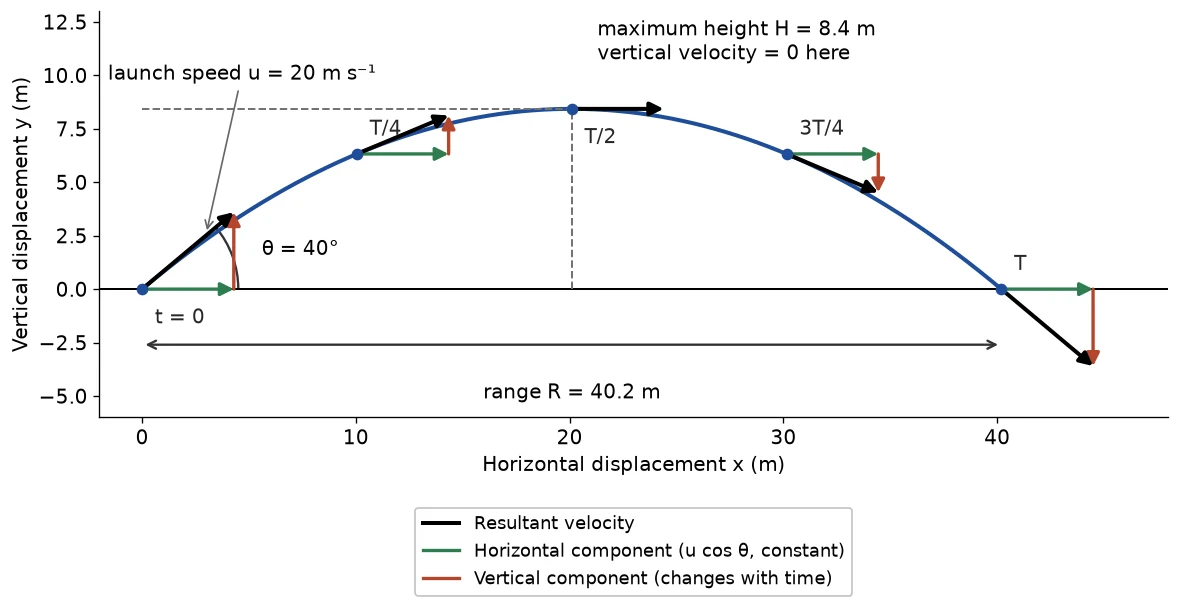
Parabolic path of a projectile launched at 20 m s−1 and 40 degrees, with resultant, horizontal and vertical velocity components at five times
Motion in two dimensions and projectiles
 ⤢ Enlarge
1
A projectile has zero horizontal acceleration and a constant vertical acceleration of magnitude g.
2
Its horizontal velocity stays constant, its trajectory is a parabola, and its time of flight depends only on its vertical motion.
3
These results follow directly from the vector forms of the constant-acceleration equations and are the basis of the projectile problems in later units.
◀ Previous2 / 2
Key equations of Unit 1
| Equation | Symbols and SI units | Topic |
|---|---|---|
| r = xi + yj + zk; r̂ = r/|r| | r position vector (m); x, y, z coordinates (m); r̂ unit vector (no units) | 1.1 |
| R = A + B, with Rx = Ax + Bx; |A| = √(Ax2 + Ay2 + Az2) | Vector components in the units of the vectors (m, m/s, m/s2, N) | 1.1 |
| Δx = xf − xi; Δr = rf − ri | Δx displacement (m) | 1.2 |
| vavg = Δx/Δt; aavg = Δv/Δt | vavg average velocity (m/s); aavg average acceleration (m/s2); Δt interval (s) | 1.2 |
| vx = dx/dt; ax = dvx/dt | vx instantaneous velocity (m/s); ax instantaneous acceleration (m/s2); t time (s) | 1.2, 1.3 |
| v = dr/dt; a = dv/dt | Vector forms of velocity and acceleration; each component differentiated separately | 1.2, 1.5 |
| Δx = ∫t1t2 vx(t) dt; Δvx = ∫t1t2 ax(t) dt | Displacement is the area under the velocity graph; change in velocity is the area under the acceleration graph | 1.3 |
| vx = vx0 + axt; x = x0 + vx0t + ½axt2; vx2 = vx02 + 2ax(x − x0) | Constant acceleration only; x, x0 in m; velocities in m/s; ax in m/s2; t in s | 1.3 |
| g = 10 m/s2 (AP numerical value; 9.8 m/s2 or 9.81 m/s2 accepted) | Downward acceleration near Earth’s surface, with air resistance neglected | 1.3, 1.5 |
| vAC = vAB + vBC; aAC = aAB when frame B moves at constant velocity | v velocity (m/s); subscripts show the object and the frames involved | 1.4 |
| x = vx0t; vy = vy0 − gt; y = vy0t − ½gt2; vy2 = vy02 − 2gy | Projectile equations with launch at the origin; positions in m, velocities in m/s, t in s | 1.5 |
| T = 2v0 sin θ/g; H = v02 sin2 θ/(2g); R = v02 sin 2θ/g | T time of flight (s); H maximum height (m); R range (m); v0 launch speed (m/s); θ launch angle above horizontal | 1.5 |
How the topics connect · How the topics connect
How the topics connect
Topic 1.1 supplies the vector language, topic 1.2 defines velocity and acceleration as rates of change, and topic 1.3 shows how graphs and equations describe the same motion.
How the topics connect
Topic 1.4 explains why the values of these quantities depend on the observer, and topic 1.5 applies all of them in two dimensions.
A useful check on any Unit 1 problem is to ask whether the answer agrees in each representation: a sketch, a graph, the equations and a verbal description of the same motion should tell the same story.
Key terms
| Term | Meaning |
|---|---|
| Scalar and vector | A scalar has a magnitude alone; a vector has a magnitude and a direction. |
| Displacement | The change in an object’s position, a vector measured in metres. |
| Instantaneous velocity and acceleration | The derivatives of position and velocity with respect to time. |
| Constant-acceleration equations | The three kinematic equations that apply when acceleration is constant along a single axis. |
| Inertial reference frame | A frame in which an object with no net force moves at constant velocity; all such frames measure the same acceleration. |
| Relative velocity | The velocity of an object measured in one frame, found by vector addition of velocities between frames. |
| Projectile | An object moving under gravity alone, with zero horizontal acceleration and constant vertical acceleration of magnitude g. |
1Avoid these mistakes2Avoid these mistakes