Curriculum
AP Physics C: Mechanics
1. Kinematics
0/11
2. Force and Translational Dynamics
0/21
3. Work, Energy, and Power
0/11
4. Linear Momentum
0/9
-
4. Linear Momentum
 Preview
-
4.1 Linear Momentum
Preview
-
4.1 Linear Momentum - Check yourself
 Preview
-
4.2 Change in Momentum and Impulse
Preview
-
4.2 Change in Momentum and Impulse - Check yourself
Preview
-
4.3 Conservation of Linear Momentum
Preview
-
4.3 Conservation of Linear Momentum - Check yourself
Preview
-
4.4 Elastic and Inelastic Collisions
Preview
-
4.4 Elastic and Inelastic Collisions - Check yourself
Preview
5. Torque and Rotational Dynamics
0/13
6. Energy and Momentum of Rotating Systems
0/13
7. Oscillations
0/11
Text lesson
4.1 Linear Momentum
4.1 Linear Momentum — AP PHYSICS C: MECHANICS notes: You will be able to describe the linear momentum of an object and of a system of objects, calculate momentum as a function of time using derivatives, and decide when a collision or an explosion is a suitable model for an interaction.
1
It is defined by the equation p = mv, where p is the momentum in kilogram-metres per second (kg·m/s), m is the mass in kilograms (kg), and v is the velocity in metres per second (m/s).
2
Momentum is a vector, so the vector form is p = mv.
3
The direction of momentum is always the same as the direction of the velocity.
4
A heavy object moving slowly and a light object moving quickly can have the same momentum, because momentum depends on both mass and velocity.
5
For motion along one axis, the momentum is given with a sign a positive value means the object moves in the positive direction of the chosen axis, and a negative value means it moves in the negative direction.
6
For motion in two dimensions, the momentum is found component by component.
7
If an object of mass m has velocity components vx and vy, then its momentum components are px = mvx and py = mvy.
8
The magnitude of the momentum is |p| = √(px2 + py2), and its direction makes the angle θ with the x-axis, where tan θ = py/px.
The total momentum of a system is the vector sum of the momenta of its constituent objects: psystem = Σpi = Σmivi.
Momentum adds as a vector, so momenta in opposite directions partly cancel.
Two objects moving in opposite directions can have a total momentum of zero even though each has a large momentum on its own.
The choice of system matters.
A system that is drawn to include both a cart and the track it rolls on is analysed in the same way as any other system, but the internal forces inside the system do not change its total momentum.
Only the forces that cross the boundary of the system, the external forces, can change the total momentum.
Later in this unit, this idea leads to the conservation of linear momentum.
1
When an object moves along a straight line with position x(t), its velocity is the derivative of position with respect to time, v = dx/dt.
2
For an object of constant mass, its momentum as a function of time is therefore p(t) = m dx/dt.
3
The rate at which momentum changes with time is the slope of the momentum–time graph, which is the derivative dp/dt.
4
The units of dp/dt are kg·m/s2 or newtons.
5
If the velocity is known only as a graph, the momentum at any instant is the product of the mass and the velocity read from the graph.
6
The momentum of a system can be tracked over time by calculating p(t) at several instants and plotting the values.
7
A curved momentum–time graph shows a changing momentum, and the value of the slope at an instant gives the net force at that instant. (this relationship is developed in topic 4.2)
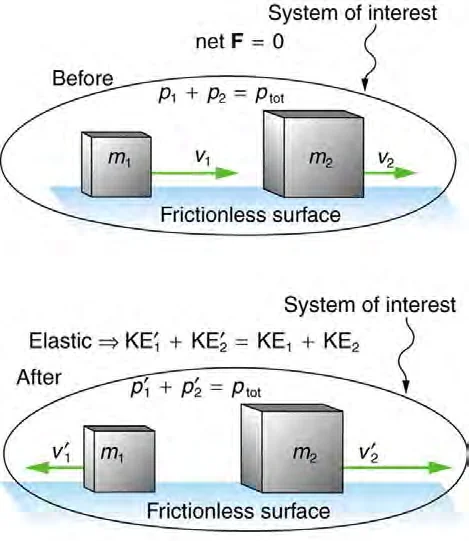
1
Because the internal forces are so large, the external forces can be ignored for the short time of the interaction.
2
Collisions include car crashes, the impact of a ball on a bat, and the contact between two colliding carts on a track.
3
A collision can be analysed using only the initial state, just before the interaction, and the final state, just after it.
4
The forces and motion during the interaction itself do not have to be calculated.
5
This is why the collision model is so useful it allows the velocities before and after a collision to be linked without knowing the force law of the contact.
6
An explosion is a model for an interaction in which forces internal to the system move the objects within that system apart.
7
A cart launched by a compressed spring, a firework that splits into fragments, and a gun recoiling after it fires are all explosion models.
8
In an explosion the objects start together, or nearly together, and end moving apart.
1
p = mv = (0.150 kg)(40.0 m/s) = 6.00 kg·m/s
2
The momentum points in the same direction as the velocity toward the batter
Answer
6.00 kg·m/s in the direction of motion
1
The momenta are pcar = (1200 kg)(+15 m/s) = +1.80 × 10⁴ kg·m/s and ptruck = (800 kg)(−10 m/s) = −8.00 × 10³ kg·m/s
2
The total is psystem = +1.80 × 10⁴ − 8.00 × 103 = +1.00 × 10⁴ kg·m/s.
Answer
1.00 × 10⁴ kg·m/s in the positive x-direction. The truck’s momentum partly cancels the car’s momentum.
1
px = (2.0 kg)(3.0 m/s) = 6.0 kg·m/s and py = (2.0 kg)(4.0 m/s) = 8.0 kg·m/s
2
The magnitude is p = √(6.02 + 8.02) = √100 = 10 kg·m/s
3
The angle is tan θ = 8.0/6.0, so θ = 53° above the x-axis.
Answer
10 kg·m/s at 53° above the positive x-axis
1
The velocity is the derivative v(t) = dx/dt = 6.0t m/s
2
The momentum is p(t) = mv(t) = (2.0 kg)(6.0t m/s) = 12t kg·m/s
3
At t = 2.0 s p = 12 × 2.0 = 24 kg·m/s
Answer
p(t) = 12t kg·m/s, so the momentum is 24 kg·m/s at 2.0 s
Treating momentum as a scalar
Momentum has a direction, the same as the velocity, so opposite momenta must be given opposite signs before they are added.
Adding the speeds of objects in a system instead of their momenta
The total momentum is the vector sum of the momenta, so a system of two equal masses moving at equal speeds in opposite directions has zero total momentum.
Confusing momentum with kinetic energy
Momentum is mv, which is proportional to velocity, while kinetic energy is ½mv2, which is proportional to the square of velocity.
Using the velocity-time value where the derivative is needed
If position is given as a function of time, differentiate it to find v before multiplying by mass to get p.
Calling an interaction a collision when the forces between the objects are not much larger than the external forces
A collision model is only appropriate when the internal forces dominate during the interaction.
Choosing a system boundary and then counting an internal force as an external one, or the reverse
Only forces that cross the boundary of the chosen system can change its total momentum.