Curriculum
AP Physics C: Mechanics
1. Kinematics
0/11
2. Force and Translational Dynamics
0/21
3. Work, Energy, and Power
0/11
4. Linear Momentum
0/9
-
4. Linear Momentum
 Preview
-
4.1 Linear Momentum
Preview
-
4.1 Linear Momentum - Check yourself
 Preview
-
4.2 Change in Momentum and Impulse
Preview
-
4.2 Change in Momentum and Impulse - Check yourself
Preview
-
4.3 Conservation of Linear Momentum
Preview
-
4.3 Conservation of Linear Momentum - Check yourself
Preview
-
4.4 Elastic and Inelastic Collisions
Preview
-
4.4 Elastic and Inelastic Collisions - Check yourself
Preview
5. Torque and Rotational Dynamics
0/13
6. Energy and Momentum of Rotating Systems
0/13
7. Oscillations
0/11
Text lesson
4. Linear Momentum
Unit 4 Linear Momentum — AP PHYSICS C: MECHANICS notes: You will be able to link momentum, impulse, conservation of momentum and the classification of collisions, and choose the right equations for a problem on linear momentum.
1Core ideas of linear momentum2Core ideas of linear momentum3Core ideas of linear momentum4Core ideas of linear momentum
Core ideas of linear momentum
Core ideas of linear momentum
Linear momentum, p = mv, is a vector with the direction of the velocity.
1 / 4Next ▶
Core ideas of linear momentum
1
The momentum of a system is the vector sum of the momenta of its objects.
2
The net external force on a system equals the rate of change of its momentum,
3
F
4
net
5
= d
6
p
◀ Previous2 / 4Next ▶
Core ideas of linear momentum
Core ideas of linear momentum
/d
t
,
and the impulse of that force, the integral of the force over time, equals the change in momentum.
Conservation of linear momentum follows when the net external force on the chosen system is zero: the total momentum before an interaction equals the total momentum after it.
Momentum is conserved in every interaction
but kinetic energy is conserved only in elastic collisions.
◀ Previous3 / 4Next ▶
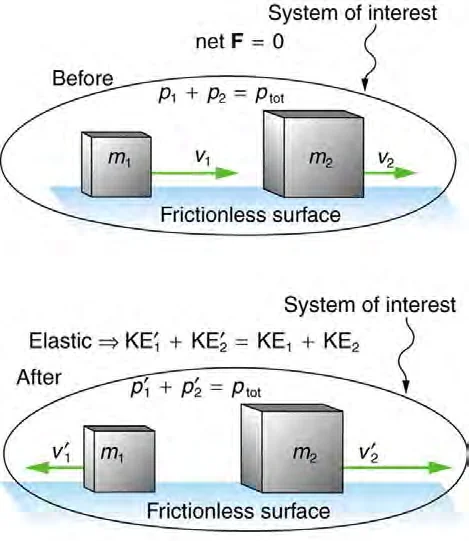
Collisions and explosions as models: An elastic collision of two blocks on a frictionless surface, with momentum conserved and kinetic energy unchanged.
Core ideas of linear momentum
 ⤢ Enlarge
Core ideas of linear momentum
Unit 4 therefore uses momentum as the main tool for analysing collisions and explosions and kinetic energy to classify them.
The choice of system is the first step in any problem. Only forces that cross the boundary of the system, the external forces, change its total momentum, and the center of mass of an isolated system moves with constant velocity.
◀ Previous4 / 4
Key equations of Unit 4
| Equation | Meaning and units |
|---|---|
| p = mv | Linear momentum of an object, in kg·m/s (topic 4.1). |
| psystem = Σpi | Total momentum of a system, the vector sum of its objects’ momenta, in kg·m/s (topic 4.1). |
| Fnet = dp/dt | Net external force as the rate of change of momentum, in N (topic 4.2). |
| J = ∫Fnet dt = Δp | Impulse and the impulse–momentum theorem, in N·s (topic 4.2). |
| Favg = J/Δt | Average net force over a time interval, in N (topic 4.2). |
| Fnet = (dm/dt)v | Force for a system of changing mass moving at constant velocity; dm/dt in kg/s (topic 4.2). |
| Σpinitial = Σpfinal | Conservation of linear momentum when the net external force is zero (topic 4.3). |
| vcm = Σmivi/Σmi | Center-of-mass velocity, in m/s; equivalently ptotal = Mvcm (topic 4.3). |
| xcm = (1/M)∫x dm | Center-of-mass position for a continuous object, in m (topic 4.3). |
| K = ½mv2 = p2/(2m) | Kinetic energy, in J; its total is conserved only in elastic collisions (topic 4.4). |
| v1f = [(m1 − m2)/(m1 + m2)]v1i, v2f = [2m1/(m1 + m2)]v1i | Final velocities in a one-dimensional elastic collision with the target at rest, in m/s (topic 4.4). |
| vf = (m1v1i + m2v2i)/(m1 + m2) | Common final velocity in a perfectly inelastic collision, in m/s (topic 4.4). |
1How the four topics connect2How the four topics connect3How the four topics connect
How the four topics connect
How the four topics connect
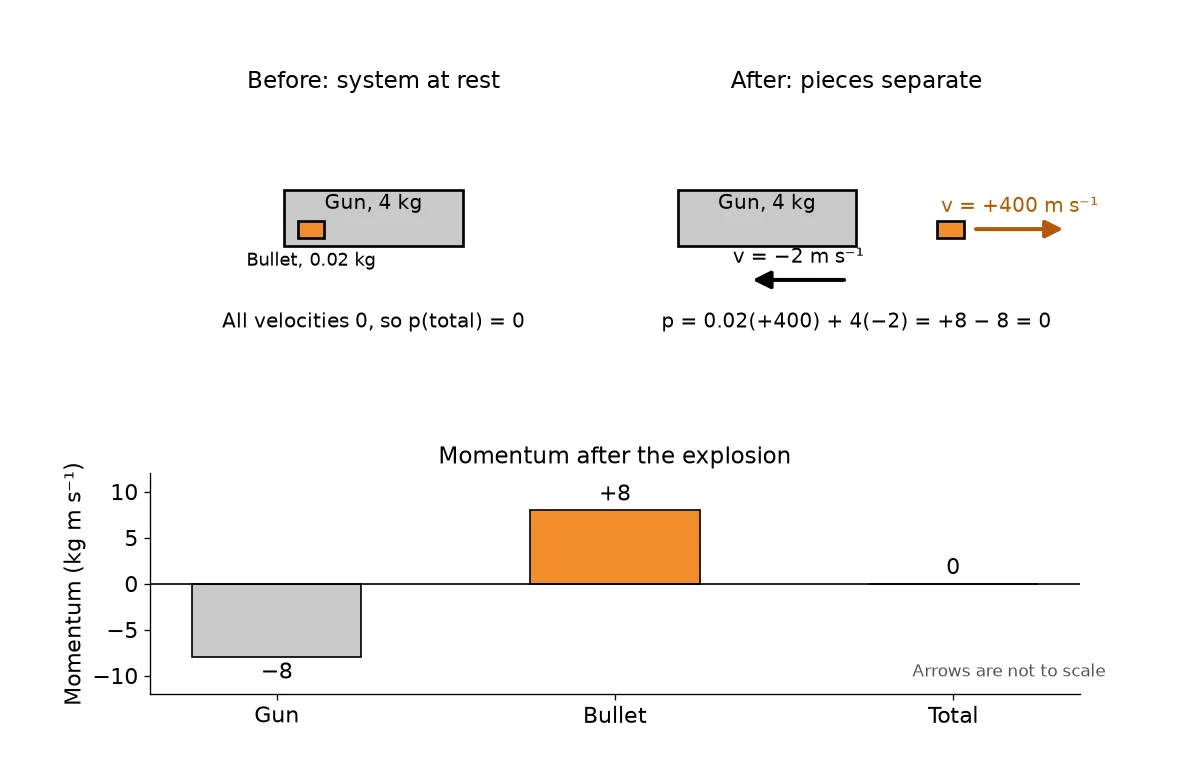
Topic 4.1 defines momentum and the two models, collision and explosion, that are analysed with it.
1 / 3Next ▶
How the four topics connect
How the four topics connect
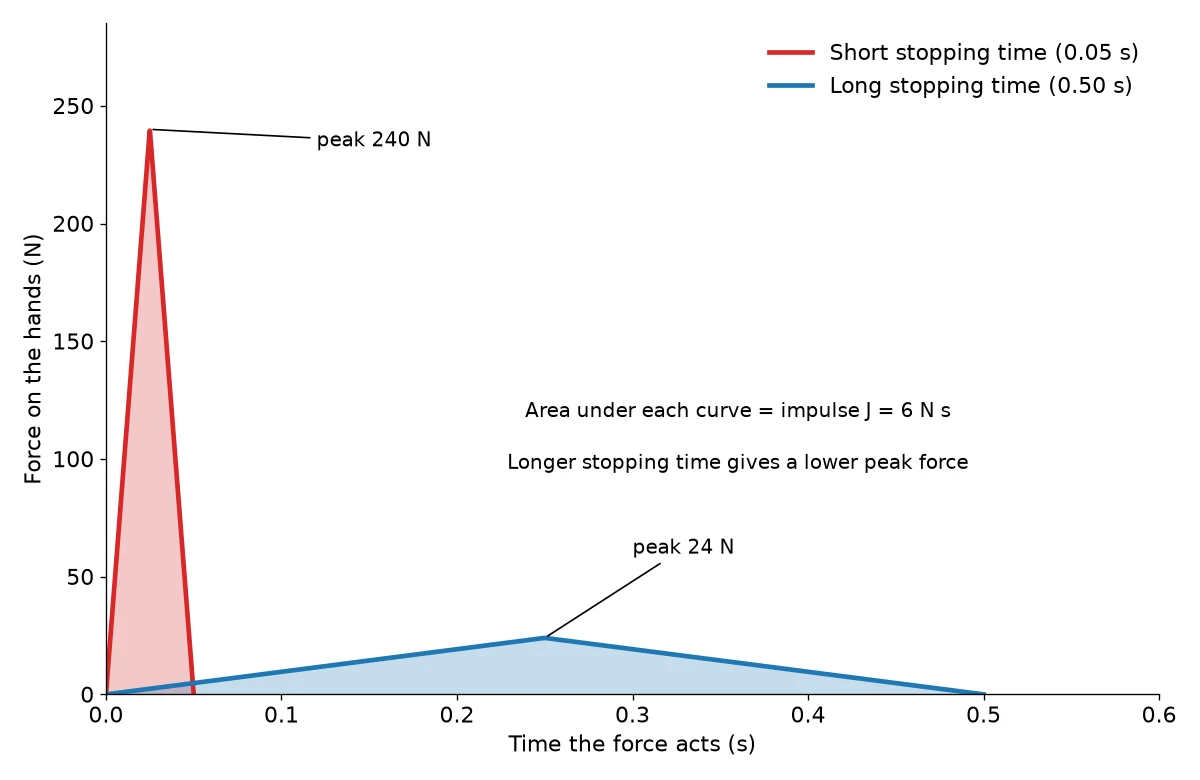
Topic 4.2 connects force and impulse to the change in momentum,
so that a force-time graph and a momentum-time graph give the same information from different sides.
Topic 4.3 combines these ideas into conservation of momentum,
which is applied to a chosen system with zero net external force,
and to the center of mass.
Topic 4.4 uses the results of topic 4.3 and adds kinetic energy. Every collision in topic 4.4 satisfies conservation of momentum, and the energy condition decides whether it is elastic, inelastic or perfectly inelastic. The derivatives and integrals of topics 4.1 and 4.2 are used whenever a momentum or force is given as a function of time.
◀ Previous2 / 3Next ▶
Before and after diagrams of a gun firing a bullet, with a bar chart of the momenta after the explosion
How the four topics connect
 ⤢ Enlarge
How the four topics connect
In a typical problem the steps are the same: choose the system, decide whether the net external force is zero, write the momentum equation in each direction, and use kinetic energy only when the type of collision is known or must be determined.
◀ Previous3 / 3
1Example 1: Impulse, then an elastic collision2Worked examples3Worked examples
Example 1: Impulse, then an elastic collision
Example 1: Impulse, then an elastic collision
A 0.50 kg ball at rest is struck by a net force of 60 N for 0.10 s. The ball then undergoes an elastic collision with a 1.5 kg block that is at rest. Find the ball’s velocity after the force, and the velocities of the ball and block after the collision.
Working: The impulse is J = (60 N)(0.10 s) = 6.0 N·s
so Δp = 6.0 kg·m/s and the ball’s velocity is v1i = 6.0/0.50 = 12 m/s.
1 / 3Next ▶
Worked examples
Worked examples
For the elastic collision,
v
1f
= [(0.50 − 1.5)/(2.0)](12 m/s) = −6.0 m/s and
2f
= [2(0.50)/(2.0)](12 m/s) = 6.0 m/s.
◀ Previous2 / 3Next ▶
Two triangular force-time graphs with the same area for a short and a long stopping time, showing different peak forces
Worked examples
 ⤢ Enlarge
1
Check the momentum: (0.50)(−6.0) + (1.5)(6.0) = 6.0 kg·m/s, equal to the initial 0.50 × 12 = 6.0 kg·m/s.
2
Check the kinetic energy: 36 J before, and 9.0 + 27 = 36 J after.
3
Answer: The ball leaves the force at 12 m/s. After the elastic collision, the ball rebounds at 6.0 m/s and the block moves forward at 6.0 m/s.
◀ Previous3 / 3
Key terms
| Term | Meaning |
|---|---|
| Linear momentum | The vector quantity p = mv, in kg·m/s, in the direction of the velocity. |
| Impulse | The integral of the net external force over a time interval, equal to the change in momentum, in N·s. |
| Net external force | The vector sum of the forces on a system from objects outside it; it alone changes the total momentum of the system. |
| Conservation of linear momentum | The principle that total momentum is constant when the net external force on a system is zero. |
| Center-of-mass velocity | The total momentum of a system divided by its total mass. |
| Elastic collision | A collision in which the total kinetic energy of the system is conserved. |
| Inelastic collision | A collision in which the total kinetic energy of the system decreases. |
| Perfectly inelastic collision | An inelastic collision in which the objects stick together and share one final velocity. |
1Avoid these mistakes2Avoid these mistakes3Avoid these mistakes