Curriculum
AP Physics C: Mechanics
1. Kinematics
0/11
-
1. Kinematics
 Preview
-
1.1 Scalars and Vectors in One Dimension
Preview
-
1.1 Scalars and Vectors in One Dimension - Check yourself
 Preview
-
1.2 Displacement, Velocity, and Acceleration
Preview
-
1.2 Displacement, Velocity, and Acceleration - Check yourself
Preview
-
1.3 Representing Motion
Preview
-
1.3 Representing Motion - Check yourself
Preview
-
1.4 Reference Frames and Relative Motion
Preview
-
1.4 Reference Frames and Relative Motion - Check yourself
Preview
-
1.5 Motion in Two or Three Dimensions
Preview
-
1.5 Motion in Two or Three Dimensions - Check yourself
Preview
2. Force and Translational Dynamics
0/21
3. Work, Energy, and Power
0/11
4. Linear Momentum
0/9
5. Torque and Rotational Dynamics
0/13
6. Energy and Momentum of Rotating Systems
0/13
7. Oscillations
0/11
Text lesson
1.5 Motion in Two or Three Dimensions
1.5 Motion in Two or Three Dimensions — AP PHYSICS C: MECHANICS notes: You will be able to describe the motion of an object moving in two dimensions by treating each component separately, differentiating and integrating vector position, velocity and acceleration, and analysing projectile motion with and without a launch angle.
1Vector position, velocity and acceleration2Vector position, velocity and acceleration3Vector position, velocity and acceleration4Vector position, velocity and acceleration
1Separating motion into components2Separating motion into components3Separating motion into components
Separating motion into components
Separating motion into components
Motion in two dimensions can be analysed with one-dimensional kinematic relationships, provided the motion is separated into components along perpendicular axes.
1 / 3Next ▶
Separating motion into components
1
Each component obeys its own equations of motion, and the only link between the components is the common time
2
t
3
.
4
A motion in one dimension can change without causing any change in a perpendicular dimension,
5
so the horizontal and vertical motions of a projectile can be analysed independently.
6
To use this method, choose axes, write the position, velocity and acceleration components
and then solve each component equation separately. The time found from one component is used in the other. This separation is the main method for every problem in this topic.
◀ Previous2 / 3Next ▶
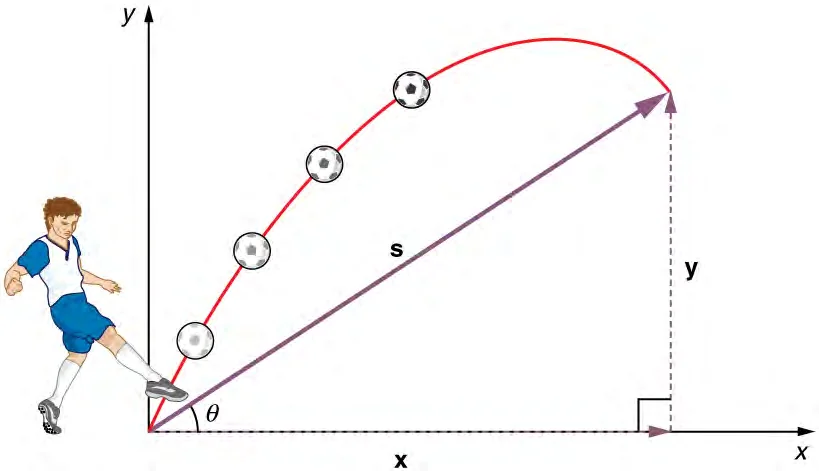
Vectors and components: A kicked ball whose displacement vector is split into horizontal and vertical components.
Separating motion into components
◀ Previous3 / 3
Motion with constant acceleration in two dimensions · Motion with constant acceleration in two dimensions
Motion with constant acceleration in two dimensions
If the acceleration is constant, integrating the acceleration gives the velocity and integrating the velocity gives the position, component by component: v = v0 + at and r = r0 + v0t + ½at2.
Motion with constant acceleration in two dimensions
These are the vector forms of the constant-acceleration equations.
In a component form each equation has the same structure as the one-dimensional equations in topic 1.3, with the component values substituted.
1Projectile motion2Projectile motion3Projectile motion4Projectile motion5Projectile motion6Projectile motion7Projectile motion8Projectile motion9Projectile motion10Projectile motion11Projectile motion
Projectile motion
Projectile motion
Projectile motion is a special case of two-dimensional motion in which there is zero acceleration in one dimension and a constant, nonzero acceleration in the second dimension.
1
Near the surface of Earth, and neglecting air resistance, a projectile has
a
x
= 0 and
1 / 11Next ▶
Projectile motion
Projectile motion
y
= −
g
with upward as positive.
2
The horizontal velocity is therefore constant.
◀ Previous2 / 11Next ▶
Projectile motion
1
3
2
The vertical motion is that of free fall, with a constant downward acceleration.
3
4
4
For AP numerical problems,
5
= 10 m/s
6
is used, and answers that use 9.8 m/s
◀ Previous3 / 11Next ▶
Projectile motion
1
or 9.81 m/s
2
are accepted.
3
For a projectile that starts at the origin with velocity components vx0 and vy0, the equations are: x = vx0t
vy = vy0 − gty = vy0t − ½gt2and vy2 = vy02 − 2gy.
◀ Previous4 / 11Next ▶
Projectile motion
Projectile motion
Here
,
are in metres, velocities in metres per second, and
t
is in seconds.
Eliminating
◀ Previous5 / 11Next ▶
Projectile motion
1
from the first two equations gives the trajectory
2
(
3
) =
4
tan θ −
5
gx
6
/(2
◀ Previous6 / 11Next ▶
Projectile motion
Projectile motion
v
0
cos
θ)
which is a parabola.
For a projectile launched from ground level at speed v0 and angle θ above the horizontal, vx0 = v0 cos θ and vy0 = v0 sin θ.
The time of flight is
◀ Previous7 / 11Next ▶
Projectile motion
Projectile motion
T
= 2
sin θ/
, the maximum height is
H
=
◀ Previous8 / 11Next ▶
Projectile motion
1
sin
2
θ/(2
3
), and the horizontal range is
4
R
5
sin 2θ/
6
.
◀ Previous9 / 11Next ▶
Projectile motion
1
The range formula applies only when the object lands at the same height from which it was launched.
2
At the peak of the trajectory
3
= 0, and the speed there equals the horizontal component
4
x0
5
The time of flight is found from the vertical motion alone. A projectile launched horizontally from a height h has an initial vertical velocity of zero
so it reaches the ground after the same time as an object dropped from the same height. Its horizontal velocity does not changeso its horizontal distance grows at a constant rate.
◀ Previous10 / 11Next ▶
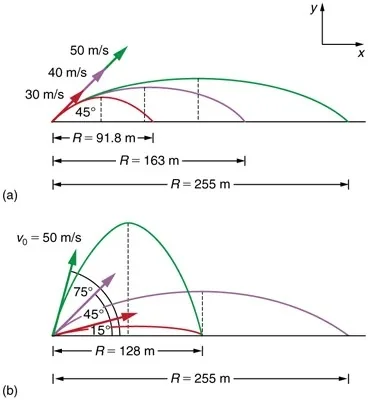
Launch at an angle: time of flight, maximum height and range: Projectile paths on level ground comparing different launch speeds and angles and how they change the range.
Projectile motion
◀ Previous11 / 11
1Example 1: Horizontal launch from a cliff2Worked examples3Worked examples4Worked examples5Example 2: Projectile launched at an angle from the ground6Example 2: Projectile launched at an angle from the ground7Example 2: Projectile launched at an angle from the ground8Example 2: Projectile launched at an angle from the ground9Example 3: Position, velocity and acceleration from vector f10Example 3: Position, velocity and acceleration from vector f11Example 3: Position, velocity and acceleration from vector f12Example 3: Position, velocity and acceleration from vector f
Key terms
| Term | Meaning |
|---|---|
| Position vector function | A vector r(t) giving the position of an object as a function of time. |
| Component | The part of a vector along one of the perpendicular coordinate axes, which can be analysed separately. |
| Independence of components | The property that motion along one perpendicular axis can change without changing motion along another, linked only by the common time. |
| Projectile | An object moving under gravity alone, with no forces other than the gravitational force, once it has been launched. |
| Trajectory | The path followed by a projectile, which is a parabola y(x) when air resistance is neglected. |
| Time of flight | The total time a projectile spends in the air. |
| Maximum height | The greatest vertical position reached by a projectile, at which the vertical velocity is zero. |
| Range | The horizontal distance a projectile travels between launch and landing at the same height. |
| Launch angle (θ) | The angle above the horizontal at which a projectile is launched. |
1Avoid these mistakes2Avoid these mistakes3Avoid these mistakes4Avoid these mistakes