Curriculum
AP Physics C: Mechanics
1. Kinematics
0/11
2. Force and Translational Dynamics
0/21
-
2. Force and Translational Dynamics
 Preview
-
2.1 Systems and Center of Mass
Preview
-
2.1 Systems and Center of Mass - Check yourself
 Preview
-
2.2 Forces and Free-Body Diagrams
Preview
-
2.2 Forces and Free-Body Diagrams - Check yourself
Preview
-
2.3 Newton’s Third Law
Preview
-
2.3 Newton’s Third Law - Check yourself
Preview
-
2.4 Newton’s First Law
Preview
-
2.4 Newton’s First Law - Check yourself
Preview
-
2.5 Newton’s Second Law
Preview
-
2.5 Newton’s Second Law - Check yourself
Preview
-
2.6 Gravitational Force
Preview
-
2.6 Gravitational Force - Check yourself
Preview
-
2.7 Kinetic and Static Friction
Preview
-
2.7 Kinetic and Static Friction - Check yourself
Preview
-
2.8 Spring Forces
Preview
-
2.8 Spring Forces - Check yourself
Preview
-
2.9 Resistive Forces
Preview
-
2.9 Resistive Forces - Check yourself
Preview
-
2.10 Circular Motion
Preview
-
2.10 Circular Motion - Check yourself
Preview
3. Work, Energy, and Power
0/11
4. Linear Momentum
0/9
5. Torque and Rotational Dynamics
0/13
6. Energy and Momentum of Rotating Systems
0/13
7. Oscillations
0/11
Text lesson
2.4 Newton’s First Law
2.4 Newton’s First Law — AP PHYSICS C: MECHANICS (CALCULUS-BASED) notes: You will be able to state the conditions under which a system’s velocity remains constant, add forces as vectors to find the net force, and identify the inertial reference frames in which Newton’s first law holds.
A vehicle moving at constant velocity with balanced forces and net force zero. Image: OpenStax, College Physics 2e, CC BY 4.0.
Net force and translational equilibrium
 ⤢ Enlarge
Net force and translational equilibrium
The net force on a system is the vector sum of all the forces exerted on the system.
Forces are added as vectors,
so two forces of equal magnitude that point in opposite directions give a net force of zero,while two forces at a right angle give a net force whose magnitude is found from the Pythagorean theorem.
The net force is measured in newtons (N) and has the same direction as the resultant vector.
Translational equilibrium is the configuration of forces in which the net force exerted on a system is zero. In symbols, ΣF = 0. Equilibrium is a statement about forces only. It does not require the system to be at rest. An object moving at a constant velocity is in translational equilibrium just as an object at rest is.
1Newton’s first law and constant velocity2Newton’s first law and constant velocity
Forces balanced in one direction only
Forces balanced in one direction only
Forces may be balanced in one dimension but unbalanced in another.
In that case the net force has a component only in the unbalanced direction, and the system’s velocity changes only in that direction.
A puck sliding east that is pushed north by an unbalanced force keeps its eastward velocity component
while its northward component grows.
The speed changes
but the eastward motion is unaffected.
1Inertial reference frames2Inertial reference frames
Inertial reference frames
1
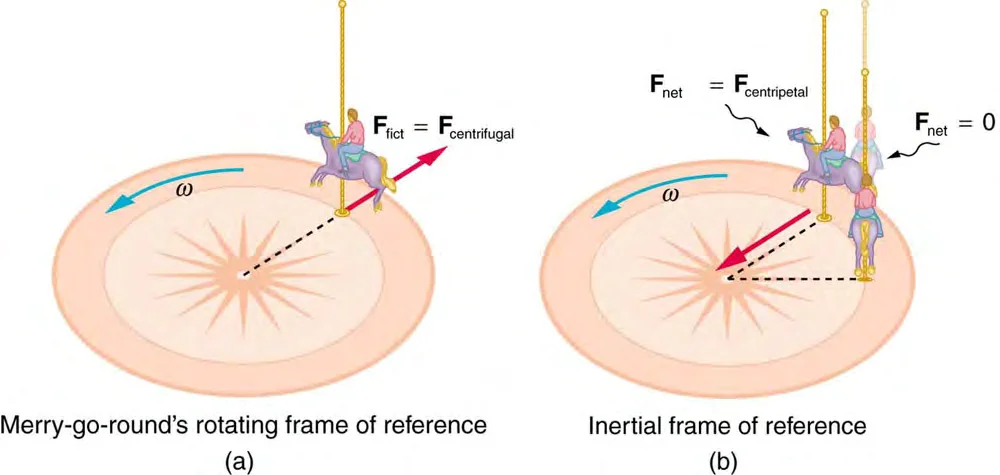
An inertial reference frame is one from which an observer would verify Newton’s first law of motion.
2
In an inertial frame, an object with no net force acting on it moves at a constant velocity.
3
A frame that is not accelerating, such as a laboratory at rest on the ground, is inertial to a very good approximation.
4
A frame that accelerates,
such as an elevator that starts moving upward, is not inertial,because a suspended object appears to accelerate even though no net force acts on it.
5
For that reason, the first law is only tested and applied in inertial frames.
1 / 2Next ▶
A merry-go-round rider seen from a rotating frame versus an inertial frame. Image: OpenStax, College Physics for AP Courses, CC BY 4.0.
Inertial reference frames
 ⤢ Enlarge
Inertial reference frames
Whether a frame is inertial depends on how it moves relative to other frames. A frame moving at a constant velocity relative to an inertial frame is also inertial
so the laws of motion look the same in it. In this course, unless stated otherwise, the frame of the classroom or the ground is taken to be inertial.
◀ Previous2 / 2
1Example 1: Puck in equilibrium under three forces2Example 2: Forces balanced in one direction only3Example 3: A car moving at constant velocity
Key terms
| Term | Meaning |
|---|---|
| Net force | The vector sum of all the forces exerted on a system, measured in newtons. |
| Translational equilibrium | The configuration of forces for which the net force on a system is zero, so ΣF = 0. |
| Balanced forces | Forces whose vector sum is zero, so that they do not change the velocity of the system. |
| Unbalanced forces | Forces whose vector sum is not zero, so that the velocity of the system changes in the direction of the net force. |
| Newton’s first law | A statement that a system with zero net force keeps a constant velocity, which may be zero. |
| Inertial reference frame | A frame in which an observer would verify Newton’s first law, meaning one that is not accelerating. |
| Constant velocity | A velocity that has the same magnitude and direction at all times, so the acceleration is zero. |
1Avoid these mistakes2Avoid these mistakes3Avoid these mistakes