Curriculum
Course: AP Physics C: Mechanics
Login

Curriculum

AP Physics C: Mechanics

Text lesson

5.6 Newton’s Second Law in Rotational Form

5.6 Newton’s Second Law in Rotational Form — AP PHYSICS C: MECHANICS notes: You will be able to describe the conditions under which a rigid system’s angular velocity changes, apply Στ = Iα to find angular acceleration, and analyse a rotating system together with the translational motion of linked bodies.

1When the angular velocity changes2When the angular velocity changes3When the angular velocity changes
When the angular velocity changes
The angular velocity of a rigid system changes when the net torque exerted on it is not zero.
1 / 3Next ▶
When the angular velocity changes
1

A net torque in the counterclockwise direction increases a counterclockwise angular velocity and decreases a clockwise one,
2

and a net torque in the opposite direction does the reverse.
3

The angular velocity is changing whenever the angular acceleration is nonzero

so the condition for a change is Σ
4

τ
5

≠ 0.
◀ Previous2 / 3Next ▶
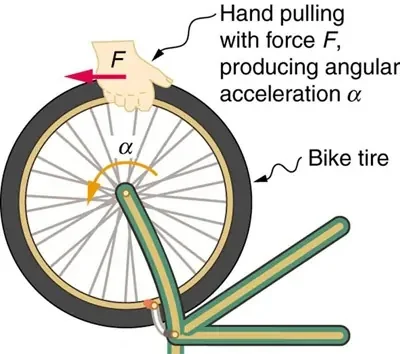
A force applied at the rim of a bike wheel produces an angular acceleration about its axle. Image: OpenStax, College Physics 2e, CC BY 4.0.
When the angular velocity changes
◀ Previous3 / 3
1Newton’s second law in rotational form2Newton’s second law in rotational form3Newton’s second law in rotational form
Newton’s second law in rotational form
For a rigid system rotating about a fixed axis, or about an axis through its centre of mass, the rate at which the angular velocity changes is directly proportional to the net torque and is in the same direction as it. The constant of proportionality is the rotational inertia, so:
Στ = Iα
Here Στ is the net torque in N·m, I is the rotational inertia about the axis in kg·m2, and α is the angular acceleration in rad/s2.
1 / 3Next ▶
Newton’s second law in rotational form
1

Solving for the angular acceleration gives
2

α
3

= Σ
4

τ
5

/
6

I
◀ Previous2 / 3Next ▶
Newton’s second law in rotational form
1

.
2

The angular acceleration is therefore directly proportional to the net torque and inversely proportional to the rotational inertia.
3

For the same torque, a system with twice the rotational inertia has half the angular acceleration.
4

The equation is a vector equation, and the direction of the angular acceleration is the same as the direction of the net torque. Using counterclockwise as positive makes the sign of each term show whether the angular velocity increases or decreases.
◀ Previous3 / 3
1Analysing rotation and translation separately2Analysing rotation and translation separately3Analysing rotation and translation separately4Analysing rotation and translation separately5Analysing rotation and translation separately
Analysing rotation and translation separately
To describe a rotating rigid system completely, the linear and rotational motion may need to be analysed separately.
1
For the centre of mass, Σ
F
=
ma
1 / 5Next ▶
Analysing rotation and translation separately
1

cm
2

.
3

2
4

For rotation, Σ
5

τ
6

Iα
◀ Previous2 / 5Next ▶
Analysing rotation and translation separately
3
The two equations are solved together, and the motion of the object is linked by constraints.
4
A rope that does not slip over a pulley gives
a
Rα
◀ Previous3 / 5Next ▶
Analysing rotation and translation separately
, where
is the acceleration of the rope and
R
is the radius of the pulley.
5
The tension in the rope exerts a torque on the pulley

which is why the pulley’s rotational inertia affects the motion of the hanging mass.
◀ Previous4 / 5Next ▶
Analysing rotation and translation separately
When a pulley is massless, its rotational inertia is zero, the tension is the same on both sides, and the motion is that of a simple Atwood machine. When the pulley has mass, the tensions on the two sides differ, and the torque equation must be included.
◀ Previous5 / 5
Calculus form of the rotational equation
1

When the torque changes with time, the angular acceleration is also a function of time, α(t) = Στ(t)/I. The angular velocity and angular position are then found by integration, as in topic 5.1:
2

ω(t) = ω0 + ∫0t α(t′) dt′ and θ(t) = θ0 + ∫0t ω(t′) dt′
3

For a constant rotational inertia this is the same as integrating a torque that changes with time. The result must be checked by differentiating it and confirming that the torque and angular acceleration are recovered.
1Example 1: Disk accelerated by a constant torque · Example 22Worked examples3Worked examples4Worked examples5Worked examples6Worked examples7Worked examples8Example 3: Angular motion when the torque depends on time9Example 3: Angular motion when the torque depends on time10Example 3: Angular motion when the torque depends on time11Example 3: Angular motion when the torque depends on time12Example 3: Angular motion when the torque depends on time
Example 1: Disk accelerated by a constant torque · Example 2: Hanging mass lowered over a massive pulley
Example 1: Disk accelerated by a constant torque
A solid disk of mass 4.0 kg and radius 0.50 m rotates about its central axis. A constant torque of 2.0 N·m is applied to it, and it starts from rest. Find the angular acceleration, the angular velocity after 3.0 s, and the angular displacement in that time.
Working: The rotational inertia is I = ½MR2 = ½(4.0)(0.50)2 = 0.50 kg·m2. Then α = Στ/I = 2.0/0.50 = 4.0 rad/s2. With ω0 = 0: ω = αt = (4.0)(3.0) = 12 rad/s, and Δθ = ½αt2 = ½(4.0)(9.0) = 18 rad.
Answer: The angular acceleration is 4.0 rad/s2, the angular velocity after 3.0 s is 12 rad/s, and the disk turns 18 rad.
Example 2: Hanging mass lowered over a massive pulley
A solid pulley of mass 2.0 kg and radius 0.10 m is free to rotate about its axle.
1 / 12Next ▶
Worked examples
1

A light rope passes over it without slipping, and a block of mass 3.0 kg hangs from the free end.
2

Find the acceleration of the block, the tension in the rope and the angular acceleration of the pulley.
3

Take g = 10 m/s
4

2
5

.
6

Working: For the block, taking downward as positive: mg − T = ma

so 30 − T = 3.0a.
◀ Previous2 / 12Next ▶
Worked examples
Worked examples
1
For the pulley, the rotational inertia is
I
= ½
MR
= ½(2.0)(0.10)
◀ Previous3 / 12Next ▶
Worked examples
Worked examples
= 0.010 kg·m
The tension gives the torque
TR
, so
=
α
◀ Previous4 / 12Next ▶
Worked examples
1

3
2

The no-slip condition gives
3

a
4

/
5

R
6

T
◀ Previous5 / 12Next ▶
Worked examples
1

Ia
2

Ma
3

= 1.0
4

4
5

Substituting: 30 −
6

= 3.0
◀ Previous6 / 12Next ▶
Worked examples
Worked examples
= 30/4.0 = 7.5 m/s
5
Then
= 1.0 × 7.5 = 7.5 N and
= 7.5/0.10 = 75 rad/s
Answer: The block accelerates downward at 7.5 m/s2, the rope tension is 7.5 N, and the pulley’s angular acceleration is 75 rad/s2. For a massless pulley the block would fall at 10 m/s2

so the pulley’s rotational inertia reduces the acceleration.
◀ Previous7 / 12Next ▶
Example 3: Angular motion when the torque depends on time
1

A rod of rotational inertia 2.0 kg·m2 starts from rest at θ = 0. A torque τ(t) = 6.0t N·m is applied about its axis. Find the angular acceleration as a function of time, and the angular velocity and angular displacement at t = 2.0 s.
2

Working: α(t) = τ(t)/I = 6.0t/2.0 = 3.0t rad/s2.
3

ω
4

(
5

t
6

) = ∫
◀ Previous8 / 12Next ▶
Example 3: Angular motion when the torque depends on time
0
3.0
′ d
′ = 1.5
rad/s.
Check: d
◀ Previous9 / 12Next ▶
Example 3: Angular motion when the torque depends on time
1

/d
2

Next,
3

θ
4

1.5
5

′
6

d
◀ Previous10 / 12Next ▶
Example 3: Angular motion when the torque depends on time
1

′ = 0.5
2

rad.
3

= 1.5
4

At 2.0 s:
5

= 1.5(4.0) = 6.0 rad/s and
6

= 0.5(8.0) = 4.0 rad.
◀ Previous11 / 12Next ▶
Example 3: Angular motion when the torque depends on time
Answer: α(t) = 3.0t rad/s2, ω(t) = 1.5t2 rad/s and θ(t) = 0.5t3 rad. At 2.0 s the rod has angular velocity 6.0 rad/s and has turned 4.0 rad.
◀ Previous12 / 12
Key terms
Term Meaning
Newton’s second law in rotational form The relation Στ = Iα, which states that the angular acceleration of a rigid system is proportional to the net torque and inversely proportional to its rotational inertia.
Net torque Στ The sum of the torques exerted on a rigid system about the same axis, which determines its angular acceleration.
Angular acceleration α The rate at which the angular velocity of a rigid system changes, equal to Στ/I for rotation about a fixed axis.
Rotational inertia I The resistance of a rigid system to changes in its rotation, which relates net torque to angular acceleration.
Non-slip condition The condition a = Rα that links the linear acceleration of a rope or rim to the angular acceleration of the wheel or pulley over which it passes.
Tension The force transmitted along a rope, which exerts a torque on a pulley when it acts at the rim.
Atwood machine A pair of masses joined by a rope over a pulley, used to study linear and rotational motion together.
1Avoid these mistakes2Avoid these mistakes3Avoid these mistakes4Avoid these mistakes
Avoid these mistakes
1Avoid this
Using the mass of a rotating body in ΣAvoid this
τAvoid this
=Avoid this
IαAvoid this
. The rotational inertiaAvoid this
1 / 4Next ▶
Avoid these mistakes
IAvoid this
is needed, and it depends on the shape of the body and the axis.Avoid this
2Avoid this
Using the rotational inertia about a different axis from the one about which the torques are taken.Avoid this
3Avoid this
Omitting the rotational inertia of a pulley when it has mass. A pulley with mass gives different tensions on the two sides of the rope.Avoid this
◀ Previous2 / 4Next ▶
Avoid these mistakes
4Avoid this
Forgetting the linkAvoid this
aAvoid this
RαAvoid this
between a rope and a rotating wheel, which is needed to solve the linear and rotational equations together.Avoid this
5Avoid this
◀ Previous3 / 4Next ▶
Avoid these mistakes
Assuming that an object at rest has zero angular acceleration.Avoid this
A body at rest can have a nonzero angular acceleration when a net torque is applied to it.Avoid this
◀ Previous4 / 4
Accepted payment methods