Curriculum
AP Physics C: Mechanics
1. Kinematics
0/11
2. Force and Translational Dynamics
0/21
-
2. Force and Translational Dynamics
 Preview
-
2.1 Systems and Center of Mass
Preview
-
2.1 Systems and Center of Mass - Check yourself
 Preview
-
2.2 Forces and Free-Body Diagrams
Preview
-
2.2 Forces and Free-Body Diagrams - Check yourself
Preview
-
2.3 Newton’s Third Law
Preview
-
2.3 Newton’s Third Law - Check yourself
Preview
-
2.4 Newton’s First Law
Preview
-
2.4 Newton’s First Law - Check yourself
Preview
-
2.5 Newton’s Second Law
Preview
-
2.5 Newton’s Second Law - Check yourself
Preview
-
2.6 Gravitational Force
Preview
-
2.6 Gravitational Force - Check yourself
Preview
-
2.7 Kinetic and Static Friction
Preview
-
2.7 Kinetic and Static Friction - Check yourself
Preview
-
2.8 Spring Forces
Preview
-
2.8 Spring Forces - Check yourself
Preview
-
2.9 Resistive Forces
Preview
-
2.9 Resistive Forces - Check yourself
Preview
-
2.10 Circular Motion
Preview
-
2.10 Circular Motion - Check yourself
Preview
3. Work, Energy, and Power
0/11
4. Linear Momentum
0/9
5. Torque and Rotational Dynamics
0/13
6. Energy and Momentum of Rotating Systems
0/13
7. Oscillations
0/11
Text lesson
2.5 Newton’s Second Law
2.5 Newton’s Second Law — AP PHYSICS C: MECHANICS (CALCULUS-BASED) notes: You will be able to describe the conditions under which a system’s velocity changes, apply ΣF = ma to a system’s center of mass, and solve for velocity and position when the net force varies with time by using derivatives and integrals.
1
Newton’s second law states that the acceleration of a system’s center of mass has a magnitude proportional to the magnitude of the net force exerted on the system, and is in the same direction as that net force.
2
For a system of constant mass m, the law is written
Here ΣF is the net force in newtons (N), m is the mass in kilograms (kg), and acm is the acceleration of the center of mass in metres per second squared (m/s2).
The acceleration is a vector, and its direction is the direction of the net force, not the direction of the velocity.
A ball thrown upward slows down while its acceleration points downward, opposite to its velocity, and it speeds up while falling, when the acceleration is in the direction of its velocity.
Only external forces change the velocity of a system’s center of mass.
Internal forces, which are paired by Newton’s third law, cancel in the sum over the system (topic 2.3).
For this reason the velocity of a system’s center of mass changes only if a nonzero net external force is exerted on that system.
When the mass of the system is written as M, the equation becomes ΣFext = Macm.
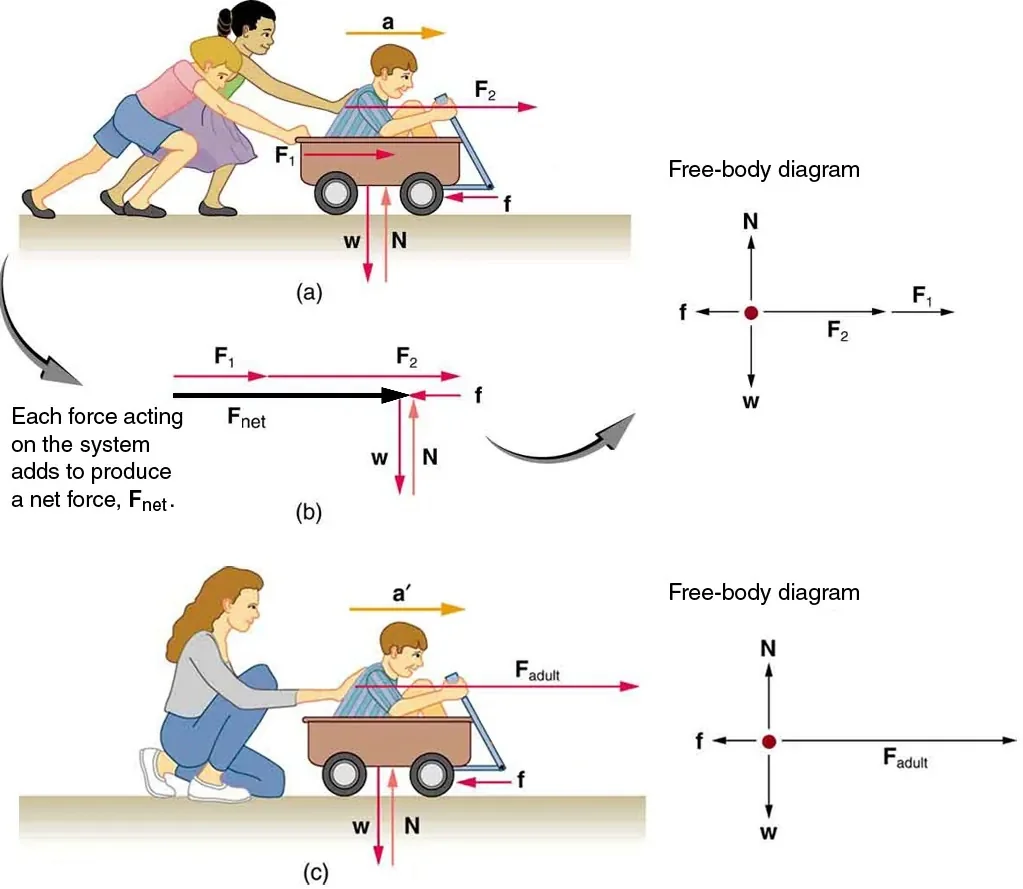
When the net force depends on time, the acceleration is a function of time, and the velocity and position must be found by calculus.
Acceleration is the derivative of velocity with respect to time, a = dv/dt, and velocity is the derivative of position, v = dx/dt.
Newton’s second law along one axis therefore becomes the differential equation
1
Here F(t) is the net force along the axis in newtons, and dv/dt is the rate of change of velocity in metres per second squared.
2
To solve it, separate the variables or integrate both sides.
3
Integrating from the initial time t = 0 to a later time t gives
1
The integral of force with respect to time is the impulse, measured in newton-seconds (N·s), and it equals the change in momentum, m Δv.
2
The constant of integration is fixed by the initial velocity, so an initial condition must always be stated.
3
The position is found by integrating the velocity again, x(t) = x0 + ∫0t v(t′) dt′, with x0 in metres.
1
Graphs give these results directly.
2
The area under a graph of net force against time is the change in momentum.
3
The slope of a graph of velocity against time is the acceleration, and the area under the velocity–time graph is the displacement.
4
A net force that is zero at a moment, with the force changing sign, marks a maximum or minimum of the velocity.
1
For each object, Newton’s second law is applied separately, with the tension included as a force.
2
The equations are solved simultaneously.
3
For an Atwood machine, with masses m1 and m2 where m2 is larger, the acceleration magnitude and the tension are, a = ((m2 − m1)/(m1 + m2)) g, and T = (2m1m2/(m1 + m2)) g, Here a is the acceleration in m/s2, T is the tension in newtons, and g is the gravitational field strength, 9.8 N/kg near the Earth’s surface.
4
The tension is not equal to the weight of either mass when the system accelerates.
Example 1
Object with a time-dependent net force
1
The acceleration is a = F/m = (12 − 4t)/3.0 = 4.0 − (4/3)t m/s2.
2
Integrate with v(0) = 0: v(t) = ∫0t (4.0 − (4/3)t′) dt′ = 4.0t − (2/3)t2
3
At t = 3.0 s, v = 12 − 6.0 = 6.0 m/s
4
Integrate again with x(0) = 0: x(t) = 2.0t2 − (2/9)t3, so x(3.0 s) = 18 − 6.0 = 12 m
Answer
At 3.0 s the velocity is 6.0 m/s and the position is 12 m. The acceleration is zero at t = 3.0 s, so the velocity is at its maximum at that instant
Example 2
Atwood machine
1
Apply Newton’s second law to each mass, with the heavier mass moving downward.
2
For the 6.0 kg mass, m2g − T = m2a.
3
For the 4.0 kg mass, which moves upward with the same acceleration, T − m1g = m1a.
4
Adding the two equations eliminates the tension (m2 − m1)g = (m1 + m2)a.
5
So a = (2.0 kg)(9.8 m/s2)/(10.0 kg) = 1.96 m/s2.
6
Substituting back, T = m1(g + a) = (4.0 kg)(11.76 m/s2) = 47 N.
Answer
The acceleration is 2.0 m/s2 (1.96 m/s2) and the tension is 47 N, which is less than the 59 N weight of the 6.0 kg mass.
Example 3
Impulse from a force that rises linearly
1
The impulse is the integral of the force over time: ∫00.040 (1.0 × 10⁴)t dt = (1.0 × 10⁴)[t2/2]00.040 = (1.0 × 10⁴)(8.0 × 10⁻⁴) = 8.0 N·s.
2
The change in momentum is equal to this impulse, so Δv = 8.0 N·s/0.20 kg = 40 m/s.
3
The impulse is 8.0 N·s and the ball leaves with a velocity of 40 m/s.
4
The force reached 400 N at the end of the interval, but the impulse is found from the area under the force–time curve, not from the peak force
Assuming that the acceleration points in the direction of the velocity
It points in the direction of the net force.
Using the weight of a mass as the tension in an Atwood machine
When the system accelerates, the tension differs from both weights.
Forgetting the constant of integration
Each integration must use the initial velocity or position.
Confusing dv/dt with dx/dt
Acceleration is the derivative of velocity, and velocity is the derivative of position.
Reading the peak of a force–time graph as the impulse
The impulse is the area under the graph.
Avoid
Including internal forces in the net external force that changes a system’s center-of-mass velocity