Curriculum
AP Physics C: Mechanics
1. Kinematics
0/11
2. Force and Translational Dynamics
0/21
3. Work, Energy, and Power
0/11
4. Linear Momentum
0/9
5. Torque and Rotational Dynamics
0/13
6. Energy and Momentum of Rotating Systems
0/13
7. Oscillations
0/11
-
7. Oscillations
 Preview
-
7.1 Defining Simple Harmonic Motion (SHM)
Preview
-
7.1 Defining Simple Harmonic Motion (SHM) - Check yourself
 Preview
-
7.2 Frequency and Period of SHM
Preview
-
7.2 Frequency and Period of SHM - Check yourself
Preview
-
7.3 Representing and Analyzing SHM
Preview
-
7.3 Representing and Analyzing SHM - Check yourself
Preview
-
7.4 Energy of Simple Harmonic Oscillators
Preview
-
7.4 Energy of Simple Harmonic Oscillators - Check yourself
Preview
-
7.5 Simple and Physical Pendulums
Preview
-
7.5 Simple and Physical Pendulums - Check yourself
Preview
Text lesson
7. Oscillations
Unit 7 Oscillations — AP PHYSICS C: MECHANICS notes: You will be able to connect the five topics of Unit 7 by identifying simple harmonic motion from its restoring force, writing and analysing its displacement, velocity and acceleration as functions of time, relating its period to the properties of springs and pendulums, and applying conservation of energy to oscillators.
Unit 7 at a glance
Unit 7 at a glance
Oscillations are the repeated motion of an object about an equilibrium position.
Unit 7 studies one important class of oscillation, simple harmonic motion (SHM), in which the restoring force is proportional to the displacement from equilibrium and opposite to it.
The unit defines SHM (topic 7.1), describes its period and frequency (topic 7.2), represents its motion with functions of time (topic 7.3), analyses its energy (topic 7.4),
and applies the same ideas to physical and simple pendulums (topic 7.5).
The condition for SHM and its equation of motion
1
An object is in SHM when the restoring force is proportional to its displacement from equilibrium, Fx = −kx (topic 7.1).
2
Newton’s second law then gives the second-order differential equation d2x/dt2 = −ω2x, with ω2 = k/m for a spring (topic 7.3).
3
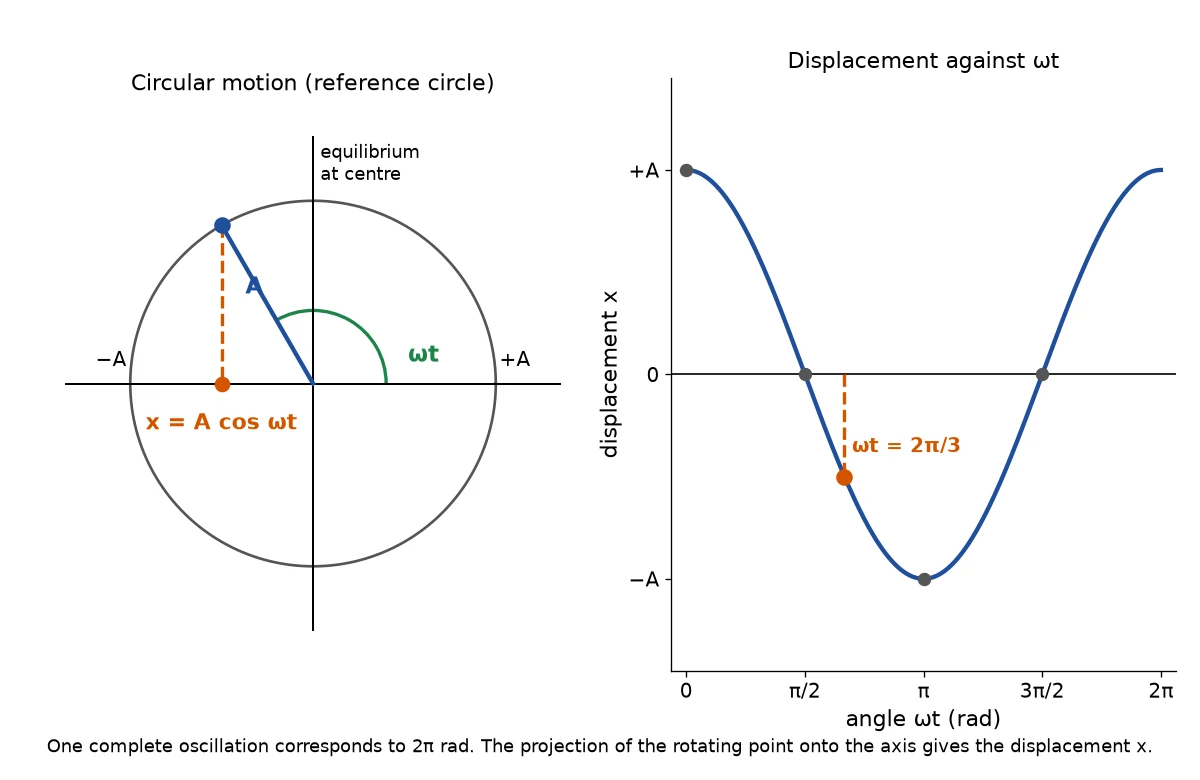
Its solution, x(t) = A cos(ωt + φ), describes the motion.
4
The same equation governs a small-angle pendulum and a torsion pendulum, with different meanings for ω (topic 7.5).
5
Recognising the equation is therefore the key to identifying SHM in any system.
1Period, frequency and the physical quantities that set them2Period, frequency and the physical quantities that set them
Period, frequency and the physical quantities that set them
Period, frequency and the physical quantities that set them
The period T is related to the angular frequency by T = 2π/ω, and the frequency is f = 1/T (topic 7.2).
The period of a mass on an ideal spring depends only on the mass and the force constant,
while the period of a simple pendulum at small angles depends only on its length and g (topic 7.2).
The amplitude does not change the period of either system (topic 7.3).
These results allow predictions of how the period changes when one quantity is altered.
1 / 2Next ▶
Reference circle showing a rotating point projected onto the displacement axis, beside a plot of displacement against angle ωt as a cosine curve
Period, frequency and the physical quantities that set them
◀ Previous2 / 2
1Displacement, velocity, acceleration and resonance2Displacement, velocity, acceleration and resonance
Displacement, velocity, acceleration and resonance
1
Velocity is the derivative of position with respect to time, and acceleration is the derivative of velocity
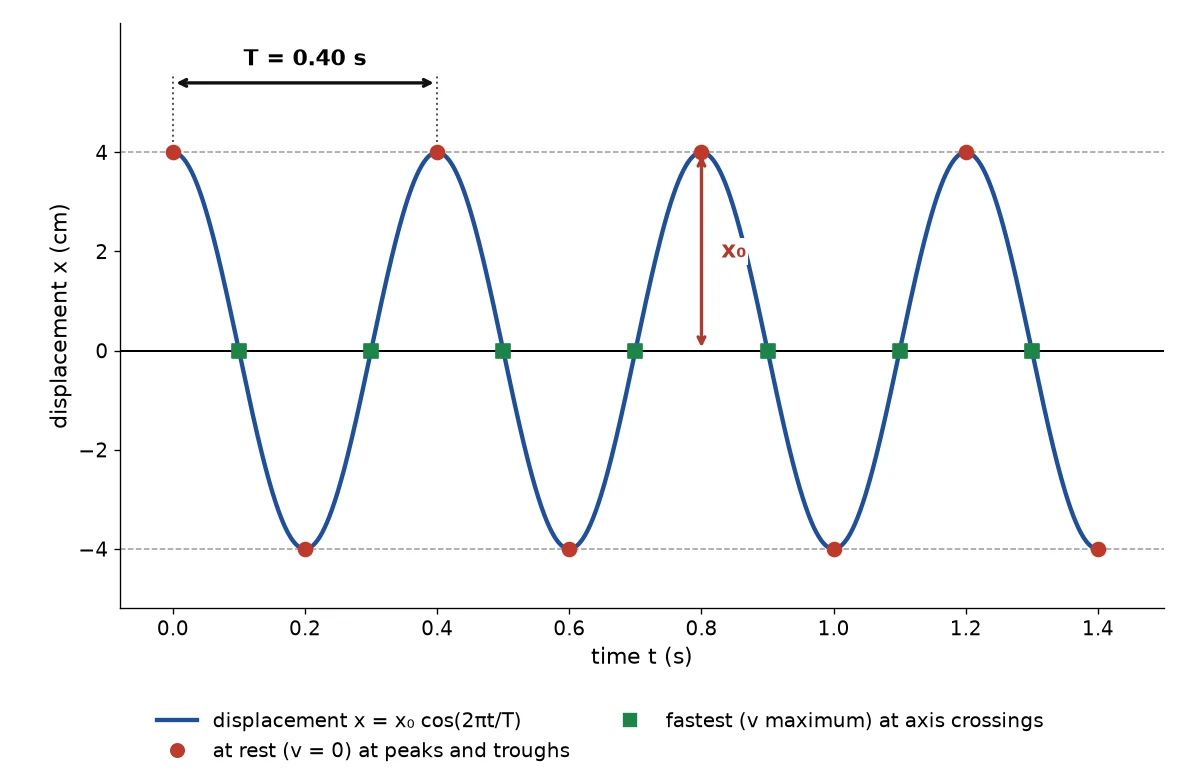
so v = −Aω sin(ωt + φ) and a = −ω2x (topic 7.3).
2
The maximum speed is Aω, reached at equilibrium, and the maximum magnitude of acceleration is Aω2, reached at the turning points.
3
The velocity leads the displacement by a quarter of a cycle.
4
A sinusoidal driving force at the natural frequency produces resonance, in which the amplitude increases (topic 7.3).
1 / 2Next ▶
Displacement-time graph of a sinusoidal oscillation with amplitude x₀ and period T = 0.40 s, marking rest points at peaks and fastest points at axis crossings
Displacement, velocity, acceleration and resonance
◀ Previous2 / 2
Energy in oscillating systems
Energy in oscillating systems
The total mechanical energy of a spring-object system is the sum of its kinetic and potential energies, E = K + U (topic 7.4).
Without friction it is constant, and it equals ½kA2.
The kinetic energy is greatest at equilibrium,
where the potential energy is zero,and the potential energy is greatest at the turning points,where the kinetic energy is zero.
The total energy depends on the square of the amplitude,
so doubling the amplitude multiplies the energy by four while leaving the period unchanged (topic 7.4).
Pendulums as oscillators
1
A physical pendulum is a rigid body oscillating about a fixed axis.
2
Its restoring torque is −mgd sin θ
which becomes SHM at small amplitudegiving T = 2π√(I/(mgd)) (topic 7.5).
3
A simple pendulum is the special case of a point mass at distance L, with T = 2π√(L/g),
and a torsion pendulum has restoring torque −κθ and period T = 2π√(I/κ) (topic 7.5).
4
The same mathematical structure links all these systems
which is why one set of tools describes them all.
Key equations of Unit 7
| Equation | Symbols and SI units | Topic |
|---|---|---|
| Fx = −kx | k force constant (N/m); x displacement (m) | 7.1 |
| T = 2π/ω; f = 1/T; ω = 2πf | T period (s); f frequency (Hz); ω angular frequency (rad/s) | 7.2 |
| T = 2π√(m/k) | Ideal spring: m mass (kg); k force constant (N/m); T (s) | 7.2 |
| T = 2π√(L/g) | Simple pendulum at small angles: L length (m); g = 9.8 m/s2; T (s) | 7.2, 7.5 |
| d2x/dt2 = −ω2x; ω2 = k/m | Equation of motion for SHM; ω (rad/s); x (m) | 7.3 |
| x(t) = A cos(ωt + φ) | A amplitude (m); φ phase constant (rad); t time (s) | 7.3 |
| v = dx/dt = −Aω sin(ωt + φ); a = dv/dt = −ω2x | v velocity (m/s); a acceleration (m/s2) | 7.3 |
| vmax = Aω; amax = Aω2 | Maximum speed (m/s) and maximum acceleration magnitude (m/s2) | 7.3 |
| v2 = ω2(A2 − x2) | Speed at displacement x (m); speed in m/s | 7.3, 7.4 |
| Etotal = K + U; K = ½mv2; U = ½kx2 | Energies in joules (J); m (kg); v (m/s); x (m) | 7.4 |
| Etotal = ½kA2 | Total energy of a spring-object system (J); A amplitude (m) | 7.4 |
| I d2θ/dt2 = −mgd sin θ ≈ −mgdθ; T = 2π√(I/(mgd)) | Physical pendulum: I moment of inertia about the pivot (kg·m2); m (kg); d pivot to centre of mass (m); θ (rad) | 7.5 |
| τ = −κθ; T = 2π√(I/κ) | Torsion pendulum: κ torsion constant (N·m/rad); I (kg·m2); θ (rad) | 7.5 |
How the topics connect
How the topics connect
Topic 7.1 supplies the condition for SHM, and topic 7.2 uses the resulting equation to find the period.
Topic 7.3 solves the equation of motion and describes the motion in terms of time,
and topic 7.4 uses the same solution to describe the energy and the speed at any displacement.
Topic 7.5 applies the framework to pendulums
where the restoring torque replaces the restoring force and the moment of inertia replaces the mass.
A useful check on any Unit 7 problem is to ask whether the restoring force is proportional to displacement, whether the period depends on amplitude,
and whether the energy is conserved.
Key terms
| Term | Meaning |
|---|---|
| Simple harmonic motion | Periodic motion in which the restoring force is proportional to the displacement from equilibrium and opposite to it. |
| Restoring force | A force that acts opposite to the displacement from equilibrium and tends to return the object to equilibrium. |
| Amplitude | The maximum displacement of an object in SHM from its equilibrium position. |
| Angular frequency | The rate of change of phase of an oscillation, equal to 2π divided by the period, in radians per second. |
| Natural frequency | The frequency at which a system oscillates when displaced from equilibrium and released. |
| Resonance | The large increase in amplitude that occurs when a sinusoidal external force acts at the natural frequency. |
| Physical pendulum | A rigid body that oscillates about a fixed axis under gravity. |
| Torsion pendulum | A rotating system whose restoring torque is proportional to its angular displacement. |
1Avoid these mistakes2Avoid these mistakes3Avoid these mistakes