Curriculum
AP Physics C: Mechanics
1. Kinematics
0/11
2. Force and Translational Dynamics
0/21
3. Work, Energy, and Power
0/11
-
3. Work, Energy, and Power
 Preview
-
3.1 Translational Kinetic Energy
Preview
-
3.1 Translational Kinetic Energy - Check yourself
 Preview
-
3.2 Work
Preview
-
3.2 Work - Check yourself
Preview
-
3.3 Potential Energy
Preview
-
3.3 Potential Energy - Check yourself
Preview
-
3.4 Conservation of Energy
Preview
-
3.4 Conservation of Energy - Check yourself
Preview
-
3.5 Power
Preview
-
3.5 Power - Check yourself
Preview
4. Linear Momentum
0/9
5. Torque and Rotational Dynamics
0/13
6. Energy and Momentum of Rotating Systems
0/13
7. Oscillations
0/11
Text lesson
3.3 Potential Energy
3.3 Potential Energy — AP PHYSICS C: MECHANICS notes: You will be able to describe the potential energy of a system, relate conservative forces to the gradient of potential energy, use the spring and gravitational potential energy equations, and locate stable and unstable equilibria from a graph of potential energy.
1
Potential energy is a property of the system, not of a single object, and it depends on the position or configuration of the objects within the system.
2
It is a scalar quantity, measured in joules.
3
The zero of potential energy is a choice made by the observer.
4
Only changes in potential energy have physical meaning, so the observer may set the potential energy to zero at any convenient configuration, such as the floor or the natural length of a spring.
5
The choice does not change the forces or the motion, only the numerical value of the energy.
6
When a system contains more than two objects, its total potential energy is the sum of the potential energies of each pair of objects within the system.
For a conservative force acting along one dimension, the work done by the force equals the negative of the change in potential energy: Wc = −ΔU.
Taking the limit of small displacements gives the force as the negative derivative of the potential energy with respect to position: Fx = −dU(x)/dx.
Here Fx is the force in newtons (N), U is the potential energy in joules (J), and x is the position in metres (m).
The force is therefore the slope of the potential energy graph, with a minus sign.
The conservative force points in the direction of decreasing potential energy.
Where the graph of U against x is steep, the force is large; where the graph is flat, the force is zero.
Conversely, the potential energy at a point can be found by integrating the force, U(x) = −∫Fx dx, up to a chosen zero.
1
A graph of the potential energy of a system against position is a useful way to describe its motion.
2
A location of equilibrium is one where the force on the object is zero, which means that the slope dU/dx is zero.
3
A stable equilibrium is a location at which a small displacement of an object results in a force opposite to the displacement, which accelerates the object back toward the equilibrium position.
4
In a given dimension, stable equilibria occur at local minima of the potential energy.
5
An unstable equilibrium is a location at which a small displacement results in a force in the same direction as the displacement, which accelerates the object away from the equilibrium.
6
Unstable equilibria occur at local maxima of the potential energy.
7
The second derivative tells the same story in calculus form at a stable equilibrium d2U/dx2 > 0, and at an unstable equilibrium d2U/dx2 < 0. A point where the potential energy is constant over an interval is a neutral equilibrium.
1
Here k is the spring constant in newtons per metre (N/m), and Δx is the distance the spring is stretched or compressed from its equilibrium length, in metres.
2
The spring force is Fx = −kΔx, and this agrees with the derivative: −dUs/dx = −kΔx.
3
The general gravitational potential energy of two approximately spherical masses m1 and m2 whose centres are a distance r apart is Ug = −Gm1m2/r.
4
Here G = 6.67 × 10⁻¹¹ N·m2/kg2 and r is measured from the centre of each mass.
5
The potential energy is zero when the masses are infinitely far apart, and it is negative for any finite separation.
6
Near the surface of a planet, the gravitational field is nearly constant, with magnitude g = 9.8 N/kg.
7
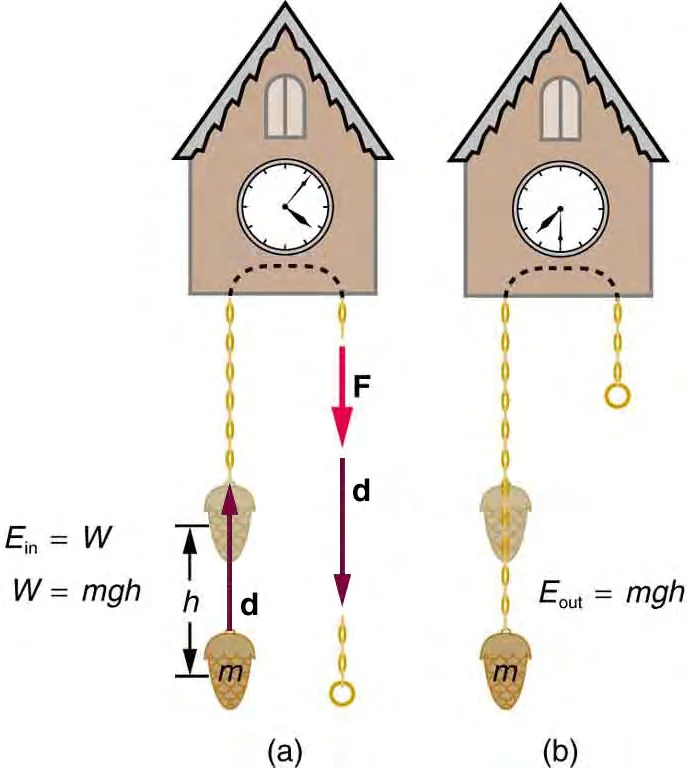
The change in gravitational potential energy of an object of mass m that moves a height Δh is ΔUg = mgΔh, where Δh is positive when the object moves upward.
8
This form is the limit of the general equation for small changes in height.
Example 1
Elastic potential energy of a spring
1
Us = ½k(Δx)2 = ½(200 N/m)(0.15 m)2 = ½(200)(0.0225) J = 2.25 J.
2
The spring force has magnitude kΔx = (200 N/m)(0.15 m) = 30 N, directed back toward the equilibrium length.
Answer
The stored energy is 2.3 J (2.25 J), and the spring pulls back with a force of 30 N.
Example 2
Equilibrium from a potential energy function
1
The force is Fx = −dU/dx = −(4.0x − 8.0) = (8.0 − 4.0x) N.
2
Equilibrium occurs where the force is zero 8.0 − 4.0x = 0, so x = 2.0 m.
3
The second derivative is d2U/dx2 = 4.0 J/m2, which is positive, so the point is a local minimum of U.
4
The potential energy there is U(2.0 m) = 2.0(4.0) − 8.0(2.0) = −8.0 J.
Answer
Fx = (8.0 − 4.0x) N. The equilibrium is at x = 2.0 m, where U = −8.0 J, and it is stable because the potential energy has a minimum there.
Example 3
Change in gravitational potential energy near Earth
1
ΔUg = mgΔh = (5.0 kg)(9.8 N/kg)(3.0 m) = 147 J.
Answer
The change is +1.5 × 10² J, so the potential energy of the object–Earth system increases by 147 J.
Example 4
Gravitational potential energy of a satellite
1
Ug = −Gm1m2/r = −(6.67 × 10⁻¹¹)(1000)(5.97 × 1024)/(7.0 × 106) J = −5.7 × 10¹⁰ J.
Answer
−5.7 × 10¹⁰ J. The negative sign shows that the system is bound, and the energy is zero only at infinite separation.
Reading the force from the height of the potential energy graph instead of its slope
The force is −dU/dx, so a high point with a flat slope has zero force.
Giving the force the same direction as the slope
The conservative force points toward decreasing potential energy, so the minus sign is essential.
Assuming that a potential energy is zero at the position where the force is zero
Equilibrium is set by the slope, not by the value of U.
Calling a local maximum of potential energy a stable equilibrium
A local minimum is stable; a local maximum is unstable.
Using Δx as the length of the stretched spring
In Us = ½k(Δx)2, Δx is the stretch or compression measured from the equilibrium length.
Avoid
Dropping the minus sign in the gravitational potential energy Ug = −Gm1m2/r, whereas the correct value is negative at every finite separation