Curriculum
AP Physics C: Mechanics
1. Kinematics
0/11
2. Force and Translational Dynamics
0/21
3. Work, Energy, and Power
0/11
-
3. Work, Energy, and Power
 Preview
-
3.1 Translational Kinetic Energy
Preview
-
3.1 Translational Kinetic Energy - Check yourself
 Preview
-
3.2 Work
Preview
-
3.2 Work - Check yourself
Preview
-
3.3 Potential Energy
Preview
-
3.3 Potential Energy - Check yourself
Preview
-
3.4 Conservation of Energy
Preview
-
3.4 Conservation of Energy - Check yourself
Preview
-
3.5 Power
Preview
-
3.5 Power - Check yourself
Preview
4. Linear Momentum
0/9
5. Torque and Rotational Dynamics
0/13
6. Energy and Momentum of Rotating Systems
0/13
7. Oscillations
0/11
Text lesson
3.5 Power
3.5 Power — AP PHYSICS C: MECHANICS notes: You will be able to describe the transfer or conversion of energy in terms of power, calculate average and instantaneous power from work and from force and velocity, and use calculus to relate power, work and energy when the power changes with time.
1Power as the rate of energy transfer2Power as the rate of energy transfer3Power as the rate of energy transfer4Power as the rate of energy transfer
Power as the rate of energy transfer
Power as the rate of energy transfer
Power is the rate at which energy changes with respect to time. The change may be a transfer of energy into or out of a system, or a conversion of energy from one type to another within a system. Power is a scalar quantity measured in watts (W)
where 1 W = 1 J/s.
Average power is the amount of energy transferred or converted, divided by the time it took for that transfer or conversion: Pavg = ΔE/Δt.
1 / 4Next ▶
Power as the rate of energy transfer
1
Here Δ
2
E
3
is the energy transferred in joules and Δ
4
t
5
is the time interval in seconds.
6
Because work is the energy transferred by a force, the average power is the total work done divided by the time during which that work was done:
◀ Previous2 / 4Next ▶
Power as the rate of energy transfer
Power as the rate of energy transfer
P
avg
=
W
/Δ
.
◀ Previous3 / 4Next ▶
What is power?: A rocket on the Space Shuttle lifting off, doing work and using energy at a very high rate.
Power as the rate of energy transfer
 ⤢ Enlarge
Power as the rate of energy transfer
A machine that does 3000 J of work in 10 s has an average power of 300 W. A second machine that does the same work in 5 s has an average power of 600 W
so it transfers energy twice as fast.
◀ Previous4 / 4
1Instantaneous power and the derivative of work2Instantaneous power and the derivative of work3Instantaneous power and the derivative of work4Instantaneous power and the derivative of work5Instantaneous power and the derivative of work6Instantaneous power and the derivative of work
1Power and the change in kinetic energy2Power and the change in kinetic energy
1Example 1: Average power of a car accelerating from rest · E2Example 3: Power and work from a time-dependent velocity3Example 3: Power and work from a time-dependent velocity4Example 3: Power and work from a time-dependent velocity5Example 3: Power and work from a time-dependent velocity6Example 3: Power and work from a time-dependent velocity7Example 3: Power and work from a time-dependent velocity
Example 1: Average power of a car accelerating from rest · Example 2: Instantaneous power of an engine
Example 1: Average power of a car accelerating from rest
A car of mass 1200 kg accelerates from rest to a speed of 20 m/s in 8.0 s. Assume the car’s kinetic energy is the only energy that changes. Find the average power delivered to the car.
Working: The energy transferred is ΔK = ½mv2 − 0 = ½(1200 kg)(20 m/s)2 = 2.4 × 10⁵ J. The average power is Pavg = ΔK/Δt = (2.4 × 10⁵ J)/(8.0 s) = 3.0 × 10⁴ W.
Answer: 3.0 × 10⁴ W (30 kW).
Example 2: Instantaneous power of an engine
The engine of a car pushes the car forward with a constant force of 3000 N along the direction of motion. At the instant the car has a velocity of 25 m/s, find the instantaneous power delivered by the engine’s force. Then find the work done by the force in 4.0 s if the speed stays at 25 m/s.
Working: The force and velocity are parallel
so P = Fv cos 0° = (3000 N)(25 m/s) = 7.5 × 10⁴ W. If the speed stays constant, the power is constantso W = PΔt = (7.5 × 10⁴ W)(4.0 s) = 3.0 × 10⁵ J.
Answer: The instantaneous power is 7.5 × 10⁴ W (75 kW). The work done in 4.0 s is 3.0 × 10⁵ J.
1 / 7Next ▶
Example 3: Power and work from a time-dependent velocity
1
A particle of mass 2.0 kg moves along a straight line with velocity v(t) = 3.0t m/s
where t is in seconds. Find the instantaneous power delivered by the net force as a function of time, the work done from t = 0 to t = 2.0 s, and the average power over that interval.
2
Working: The acceleration is a = dv/dt = 3.0 m/s2
so the net force is F = ma = 6.0 N, constant and in the direction of motion.
3
1
4
The power is
5
P
6
(
◀ Previous2 / 7Next ▶
Example 3: Power and work from a time-dependent velocity
Example 3: Power and work from a time-dependent velocity
t
) =
Fv
= (6.0 N)(3.0
m/s) = 18
W.
◀ Previous3 / 7Next ▶
Example 3: Power and work from a time-dependent velocity
Example 3: Power and work from a time-dependent velocity
2
The work is
W
= ∫
0
2.0
◀ Previous4 / 7Next ▶
Example 3: Power and work from a time-dependent velocity
1
18
2
d
3
= [9.0
4
]
5
= 36 J.
6
3
◀ Previous5 / 7Next ▶
Example 3: Power and work from a time-dependent velocity
1
As a check, the kinetic energy changes from 0 to ½(2.0)(6.0)
2
4
3
The average power is
4
/Δ
5
= 36 J/2.0 s = 18 W
which equals the power at the midpoint,
6
(1.0 s) = 18 W.
◀ Previous6 / 7Next ▶
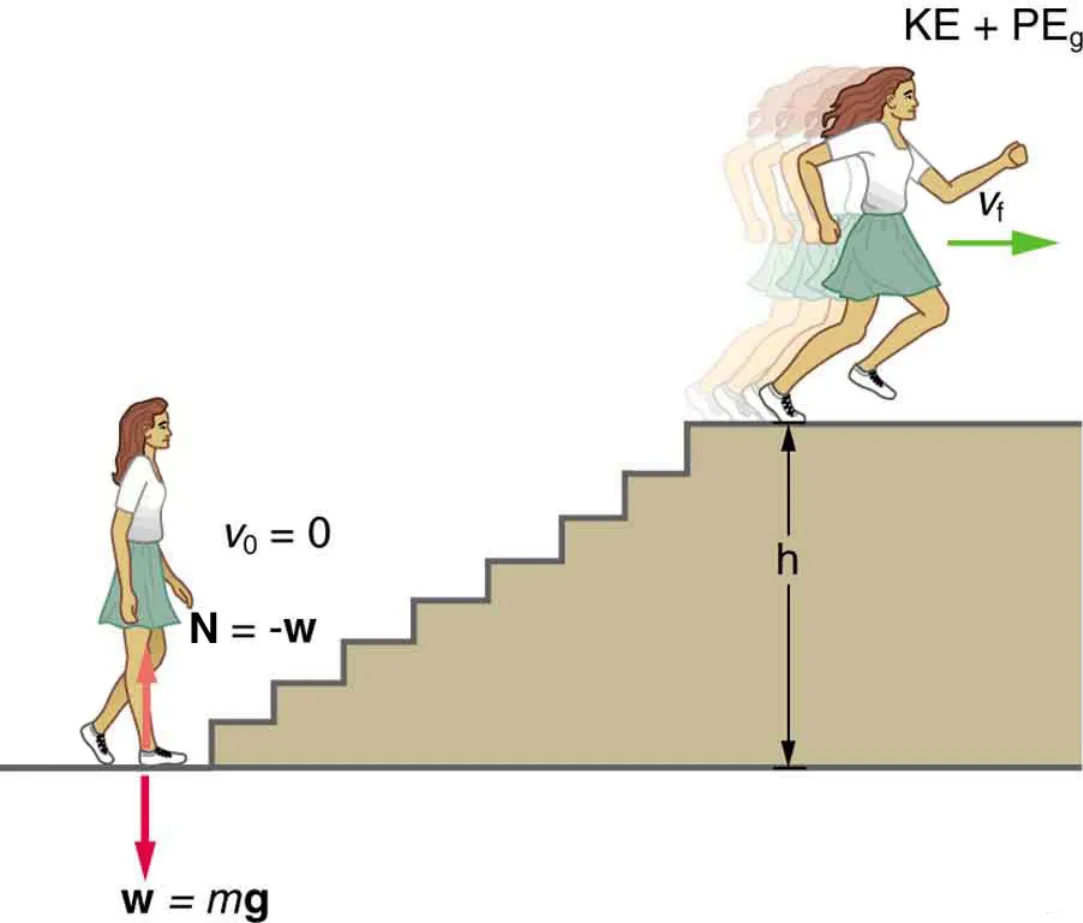
Worked examples: A woman running up a flight of stairs from rest, converting chemical energy from food into kinetic and gravitational potential energy.
Example 3: Power and work from a time-dependent velocity
 ⤢ Enlarge
Example 3: Power and work from a time-dependent velocity
Answer: P(t) = 18t W
the work done is 36 Jthe average power is 18 W.
◀ Previous7 / 7
Key terms
| Term | Meaning |
|---|---|
| Power (P) | The rate at which energy is transferred or converted with respect to time, measured in watts. |
| Watt (W) | The SI unit of power, equal to one joule per second. |
| Average power | The energy transferred or converted divided by the time taken, Pavg = ΔE/Δt. |
| Instantaneous power | The rate of energy transfer at a particular moment, given by P = dW/dt = F·v. |
| Component of force parallel to velocity (F∥) | The part of a force that lies along the direction of the velocity, and the only part that contributes to power. |
| Energy conversion | The change of energy from one type to another within a system, for example from chemical energy to kinetic energy. |
1Avoid these mistakes2Avoid these mistakes3Avoid these mistakes4Avoid these mistakes