Curriculum
AP Physics C: Mechanics
1. Kinematics
0/11
-
1. Kinematics
 Preview
-
1.1 Scalars and Vectors in One Dimension
Preview
-
1.1 Scalars and Vectors in One Dimension - Check yourself
 Preview
-
1.2 Displacement, Velocity, and Acceleration
Preview
-
1.2 Displacement, Velocity, and Acceleration - Check yourself
Preview
-
1.3 Representing Motion
Preview
-
1.3 Representing Motion - Check yourself
Preview
-
1.4 Reference Frames and Relative Motion
Preview
-
1.4 Reference Frames and Relative Motion - Check yourself
Preview
-
1.5 Motion in Two or Three Dimensions
Preview
-
1.5 Motion in Two or Three Dimensions - Check yourself
Preview
2. Force and Translational Dynamics
0/21
3. Work, Energy, and Power
0/11
4. Linear Momentum
0/9
5. Torque and Rotational Dynamics
0/13
6. Energy and Momentum of Rotating Systems
0/13
7. Oscillations
0/11
Text lesson
1.4 Reference Frames and Relative Motion
1.4 Reference Frames and Relative Motion — AP PHYSICS C: MECHANICS notes: You will be able to describe the reference frame of a given observer, and convert the motion of an object between observers in different inertial reference frames by adding or subtracting velocity vectors.
1
The observer chooses the frame, and the direction and magnitude of every measured quantity depend on that choice.
2
A passenger in a moving train and a person standing beside the track can both measure the same ball, and they will report different velocities for it, because each measures relative to a different frame.
3
Both reports are correct.
4
The choice of reference frame determines the direction and magnitude of the velocity, position and acceleration that an observer measures.
5
A ball dropped from rest by a passenger falls straight down in the passenger’s frame, but a person on the ground sees the same ball move forward as well as down, because the ball starts with the velocity of the train.
An inertial reference frame is a frame in which an object that is not subjected to a net force moves with constant velocity.
Two inertial frames move at a constant velocity relative to each other.
A frame attached to a car that is accelerating, or to a rotating platform, is not inertial.
Unless a problem states otherwise, its frame of reference may be assumed to be inertial.
Newton’s first law holds in every inertial frame, which is why the description of motion in such frames is consistent.
The acceleration of any object is the same as measured from all inertial reference frames.
Changing to a different inertial frame adds or subtracts a constant velocity, and a constant velocity does not change the rate at which velocity changes.
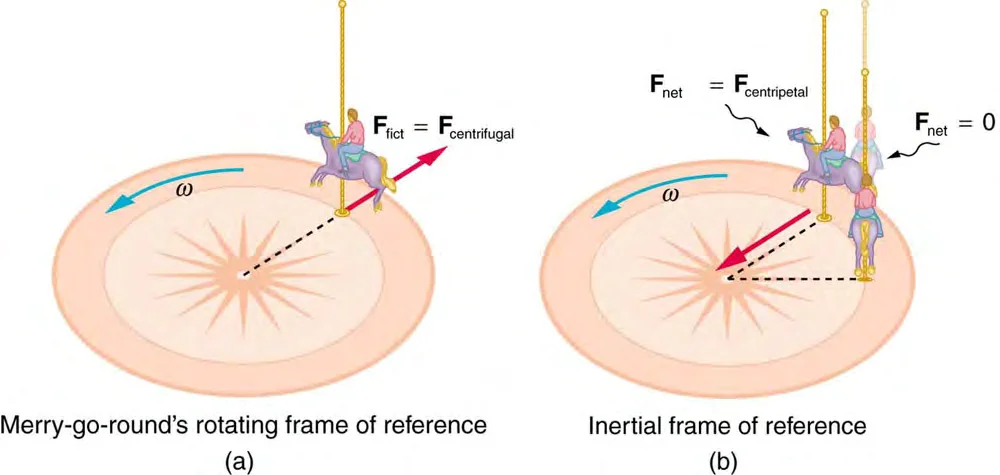
1
The observed velocity of an object results from combining the velocity of the object relative to a frame with the velocity of that frame relative to another frame.
2
If object A is observed from frame B, and frame B is observed from frame C, then the velocity of A as measured in C is given by vAC = vAB + vBC.
3
The subscripts are read as “A relative to B” and “B relative to C”, so the middle letters must match.
4
Combining the motions of an object and an observer therefore involves vector addition or subtraction, and every component must be added with its sign.
5
Rearranging the same relation gives vAB = vAC − vBC.
6
Measurements taken in one frame can be converted to another frame in the same way, by adding the velocity of the frame to the velocity measured within it.
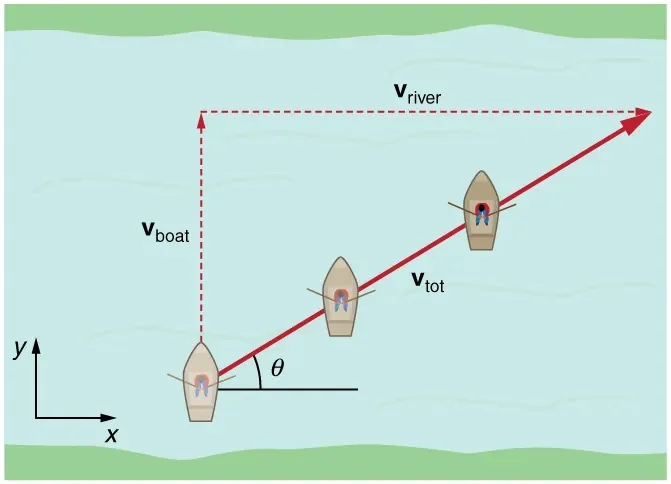
1
If rAC = rAB + rBC, then differentiating with respect to time gives vAC = vAB + vBC.
2
Differentiating once more gives aAC = aAB + aBC.
3
If frame B moves at a constant velocity relative to frame C, then aBC = dvBC/dt = 0, so aAC = aAB.
4
This is the calculus form of the statement that acceleration is the same in all inertial frames.
Example 1
Boat crossing a river
1
Let B be the boat, W the water and G the ground.
2
Then vBG = vBW + vWG = (4.0j) m/s + (3.0i) m/s = (3.0i + 4.0j) m/s.
3
The speed is √(3.02 + 4.02) m/s = 5.0 m/s.
4
The direction satisfies tan θ = 3.0/4.0, so θ = 37° measured east of north.
5
The boat moves at 5.0 m/s relative to the ground, 37° east of north.
6
The boat’s heading is north, but the river carries it east.
Example 2
Passenger on a moving train
1
Let P be the passenger, T the train and G the ground.
2
Then vPG = vPT + vTG.
3
With east positive, vPT = −2.0 m/s and vTG = +20 m/s, so vPG = +18 m/s, which is 18 m/s east.
4
A ball dropped from rest relative to the train has vBT = 0 at release, so vBG = 0 + 20 m/s = 20 m/s east, the velocity of the train.
5
The passenger moves at 18 m/s east relative to the ground.
6
The dropped ball has an initial velocity of 20 m/s east relative to the ground, and it moves in a curved path that the passenger sees as a vertical fall.
Example 3
Acceleration is the same in every inertial frame
1
Let A be car A, B car B and G the ground.
2
Then vAB = vAG − vBG.
3
Since vAG(t) = 10 + 2.0t (m/s, east positive) and vBG = 15 m/s, vAB = −5.0 + 2.0t (m/s).
4
At t = 0 this is −5.0 m/s, that is 5.0 m/s west.
5
At t = 3.0 s it is +1.0 m/s.
6
The acceleration relative to B is aAB = dvAB/dt = 2.0 m/s2, because the derivative of the constant 15 m/s is zero.
7
Relative to car B, car A has velocity 5.0 m/s west at t = 0 and 1.0 m/s east at t = 3.0 s.
8
Both observers measure the same acceleration, 2.0 m/s2 east.
Writing the subscripts of a relative velocity in the wrong order
vAB is the velocity of A relative to B, and vBA = −vAB.
Assuming that the ground is always the reference frame
Any frame can be chosen, and the ground is only one of them.
Adding the velocities of a boat and a river as magnitudes
They are vectors, so a boat heading north in a river flowing east moves at 5.0 m/s, not 7.0 m/s.
Subtracting the velocity of a frame when the object’s velocity should be added, or the reverse
Check the sign of each term against the direction of motion.
Believing that an observer in a frame moving at constant velocity measures a different acceleration
The acceleration is the same in all inertial frames.
Describing the path of a dropped object as a straight vertical line from every frame
The path depends on the observer; in the ground frame it is curved because the object starts with the horizontal velocity of its frame.