Curriculum
AP Physics C: Mechanics
1. Kinematics
0/11
2. Force and Translational Dynamics
0/21
3. Work, Energy, and Power
0/11
4. Linear Momentum
0/9
5. Torque and Rotational Dynamics
0/13
6. Energy and Momentum of Rotating Systems
0/13
7. Oscillations
0/11
-
7. Oscillations
 Preview
-
7.1 Defining Simple Harmonic Motion (SHM)
Preview
-
7.1 Defining Simple Harmonic Motion (SHM) - Check yourself
 Preview
-
7.2 Frequency and Period of SHM
Preview
-
7.2 Frequency and Period of SHM - Check yourself
Preview
-
7.3 Representing and Analyzing SHM
Preview
-
7.3 Representing and Analyzing SHM - Check yourself
Preview
-
7.4 Energy of Simple Harmonic Oscillators
Preview
-
7.4 Energy of Simple Harmonic Oscillators - Check yourself
Preview
-
7.5 Simple and Physical Pendulums
Preview
-
7.5 Simple and Physical Pendulums - Check yourself
Preview
Text lesson
7.3 Representing and Analyzing SHM
7.3 Representing and Analyzing SHM — AP PHYSICS C: MECHANICS notes: You will be able to write the displacement, velocity and acceleration of an object in SHM as functions of time, find their maxima and zeros, relate maximum speed and maximum acceleration to the angular frequency, and explain resonance in a driven oscillator.
1The equation of motion for SHM2The equation of motion for SHM3The equation of motion for SHM4The equation of motion for SHM5The equation of motion for SHM6The equation of motion for SHM
1Displacement, velocity and acceleration as functions of time2Displacement, velocity and acceleration as functions of time3Displacement, velocity and acceleration as functions of time4Displacement, velocity and acceleration as functions of time5Displacement, velocity and acceleration as functions of time6Displacement, velocity and acceleration as functions of time7Displacement, velocity and acceleration as functions of time8Displacement, velocity and acceleration as functions of time9Displacement, velocity and acceleration as functions of time10Displacement, velocity and acceleration as functions of time11Displacement, velocity and acceleration as functions of time
Displacement, velocity and acceleration as functions of time
Displacement, velocity and acceleration as functions of time
Differentiating the position with respect to time gives the velocity, vx = dx/dt = −Aω sin(ωt + φ), in metres per second (m/s).
1 / 11Next ▶
Displacement, velocity and acceleration as functions of time
1
Differentiating again gives the acceleration,
2
a
3
x
4
= d
5
v
6
/d
◀ Previous2 / 11Next ▶
Displacement, velocity and acceleration as functions of time
Displacement, velocity and acceleration as functions of time
t
= −
A
ω
2
cos(ω
◀ Previous3 / 11Next ▶
Displacement, velocity and acceleration as functions of time
Displacement, velocity and acceleration as functions of time
+ φ) = −ω
, in metres per second squared (m/s
).
The acceleration is always proportional to the displacement and opposite in direction, as found in topic 7.1.
The maximum speed and the maximum magnitude of acceleration are found from the amplitude.
Because the sine and cosine functions have maximum magnitude 1, the maximum speed is
◀ Previous4 / 11Next ▶
Displacement, velocity and acceleration as functions of time
1
max
2
=
3
ω and the maximum magnitude of acceleration is
4
.
5
The ratio
6
/
◀ Previous5 / 11Next ▶
Displacement, velocity and acceleration as functions of time
1
= ω
which shows that a large angular frequency means large accelerations for a given speed.
2
Position, velocity and acceleration reach their extreme values at different times.
3
1
4
The displacement has its maximum magnitude
5
where the velocity is zero, at the turning points.
6
The velocity has its maximum magnitude at the equilibrium position
where the displacement and the acceleration are both zero.
◀ Previous6 / 11Next ▶
Displacement, velocity and acceleration as functions of time
Displacement, velocity and acceleration as functions of time
3
The acceleration has its maximum magnitude at the turning points
where the displacement is largest.
4
These positions and times can be used to describe the motion qualitatively without writing equations.
Velocity and acceleration are not in phase with position.
For
◀ Previous7 / 11Next ▶
Displacement, velocity and acceleration as functions of time
1
cos ω
2
, the velocity is
3
ω sin ω
4
ω cos(ω
5
+ π/2),
6
so the velocity leads the displacement by a phase of π/2,
◀ Previous8 / 11Next ▶
Displacement, velocity and acceleration as functions of time
Displacement, velocity and acceleration as functions of time
which is a quarter of a cycle.
The acceleration is −ω
which is exactly opposite in phase to the displacement, differing by π.
The velocity can also be found without the time. Using the energy relation derived in topic 7.4, v2 = ω2(A2 − x2). This gives the speed at any displacement, and it confirms that the speed is zero at x = ±A and Aω at x = 0.
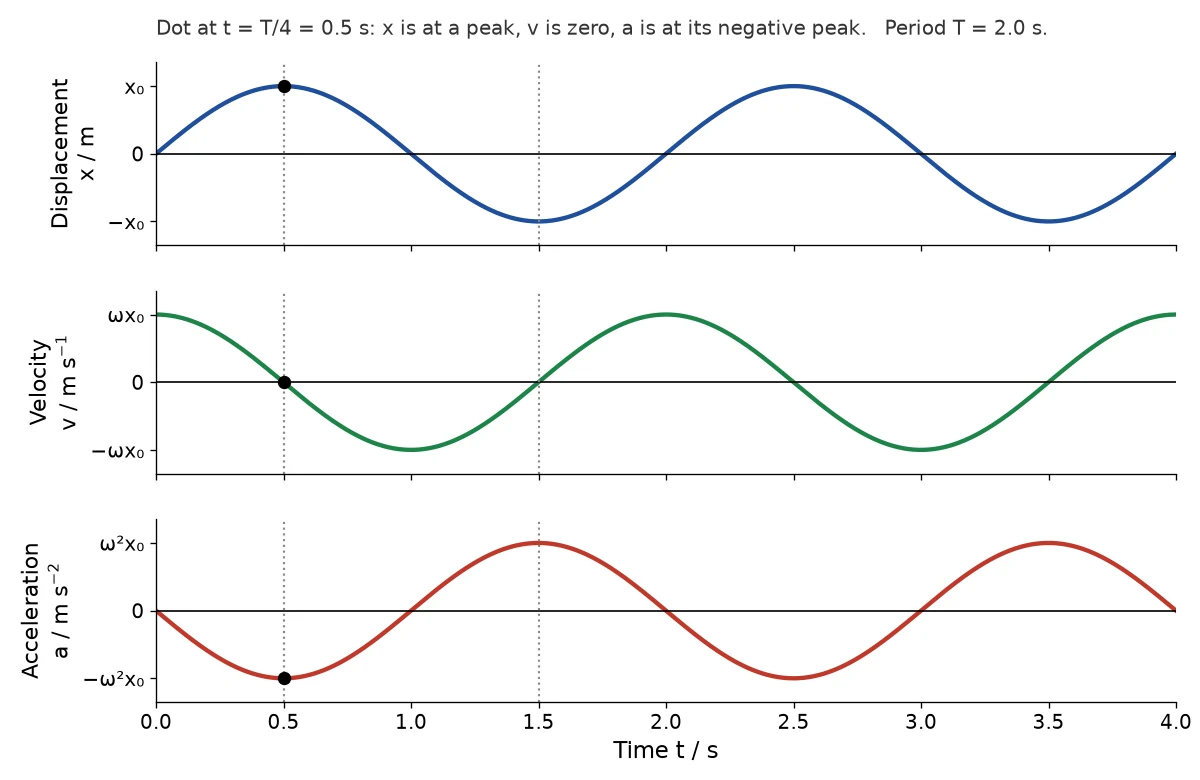
Properties of SHM can also be read from graphs of displacement, velocity and acceleration against time.
A displacement-time graph is a sinusoidal curve with amplitude
◀ Previous9 / 11Next ▶
Displacement, velocity and acceleration as functions of time
Displacement, velocity and acceleration as functions of time
and period
T
The slope of the displacement-time graph is the velocity,
so the velocity is zero where the displacement graph has a peak or trough,
and its greatest magnitude Aω occurs where the displacement graph crosses zero.
The acceleration-time graph has the same shape as the displacement-time graph, inverted and scaled by −ω
◀ Previous10 / 11Next ▶
Displacement, velocity and acceleration of SHM plotted against time as three stacked sine-type graphs with equal period
Displacement, velocity and acceleration as functions of time
 ⤢ Enlarge
1
,
2
so the two graphs cross zero together and have opposite signs.
3
Reading the slopes and extreme values from a graph gives the same information as the equations.
◀ Previous11 / 11
1Resonance and the period of SHM2Resonance and the period of SHM3Resonance and the period of SHM4Resonance and the period of SHM
Resonance and the period of SHM
1
A system that oscillates freely does so at its natural frequency
which is the frequency at which the system oscillates when it is displaced from equilibrium and released. The natural frequency depends only on the properties of the system, such as its mass and force constant for a spring.
2
In the presence of a sinusoidal external force, a system may exhibit resonance.
1 / 4Next ▶
Resonance and the period of SHM
Resonance and the period of SHM
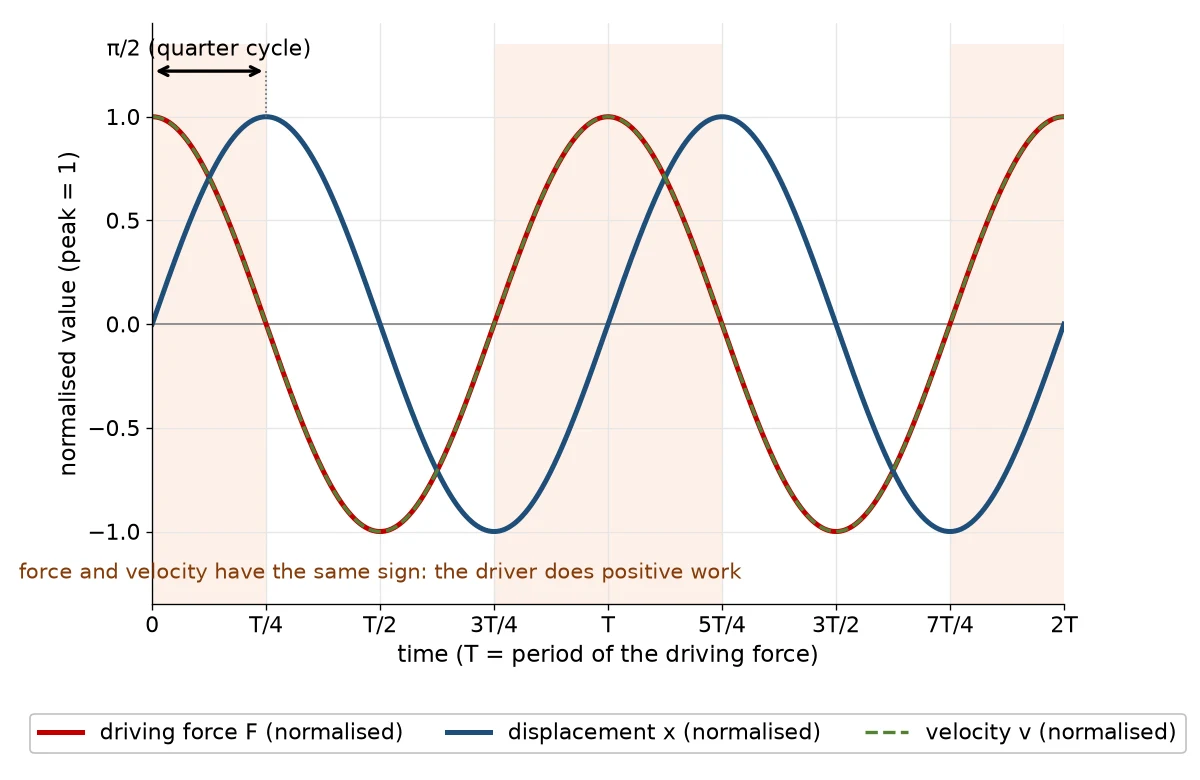
Resonance occurs when the external force is applied at the natural frequency of the system.
Each push then adds energy in phase with the motion, and the amplitude of oscillation increases.
Resonance is important in many applications,
such as the tuning of a radio, a child on a swing pushed at the right moment,
and the design of buildings and bridges,
which must avoid being driven at their natural frequencies.
◀ Previous2 / 4Next ▶
Resonance and the period of SHM
1
The period of SHM does not depend on the amplitude.
2
Changing the amplitude of an object in SHM changes its maximum speed and acceleration,
3
but it does not change the time for one cycle,
4
because the angular frequency depends only on k and m.
5
This is a key property of SHM that is used in the design of clocks and timing devices.
◀ Previous3 / 4Next ▶
Driving force, displacement and velocity against time over two periods, showing the force a quarter cycle ahead of the displacement at resonance
Resonance and the period of SHM
◀ Previous4 / 4
1Example 1: Writing and using the position function2Example 1: Writing and using the position function3Example 1: Writing and using the position function4Example 1: Writing and using the position function5Example 1: Writing and using the position function6Example 2: Time to reach equilibrium from a given release po7Worked examples8Worked examples9Example 3: Identifying ω from the differential equation10Example 3: Identifying ω from the differential equation11Example 3: Identifying ω from the differential equation12Example 3: Identifying ω from the differential equation
Key terms
| Term | Meaning |
|---|---|
| Amplitude | The maximum displacement of an object in SHM from its equilibrium position, measured in metres. |
| Phase constant | The angle φ in x(t) = A cos(ωt + φ), which fixes the position of the object at t = 0. |
| Second-order differential equation | An equation that contains the second derivative of a quantity; for SHM it is d2x/dt2 = −ω2x. |
| Maximum speed | The largest speed of an object in SHM, equal to Aω, reached at the equilibrium position. |
| Maximum acceleration | The largest magnitude of acceleration in SHM, equal to Aω2, reached at the turning points. |
| Natural frequency | The frequency at which a system oscillates when it is displaced from equilibrium and released. |
| Resonance | The large increase in amplitude that occurs when a sinusoidal external force is applied at the natural frequency of a system. |
| Phase | The argument of the trigonometric function describing an oscillation, ωt + φ, measured in radians. |
1Avoid these mistakes2Avoid these mistakes3Avoid these mistakes4Avoid these mistakes