Curriculum
AP Physics C: Mechanics
1. Kinematics
0/11
2. Force and Translational Dynamics
0/21
3. Work, Energy, and Power
0/11
4. Linear Momentum
0/9
5. Torque and Rotational Dynamics
0/13
6. Energy and Momentum of Rotating Systems
0/13
-
6. Energy and Momentum of Rotating Systems
 Preview
-
6.1 Rotational Kinetic Energy
Preview
-
6.1 Rotational Kinetic Energy - Check yourself
 Preview
-
6.2 Torque and Work
Preview
-
6.2 Torque and Work - Check yourself
Preview
-
6.3 Angular Momentum and Angular Impulse
Preview
-
6.3 Angular Momentum and Angular Impulse - Check yourself
Preview
-
6.4 Conservation of Angular Momentum
Preview
-
6.4 Conservation of Angular Momentum - Check yourself
Preview
-
6.5 Rolling
Preview
-
6.5 Rolling - Check yourself
Preview
-
6.6 Motion of Orbiting Satellites
Preview
-
6.6 Motion of Orbiting Satellites - Check yourself
Preview
7. Oscillations
0/11
Text lesson
6.5 Rolling
6.5 Rolling — AP PHYSICS C: MECHANICS notes: You will be able to describe the kinetic energy of a body that both translates and rotates, relate the motion of the centre of mass to the rotation while the body rolls without slipping, and explain how slipping changes the relationship and dissipates energy through kinetic friction.
Kinetic energy of translation plus rotation
Kinetic energy of translation plus rotation
A rolling body moves its centre of mass forward and rotates about that centre at the same time. Its total kinetic energy is the sum of the translational kinetic energy of the centre of mass and the rotational kinetic energy about the centre of mass: Ktot = Ktrans + Krot = ½Mvcm2 + ½Icmω2, as established in topic 6.1. For a body rolling without slipping, the two parts share the total energy in a fixed ratio, and that ratio is set by the shape of the body.
Writing Icm = kMR2
where k is a pure number that depends on the shape, the total kinetic energy is Ktot = ½Mvcm2(1 + k) once rolling without slipping is imposedbecause then ω = vcm/R. The values of k are k = ½ for a solid disk or cylinder, k = 2/5 for a solid sphere and k = 1 for a thin hoop.
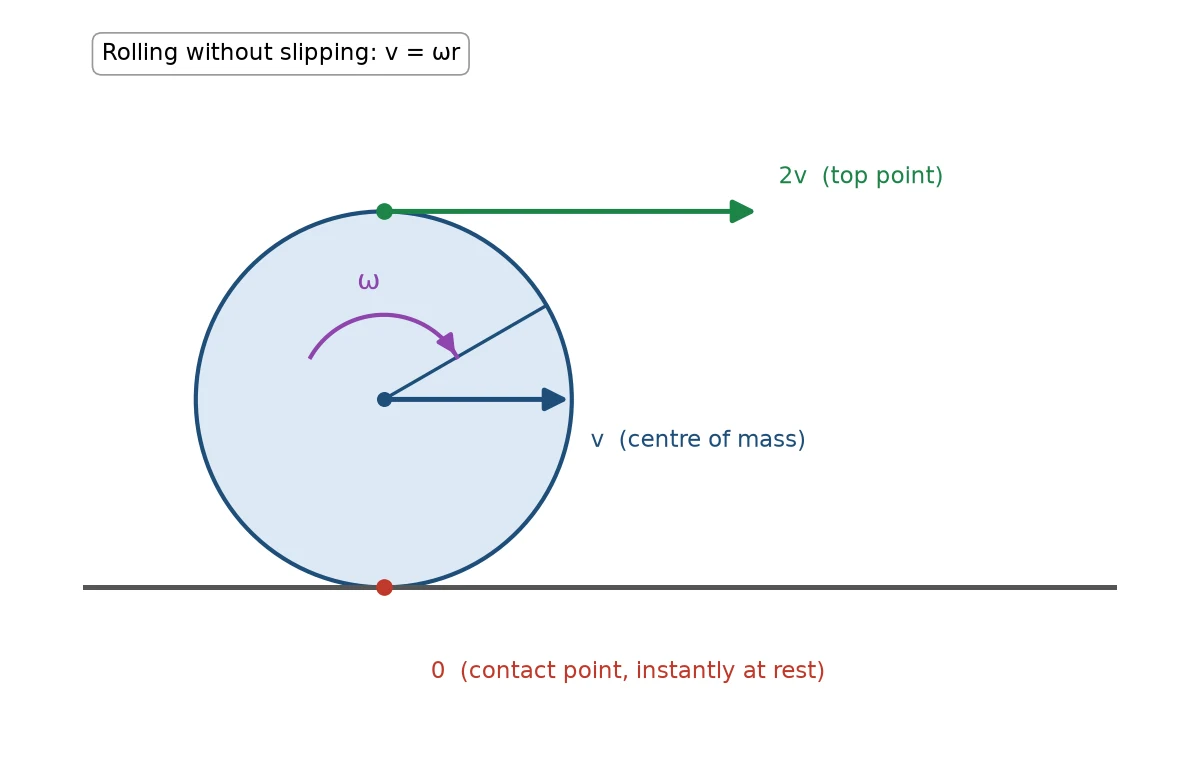
1Rolling without slipping2Rolling without slipping
Rolling without slipping
1
A body rolls without slipping when the point of its surface in contact with the ground has zero velocity relative to the ground at every instant.
2
For a body of radius R rotating at ω and moving with its centre at vcm, the contact point has velocity vcm − Rω relative to the ground,
so the rolling condition is vcm = Rω.
3
Differentiating gives acm = Rα
where α = dω/dt.
4
Because the contact point is at rest, the static friction force acting there does no work on the body in the ideal rolling case.
5
The energy of the rolling body is conserved, and the frictional force only changes how the energy is shared between translation and rotation.
6
This is why a rolling body with no other dissipation keeps the energy exchange described above and never loses mechanical energy to friction.
1 / 2Next ▶
Disc rolling to the right without slipping, with velocity arrows: centre v, top point 2v, contact point zero
Rolling without slipping
◀ Previous2 / 2
Energy and acceleration on an incline
Energy and acceleration on an incline
For a body of mass M and radius R that rolls down an incline at angle θ without slipping, energy conservation between the start and the bottom gives Mgh = ½Mvcm2(1 + k)
where h is the vertical drop of the centre of mass. This gives the speed at the bottom as vcm = √(2gh/(1 + k)).
The acceleration follows from Newton’s second law and the rotational equation.
With the static friction force f, Mg sin θ − f = Ma, and the torque about the centre is fR = Iα = Ia/R.
Eliminating f gives a = g sin θ/(1 + k).
A body with a smaller k, such as a solid disk, accelerates faster than a body with a larger k, such as a hoop, on the same incline.
This is the reason a solid cylinder beats a hoop in a race down a ramp, even though both have the same mass and radius.
Rolling while slipping
1
When a body slides as well as spins, the rolling relation vcm = Rω no longer holds, and the centre of mass and the rotation must be treated separately.
2
The contact point then has a nonzero velocity relative to the surface, and the force of kinetic friction acts at that moving point.
3
Because the point of application moves relative to the surface, kinetic friction does negative work and dissipates mechanical energy into thermal energy.
4
This is the reason a skidding ball slows down and loses energy until it rolls.
5
While slipping, the friction force gives the centre of mass an acceleration of magnitude μkg and produces a torque that changes the angular speed. The slipping stops when the two motions match and vcm = Rω. The energy dissipated equals the friction force times the distance the contact point slides over the surface.
6
Rolling friction
which describes the energy lost by a rolling body due to deformation of the surfaces, is beyond the scope of AP Physics C: Mechanics. Only the ideal case of rolling without slipping and the case of kinetic friction at a slipping contact are required.
1Example 1: Solid disk rolling down a ramp2Example 2: Sphere and hoop racing down the same ramp3Example 3: A sliding ball that begins to roll4Example 3: A sliding ball that begins to roll
Key terms
| Term | Meaning |
|---|---|
| Rolling without slipping | Motion in which the surface point in contact with the ground has zero velocity relative to the ground, so vcm = Rω. |
| Contact point | The point of a rolling body’s surface that touches the ground. |
| Static friction | The friction force at a contact point that does not slide; for ideal rolling it does no work. |
| Kinetic friction | The friction force at a sliding contact, which acts at a moving point and dissipates energy. |
| Slipping | Motion in which the centre of mass and the rotation are not related by vcm = Rω, and the contact point moves relative to the surface. |
| Translational kinetic energy | The kinetic energy of the centre of mass, ½Mvcm2. |
| Shape factor k | The ratio Icm/(MR2), which sets how a rolling body shares its energy between translation and rotation. |
| Coefficient of kinetic friction μk | The ratio of the kinetic friction force to the normal force between two sliding surfaces. |
1Avoid these mistakes2Avoid these mistakes3Avoid these mistakes4Avoid these mistakes5Avoid these mistakes6Avoid these mistakes