Curriculum
AP Physics C: Mechanics
1. Kinematics
0/11
2. Force and Translational Dynamics
0/21
3. Work, Energy, and Power
0/11
4. Linear Momentum
0/9
5. Torque and Rotational Dynamics
0/13
6. Energy and Momentum of Rotating Systems
0/13
7. Oscillations
0/11
-
7. Oscillations
 Preview
-
7.1 Defining Simple Harmonic Motion (SHM)
Preview
-
7.1 Defining Simple Harmonic Motion (SHM) - Check yourself
 Preview
-
7.2 Frequency and Period of SHM
Preview
-
7.2 Frequency and Period of SHM - Check yourself
Preview
-
7.3 Representing and Analyzing SHM
Preview
-
7.3 Representing and Analyzing SHM - Check yourself
Preview
-
7.4 Energy of Simple Harmonic Oscillators
Preview
-
7.4 Energy of Simple Harmonic Oscillators - Check yourself
Preview
-
7.5 Simple and Physical Pendulums
Preview
-
7.5 Simple and Physical Pendulums - Check yourself
Preview
Text lesson
7.5 Simple and Physical Pendulums
7.5 Simple and Physical Pendulums — AP PHYSICS C: MECHANICS notes: You will be able to describe a physical pendulum as a rigid body oscillating about a fixed axis, derive its small-amplitude period from the rotational form of Newton’s second law, and apply the result to simple pendulums and torsion pendulums.
1
Unlike a simple pendulum, its mass is spread over a finite region, so its motion depends on how its mass is distributed as well as on its total mass.
2
A rigid body such as a metre rule pivoted at one end, or a leg swinging from the hip, is a physical pendulum.
3
Let the pivot be at a fixed axis, and let the centre of mass be at a distance d, measured in metres (m), from the pivot.
4
When the body is displaced from equilibrium, where the centre of mass is directly below the pivot the gravitational force acting at the centre of mass provides a restoring torque.
5
The magnitude of this torque is mgd sin θ, where m is the mass in kilograms, θ is the angle from the equilibrium position in radians, and g = 9.8 m/s2.
6
The torque opposes the displacement, so it is written τ = −mgd sin θ.
The moment of inertia I is measured about the pivot in kilogram metres squared (kg·m2).
Combining this with the restoring torque gives I d2θ/dt2 = −mgd sin θ.
For small amplitudes of motion the small-angle approximation can be applied to the restoring torque.
When θ is in radians and small, sin θ ≈ θ.
This follows from the first term of the Maclaurin series of sin θ, since the derivative of sin θ is cos θ, which equals 1 at θ = 0.
With this approximation the equation becomes I d2θ/dt2 = −mgdθ, which is the second-order differential equation of SHM, d2θ/dt2 = −(mgd/I)θ.
Comparing with the form of the SHM equation in topic 7.3 gives the angular frequency ω = √(mgd/I).
The period is therefore T = 2π√(I/(mgd)).
The period depends on the moment of inertia about the pivot, the mass, the distance from the pivot to the centre of mass and g.
It does not depend on the amplitude, provided the amplitude is small.
The moment of inertia is larger for a body whose mass is far from the pivot.
Two bodies with the same mass and the same centre of mass distance can have different periods if their mass distributions differ.
1
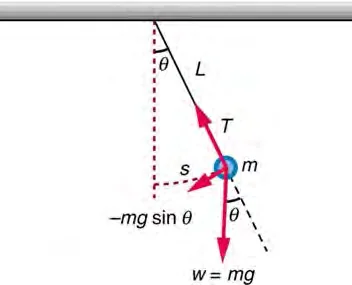
A simple pendulum is a special case of a physical pendulum in which the hanging object can be modelled as a point mass m at a distance L from the pivot.
2
For a point mass the moment of inertia about the pivot is I = mL2, and the distance to the centre of mass is d = L.
3
Substituting these values into the period of the physical pendulum gives T = 2π√(mL2/(mgL)) = 2π√(L/g).
4
The mass cancels, which is why the period of a simple pendulum does not depend on the mass of the bob.
5
The simple pendulum is valid only at small amplitudes.
6
For a larger amplitude the restoring torque is not proportional to the angle, and the period increases with amplitude.
1
A common example is a horizontal disk suspended from a wire attached to its centre of mass.
2
When the disk is twisted through an angle θ, the wire exerts a restoring torque τ = −κθ, where κ is the torsion constant of the wire, measured in newton metres per radian (N·m/rad).
3
The disk oscillates rotationally about the wire in the horizontal plane.
4
Applying the rotational form of Newton’s second law gives I d2θ/dt2 = −κθ, so the angular frequency is ω = √(κ/I) and the period is T = 2π√(I/κ).
5
The torsion pendulum has the same mathematical form as the spring-object system, with the torsion constant playing the role of the force constant and the moment of inertia playing the role of the mass.
6
Measuring the period of a torsion pendulum with an object of known moment of inertia gives the torsion constant of the wire.
1
T = 2π√(L/g) = 2π√(0.50 m/9.8 m/s2) = 2π√(0.0510 s2) = 2π(0.226 s) = 1.42 s.
What the symbols mean
T = period (s) · l = length of the pendulum (m) · g = 9.81 m s−2
Answer
The period is 1.42 s. The mass of the bob is not needed
1
The centre of mass is at d = L/2 = 0.50 m from the pivot.
2
Worked examples
3
The moment of inertia is I = (1/3)(2.0 kg)(1.0 m)2 = 0.667 kg·m2.
4
Then mgd = (2.0 kg)(9.8 m/s2)(0.50 m) = 9.8 N·m, and T = 2π√(I/(mgd)) = 2π√(0.667/9.8) s = 2π(0.261 s) = 1.64 s.
5
The mass cancels, leaving T = 2π√(2L/(3g)).
Answer
The period is 1.64 s. A simple pendulum of length 1.0 m would have a period of 2.01 s. The rod’s period is shorter because its effective length is I/(md) = 2L/3 = 0.67 m, not the full length of the rod.
1
T = 2π√(I/κ) = 2π√((2.0 × 10⁻³ kg·m2)/(0.050 N·m/rad)) = 2π√(0.040 s2) = 2π(0.20 s) = 1.26 s.
Answer
The period of the torsion pendulum is 1.26 s.
Entering the angle in degrees in the small-angle approximation
The approximation sin θ ≈ θ holds only for θ in radians.
Using the length of a physical pendulum in its period formula
The period uses the moment of inertia I and the distance d from the pivot to the centre of mass, which are not the same as the length of the body.
Using the simple pendulum formula for a rod or disk
A rod or disk has a moment of inertia that differs from mL2, so its period is different.
Believing that the mass of a simple pendulum changes its period
The mass cancels in the simple pendulum, so the period depends only on L and g.
Mixing values of g within one calculation
Use one value of g, the value stated in these notes, throughout a problem.
Avoid
Forgetting that the moment of inertia must be taken about the pivot, not about the centre of mass