Curriculum
AP Physics C: Mechanics
1. Kinematics
0/11
2. Force and Translational Dynamics
0/21
3. Work, Energy, and Power
0/11
4. Linear Momentum
0/9
5. Torque and Rotational Dynamics
0/13
6. Energy and Momentum of Rotating Systems
0/13
-
6. Energy and Momentum of Rotating Systems
 Preview
-
6.1 Rotational Kinetic Energy
Preview
-
6.1 Rotational Kinetic Energy - Check yourself
 Preview
-
6.2 Torque and Work
Preview
-
6.2 Torque and Work - Check yourself
Preview
-
6.3 Angular Momentum and Angular Impulse
Preview
-
6.3 Angular Momentum and Angular Impulse - Check yourself
Preview
-
6.4 Conservation of Angular Momentum
Preview
-
6.4 Conservation of Angular Momentum - Check yourself
Preview
-
6.5 Rolling
Preview
-
6.5 Rolling - Check yourself
Preview
-
6.6 Motion of Orbiting Satellites
Preview
-
6.6 Motion of Orbiting Satellites - Check yourself
Preview
7. Oscillations
0/11
Text lesson
6.2 Torque and Work
6.2 Torque and Work — AP PHYSICS C: MECHANICS notes: You will be able to calculate the work done on a rigid system by a torque, including a torque that varies with angular position, by integrating the torque over the angular displacement, and relate that work to the change in the system’s rotational kinetic energy.
1Torque about an axis2Torque about an axis
Torque about an axis
Torque about an axis
Torque is the rotational analogue of force.
It measures how strongly a force tends to turn a body about an axis.
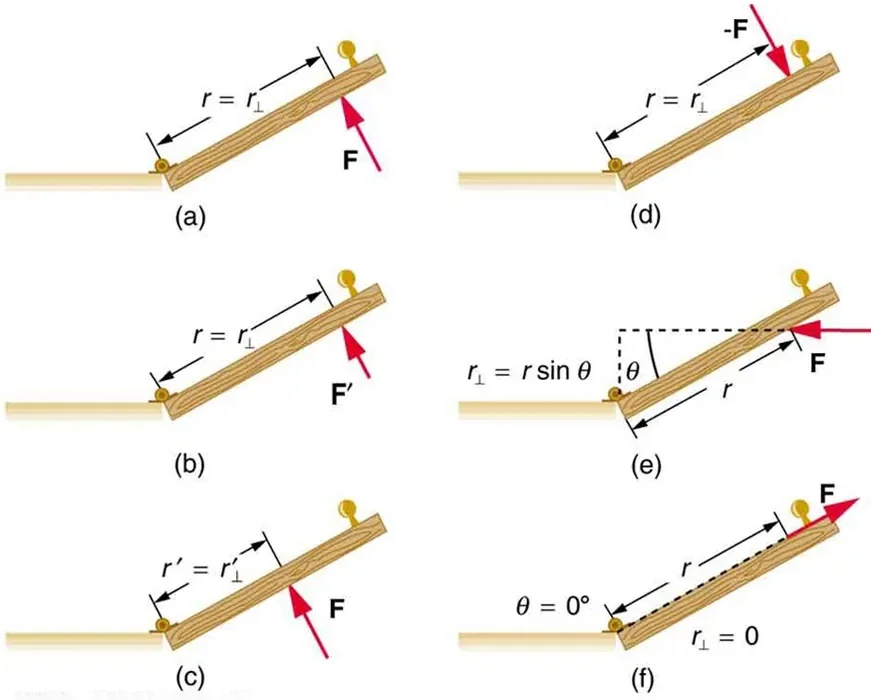
For a force F applied at a position r measured from the axis, the magnitude of the torque is τ = rF sin θ
where θ is the angle between r and F.
Torque is measured in newton metres (N·m).
The perpendicular distance r sin θ is the lever arm
so the torque is the force times its lever arm, τ = F(r sin θ).
Only the component of the force perpendicular to the lever arm produces a torque.
1 / 2Next ▶
Torque and the lever arm: A force on a rod at different angles and positions, showing how the lever arm sets the torque.
Torque about an axis
 ⤢ Enlarge
1
A force that points along the line from the axis to its point of application,
such as a radial pull on a wheel, produces no torque about that axis,because its lever arm is zero.
2
A force applied at the axis itself has the same property.
3
The direction of the torque is along the axis of rotation, given by the right-hand rule,
and it is positive when it turns the body in the sense chosen as positive.
◀ Previous2 / 2
Work done by a torque
Work done by a torque
A torque does work on a rigid system when the system rotates through an angular displacement while the torque is exerted.
For a small rotation dθ at a point where the tangential force is Ft, the displacement along the rim is r dθ
so the work is dW = Ftr dθ = τ dθ.
Adding up all the small contributions between an initial angular position θi and a final angular position θf gives W = ∫θiθf τ dθ, in joules (J).
When the torque is constant, the integral reduces to W = τΔθ
where Δθ is the angular displacement in radians. Angles must be in radians in this formula. A torque does work only over an angular displacement. A torque that acts while the system is held still transfers no energy to it.
Power and the work–energy theorem for rotation
Power and the work–energy theorem for rotation
The rate at which a torque does work is the rotational power, P = dW/dt = τ(dθ/dt) = τω, in watts (W) when τ is in N·m and ω is in rad/s. A torque that tends to speed the rotation does positive work, and a torque that opposes the rotation does negative work and removes energy from the system.
For a rigid system rotating about a fixed axis, the net work done by all torques equals the change in rotational kinetic energy: Wnet = ΔKrot = ½Iωf2 − ½Iωi2.
This is the rotational form of the work–energy theorem.
It is the same reasoning as for translation, with force replaced by torque and displacement replaced by angular displacement.
Area under the torque–angle graph
1
If the torque is given as a graph against angular position, the work is the area between the graph and the θ-axis between the two angles.
2
Because the integral is signed, an area below the axis
where the torque is negative, counts as negative work.
3
A net positive area means the torque has added energy to the rotation over the interval, and a net negative area means it has removed energy.
4
When the torque is given as a function of angle, the integral is evaluated directly. For example, if τ = (4.0 − 0.5θ) N·m
then the work from θ = 0 to θ = 6.0 rad is ∫06.0(4.0 − 0.5θ) dθ = [4.0θ − 0.25θ2]06.0 = 24 − 9.0 = 15 J.
1Example 1: Constant torque on a flywheel · Example 2: Work f2Example 3: Torque from a tangential force on a rim
Key terms
| Term | Meaning |
|---|---|
| Torque τ | The turning effect of a force about an axis, τ = rF sin θ, in N·m. |
| Lever arm | The perpendicular distance from the axis to the line of action of a force, r sin θ. |
| Net torque | The vector sum of all the torques exerted on a body about a given axis. |
| Angular displacement Δθ | The change in angular position of a rigid system, measured in radians. |
| Work done by a torque W | The energy transferred to a rigid system by a torque acting over an angular displacement, W = ∫τ dθ, in joules. |
| Rotational power P | The rate at which a torque does work, P = τω, in watts. |
| Area under a torque–angle graph | The work done by the torque over the interval, with areas below the axis counted as negative. |
| Rotational work–energy theorem | The statement that the net work done on a rigid system about a fixed axis equals its change in rotational kinetic energy. |
1Avoid these mistakes2Avoid these mistakes3Avoid these mistakes4Avoid these mistakes5Avoid these mistakes6Avoid these mistakes