Curriculum
AP Physics C: Mechanics
1. Kinematics
0/11
2. Force and Translational Dynamics
0/21
3. Work, Energy, and Power
0/11
-
3. Work, Energy, and Power
 Preview
-
3.1 Translational Kinetic Energy
Preview
-
3.1 Translational Kinetic Energy - Check yourself
 Preview
-
3.2 Work
Preview
-
3.2 Work - Check yourself
Preview
-
3.3 Potential Energy
Preview
-
3.3 Potential Energy - Check yourself
Preview
-
3.4 Conservation of Energy
Preview
-
3.4 Conservation of Energy - Check yourself
Preview
-
3.5 Power
Preview
-
3.5 Power - Check yourself
Preview
4. Linear Momentum
0/9
5. Torque and Rotational Dynamics
0/13
6. Energy and Momentum of Rotating Systems
0/13
7. Oscillations
0/11
Text lesson
3. Work, Energy, and Power
Unit 3 Work, Energy, and Power — AP PHYSICS C: MECHANICS notes: You will be able to connect the five topics of Unit 3 by explaining how work transfers energy into and out of a system, how potential energy and conservative forces are related, how conservation of energy is applied to a chosen system, and how power measures the rate of energy transfer.
1Energy of motion and the work that changes it2Energy of motion and the work that changes it3Energy of motion and the work that changes it4Energy of motion and the work that changes it
1Conservative forces and potential energy2Conservative forces and potential energy3Conservative forces and potential energy4Conservative forces and potential energy5Conservative forces and potential energy6Conservative forces and potential energy7Conservative forces and potential energy
Conservative forces and potential energy
1
Potential energy is the energy a system stores in the configuration of objects that interact through conservative forces (topic 3.3).
2
1
3
The work of a conservative force depends only on the initial and final configurations
so it can be written as W
4
c
5
= −Δ
6
U
1 / 7Next ▶
Conservative forces and potential energy
1
.
2
2
3
The force is the negative derivative of the potential energy,
4
F
5
x
6
= −d
◀ Previous2 / 7Next ▶
Conservative forces and potential energy
Conservative forces and potential energy
/d
,
so stable equilibria are local minima of U and unstable equilibria are local maxima.
3
The standard forms are
s
◀ Previous3 / 7Next ▶
Conservative forces and potential energy
1
= ½
2
k
3
(Δ
4
)
5
for an ideal spring,
6
g
◀ Previous4 / 7Next ▶
Conservative forces and potential energy
Conservative forces and potential energy
= −
Gm
m
/
r
for two masses, and Δ
◀ Previous5 / 7Next ▶
Conservative forces and potential energy
Conservative forces and potential energy
=
mg
Δ
h
near the surface of a planet.
4
◀ Previous6 / 7Next ▶
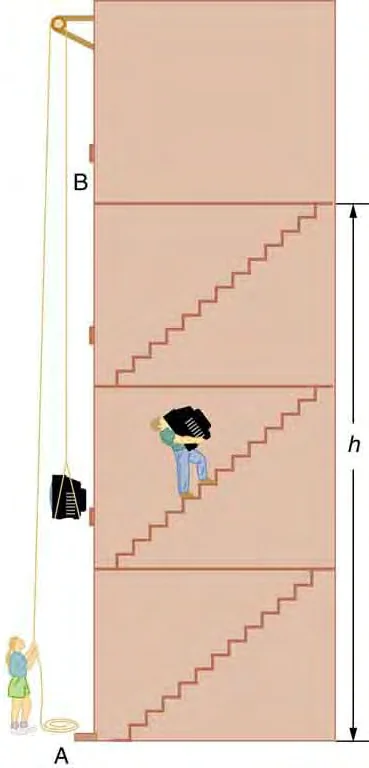
Gravitational and elastic potential energy: A load lifted by a rope over a pulley and a person climbing stairs both rise through the same height h and gain the same gravitational potential energy.
Conservative forces and potential energy
 ⤢ Enlarge
Conservative forces and potential energy
Friction and air resistance are nonconservative
so they have no potential energy.
◀ Previous7 / 7
1Conservation of energy for a chosen system2Conservation of energy for a chosen system3Conservation of energy for a chosen system4Conservation of energy for a chosen system
1Power as the rate of energy transfer2Power as the rate of energy transfer3Power as the rate of energy transfer4Power as the rate of energy transfer5Power as the rate of energy transfer
1How the topics connect2How the topics connect3How the topics connect
Key equations of Unit 3
| Equation | Symbols and SI units | Topic |
|---|---|---|
| K = ½mv2 | K translational kinetic energy (J); m mass (kg); v speed (m/s) | 3.1 |
| W = ∫ab F·dr | W work (J); F force (N); dr displacement (m) | 3.2 |
| W = FΔx cos θ | F force (N); Δx displacement (m); θ angle between force and displacement | 3.2 |
| Wnet = ΔK = ½mvf2 − ½mvi2 | Wnet net work (J); vi, vf initial and final speeds (m/s) | 3.2 |
| Eth = fkL | Eth energy dissipated (J); fk kinetic friction force (N); L path length (m) | 3.2, 3.4 |
| Wc = −ΔU | Wc work by a conservative force (J); ΔU change in potential energy (J) | 3.3 |
| Fx = −dU/dx | Fx conservative force (N); U potential energy (J); x position (m) | 3.3 |
| Us = ½k(Δx)2 | Us spring energy (J); k spring constant (N/m); Δx stretch or compression (m) | 3.3 |
| Ug = −Gm1m2/r | G = 6.67 × 10⁻¹¹ N·m2/kg2; m1, m2 masses (kg); r separation of centres (m) | 3.3 |
| ΔUg = mgΔh | ΔUg change in gravitational energy (J); g = 9.8 N/kg; Δh change in height (m) | 3.3 |
| Emech = K + U | Emech mechanical energy (J) | 3.4 |
| Ki + Ui + Wext = Kf + Uf + Eth | Wext external work on the system (J); Eth energy dissipated (J) | 3.4 |
| Pavg = W/Δt = ΔE/Δt | Pavg average power (W); Δt time interval (s) | 3.5 |
| P = dW/dt = F·v = Fv cos θ | P instantaneous power (W); v velocity (m/s); θ angle between force and velocity | 3.5 |
Key terms
| Term | Meaning |
|---|---|
| Work | The energy transferred into or out of a system by a force exerted on the system over a distance, measured in joules. |
| Kinetic energy | The energy of an object because its centre of mass moves, given by ½mv2. |
| Potential energy | The energy a system stores in the configuration of objects that interact through conservative forces. |
| Conservative force | A force whose work depends only on the initial and final configurations, so its work around a closed path is zero. |
| Nonconservative force | A force, such as friction, whose work depends on the path and which dissipates mechanical energy. |
| Mechanical energy | The sum of the kinetic and potential energies of a system. |
| Stable and unstable equilibrium | Local minima and local maxima of potential energy, respectively. |
| Power | The rate at which energy is transferred or converted with respect to time, measured in watts. |
1Avoid these mistakes2Avoid these mistakes3Avoid these mistakes