Curriculum
AP PHYSICS 2
9. Thermodynamics
0/13
-
9. Thermodynamics
 Preview
-
9.1 Kinetic Theory of Temperature and Pressure
Preview
-
9.1 Kinetic Theory of Temperature and Pressure - Check yourself
 Preview
-
9.2 The Ideal Gas Law
Preview
-
9.2 The Ideal Gas Law - Check yourself
Preview
-
9.3 Thermal Energy Transfer and Equilibrium
Preview
-
9.3 Thermal Energy Transfer and Equilibrium - Check yourself
Preview
-
9.4 The First Law of Thermodynamics
Preview
-
9.4 The First Law of Thermodynamics - Check yourself
Preview
-
9.5 Specific Heat and Thermal Conductivity
Preview
-
9.5 Specific Heat and Thermal Conductivity - Check yourself
Preview
-
9.6 Entropy and the Second Law of Thermodynamics
Preview
-
9.6 Entropy and the Second Law of Thermodynamics - Check yourself
Preview
10. Electric Force, Field, and Potential
0/15
11. Electric Circuits
0/17
12. Magnetism and Electromagnetism
0/9
13. Geometric Optics
0/9
14. Waves, Sound, and Physical Optics
0/19
15. Modern Physics
0/17
Text lesson
9.1 Kinetic Theory of Temperature and Pressure
9.1 Kinetic Theory of Temperature and Pressure — AP PHYSICS 2: ALGEBRA-BASED notes: You will be able to explain gas pressure and temperature in terms of the motion of the atoms in a gas, and use the root-mean-square speed of those atoms to relate them to absolute temperature.
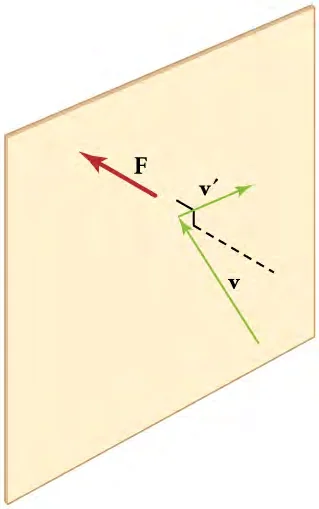
Each atom that strikes a wall exerts a force on it during the collision.
Because the collisions happen billions of times every second, the many small forces combine into a steady force that we measure as pressure.
Pressure is the ratio of the total force, perpendicular to a surface, exerted by the gas on that surface to the area of the surface.
In equation form, P = F/A, where P is the pressure in pascals (Pa, equal to N/m2), F is the sum of the magnitudes of the perpendicular force components exerted by the atoms on the surface in newtons (N), and A is the area of the surface in square metres (m2).
Collisions between atoms and a fixed wall can be analysed with conservation of momentum.
Suppose an atom of mass m moving at speed v strikes a rigid wall perpendicular to it and rebounds with the same speed.
Its momentum changes from mv to −mv, so the change in momentum of the atom is 2mv in kg·m/s.
By Newton’s third law, the wall receives an equal momentum change in the opposite direction.
The same reasoning applies to collisions between two atoms the total momentum of the pair is conserved, and the velocities after the collision can be found from that conservation law.
In a two-dimensional collision, analyse the components separately.
If an atom of speed v strikes a smooth wall at an angle θ to the normal and rebounds elastically, only the component perpendicular to the wall changes.
Its momentum change is 2mv cos θ in kg·m/s, while the component parallel to the wall stays the same.
Pressure is not only present at the walls.
Atoms are moving throughout the whole volume of the gas, so the gas has the same pressure everywhere in its interior.
If you placed a small surface inside the gas, the atoms on both sides of it would push on it with equal force per unit area.
It is not a measure of the total energy in the system.
A large sample of gas at a given temperature can have much more total energy than a small sample at the same temperature, but the average kinetic energy per atom is the same in both.
For an ideal monatomic gas, the average translational kinetic energy of one atom is related to the absolute temperature by KEaverage = (3/2)kBT, where KEaverage is the average kinetic energy of one atom in joules (J), kB is the Boltzmann constant, equal to 1.38 × 10⁻²³ J/K, and T is the absolute temperature in kelvins (K).
Temperatures must always be in kelvins in this relation.
Average KE
To convert from degrees Celsius, add 273.
Because the average kinetic energy depends only on temperature, two different gases at the same temperature have the same average kinetic energy per atom, even if their atoms have different masses.
The atoms of the lighter gas move faster on average to achieve this.
It is chosen because it is directly connected to kinetic energy.
For an ideal gas, the average kinetic energy of an atom is written as (1/2)mvrms2 = (3/2)kBT, where m is the mass of one atom in kilograms (kg).
Solving for the root-mean-square speed gives vrms = √(3kBT/m), with vrms in metres per second (m/s).
This equation shows three important dependences.
The root-mean-square speed is proportional to the square root of the absolute temperature, so doubling the temperature multiplies the speed by √2, or about 1.41.
The root-mean-square speed is inversely proportional to the square root of the atomic mass, so heavier atoms move more slowly than lighter atoms at the same temperature.
Also, the root-mean-square speed is not the same as the average speed; it is always larger than the average speed for a real distribution of speeds.
If the temperature of a gas is zero kelvin, the average kinetic energy of its atoms would be zero and the root-mean-square speed would be zero.
Real gases never reach this state, but the relation shows why absolute zero is the lowest possible temperature in this model.

At any instant, some atoms are slow, some are fast, and a few are very fast.
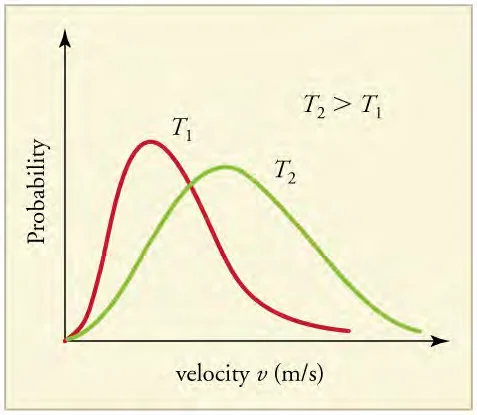
The Maxwell–Boltzmann distribution is a graph that shows how the number of atoms in a gas varies with speed (or kinetic energy) at a fixed temperature.
The horizontal axis gives the speed and the vertical axis gives the fraction of atoms with that speed.
The shape of the graph has features that you must recognise.
The curve starts at zero speed, rises to a peak at the most probable speed, and then falls off with a long tail toward high speeds.
The peak is lower and further to the right at higher temperature, and the curve becomes broader.
Speed spread
The area under the whole curve is the same at every temperature, because every atom has some speed.
At a higher temperature, a larger fraction of atoms have high speeds, which corresponds to the higher average kinetic energy.
You do not need the mathematical form of the distribution for AP Physics 2.
You do need to be able to compare two graphs for two temperatures and state which temperature has the higher average kinetic energy, the larger root-mean-square speed, and the greater spread of speeds.
Collisions between atoms keep redistributing kinetic energy among the atoms, so the distribution stays stable at a fixed temperature even though the speed of any one atom keeps changing.
Question
Find the average kinetic energy of one atom of a monatomic ideal gas at 300 K
Given
T = 300 K, kB = 1.38 × 10⁻²³ J/K.
1
KEaverage = (3/2)kBT = (3/2)(1.38 × 10−23 J/K)(300 K) = 6.21 × 10⁻²¹ J.
Answer
6.21 × 10⁻²¹ J, to three significant figures.
Question
Find the root-mean-square speed of nitrogen molecules (N2) at 300 K. The molar mass of N2 is 28.0 g/mol, and the Avogadro constant is 6.02 × 10²³ per mole.
1
Step 1, mass of one molecule m = (28.0 × 10⁻³ kg/mol)/(6.02 × 1023 /mol) = 4.65 × 10⁻²⁶ kg.
2
Step 2, speed vrms = √(3kBT/m) = √[3(1.38 × 10⁻²³ J/K)(300 K)/(4.65 × 10−26 kg)] = √(2.67 × 10⁵ m2/s2) = 517 m/s.
Answer
about 5.17 × 10² m/s.
Follow-up
If the temperature rises to 600 K, the root-mean-square speed becomes 517 × √2 = 731 m/s, about 1.41 times larger.
Question
An atom of mass 4.0 × 10⁻²⁶ kg moves at 500 m/s directly toward a rigid wall and rebounds with the same speed. Find the change in momentum of the atom and the momentum delivered to the wall.
1
Take the direction away from the wall as positive.
2
Initial momentum = −(4.0 × 10⁻²⁶ kg)(500 m/s) = −2.0 × 10⁻²³ kg·m/s.
3
Final momentum = +2.0 × 10⁻²³ kg·m/s.
4
Change in momentum of the atom = +2.0 × 10⁻²³ − (−2.0 × 10⁻²³) = +4.0 × 10⁻²³ kg·m/s.
Answer
The atom’s momentum changes by 4.0 × 10⁻²³ kg·m/s, and the wall receives 4.0 × 10⁻²³ kg·m/s in the opposite direction, which is the same as 2mv.
Using degrees Celsius in the equation KEaverage = (3/2)kBT
Always convert to kelvins first; 25 °C is 298 K, not 25 K.
Saying that temperature measures the total kinetic energy of a gas.
Temperature measures the average kinetic energy per atom, so a large sample and a small sample at the same temperature have the same temperature.
Confusing the root-mean-square speed with the average speed.
The root-mean-square speed is larger than the average speed for real speed distributions.
Concluding that heavier atoms have a higher average kinetic energy at the same temperature.
At the same temperature, all atoms have the same average kinetic energy; heavier atoms have a lower speed.
Reading the Maxwell–Boltzmann graph as showing that a higher temperature gives every atom a higher speed.
At higher temperature the peak moves to higher speed and the curve broadens, but individual atoms still have a wide range of speeds.
Avoid
Forgetting that the momentum change of an atom bouncing off a wall is 2mv, not mv, when the atom rebounds with the same speed.