Curriculum
AP PHYSICS 2
9. Thermodynamics
0/13
-
9. Thermodynamics
 Preview
-
9.1 Kinetic Theory of Temperature and Pressure
Preview
-
9.1 Kinetic Theory of Temperature and Pressure - Check yourself
 Preview
-
9.2 The Ideal Gas Law
Preview
-
9.2 The Ideal Gas Law - Check yourself
Preview
-
9.3 Thermal Energy Transfer and Equilibrium
Preview
-
9.3 Thermal Energy Transfer and Equilibrium - Check yourself
Preview
-
9.4 The First Law of Thermodynamics
Preview
-
9.4 The First Law of Thermodynamics - Check yourself
Preview
-
9.5 Specific Heat and Thermal Conductivity
Preview
-
9.5 Specific Heat and Thermal Conductivity - Check yourself
Preview
-
9.6 Entropy and the Second Law of Thermodynamics
Preview
-
9.6 Entropy and the Second Law of Thermodynamics - Check yourself
Preview
10. Electric Force, Field, and Potential
0/15
11. Electric Circuits
0/17
12. Magnetism and Electromagnetism
0/9
13. Geometric Optics
0/9
14. Waves, Sound, and Physical Optics
0/19
15. Modern Physics
0/17
Text lesson
9.2 The Ideal Gas Law
9.2 The Ideal Gas Law — AP PHYSICS 2: ALGEBRA-BASED notes: You will be able to state the assumptions of the ideal gas model, apply the ideal gas law to relate pressure, volume, amount and temperature, and read properties of a gas from pressure, temperature and volume graphs.
1The ideal gas model2The ideal gas model
The ideal gas model
The ideal gas model
An ideal gas is a model of a real gas in which the behaviour of the gas is simple enough to describe with one equation.
The classical model makes four assumptions.
First, the velocities of the atoms are random
so no direction of motion is preferred.
Second, the volume of the atoms themselves is negligible compared with the volume of the container.
Third, collisions between atoms and with the walls are elastic.
Fourth, the only significant forces on the atoms act during collisions
between collisions the atoms move in straight lines.
1 / 2Next ▶
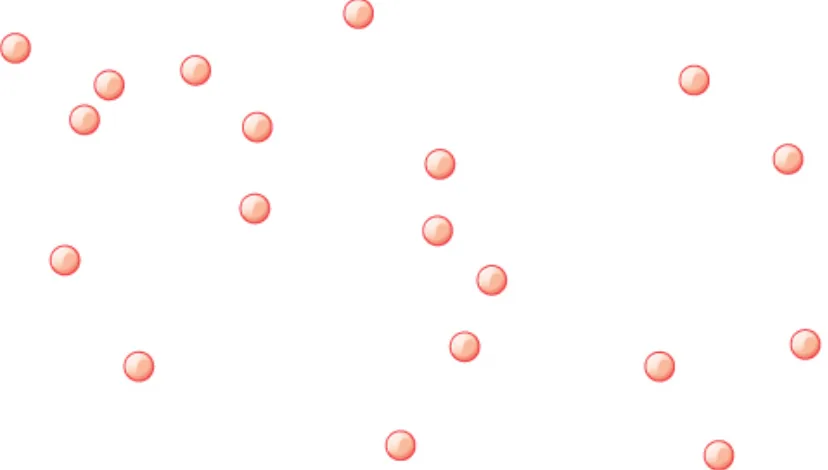
Gases, atoms and molecules: Particles of a gas are widely spaced, so the properties of the gas depend mainly on how many particles are in a given volume and on the temperature, not on the type of particle.
The ideal gas model
 ⤢ Enlarge
The ideal gas model
Real gases behave like ideal gases when they are at low pressure and high temperature
because under those conditions the atoms are far apart and move fast enough that the forces between them have little effect. At high pressure or low temperature, the atoms are closer together and the model becomes less accurate.
◀ Previous2 / 2
1The ideal gas law and the amount of gas2The ideal gas law and the amount of gas
The ideal gas law and the amount of gas
The ideal gas law and the amount of gas
For an ideal gas, the pressure, volume, amount of gas and absolute temperature are related by PV = nRT
where P is the pressure in pascals (Pa), V is the volume in cubic metres (m3), n is the amount of gas in moles (mol), R is the universal gas constant, equal to 8.31 J/(mol·K), and T is the absolute temperature in kelvins (K).
The amount of gas can also be counted in molecules.
If N is the number of atoms or molecules
then n = N/NAwhere NA = 6.02 × 10²³ per mole is the Avogadro constant.
Substituting into the ideal gas law and using kB = R/NA = 1.38 × 10⁻²³ J/K gives PV = NkT,
where k is the Boltzmann constant and N is the number of atoms.
Both forms, PV = nRT and PV = NkBT, are equally correct
choose the one that matches the quantity given in the question.
If the amount of gas is fixed, the ideal gas law can be written for two states of the same sample: P1V1/T1 = P2V2/T2. This combined form reduces to Boyle’s law (PV is constant at constant temperature) and to Charles’s law (V/T is constant at constant pressure), and to the pressure–temperature law (P/T is constant at constant volume).
1 / 2Next ▶
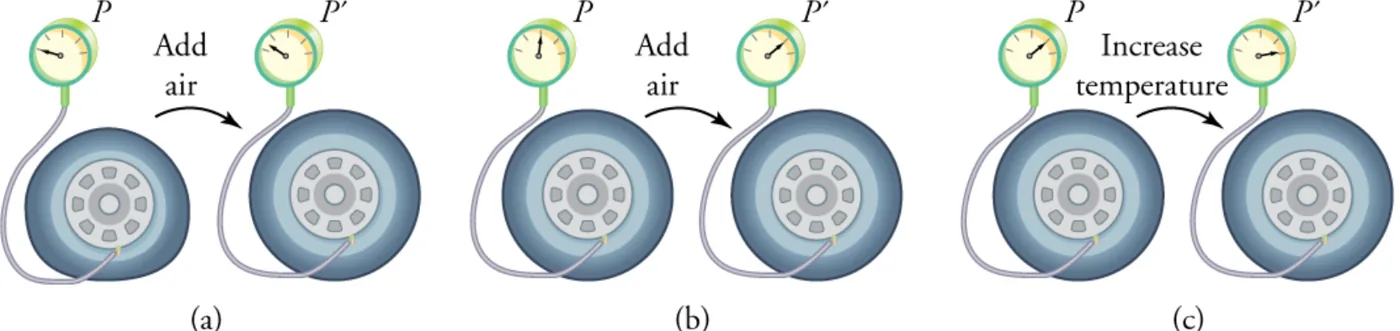
Pressure, temperature and volume in a tire: Three stages of a tire: adding air to a deflated tire first enlarges it with little pressure rise, then the pressure climbs once the walls resist expansion, and finally warming the inflated tire raises its pressure further.
The ideal gas law and the amount of gas
◀ Previous2 / 2
1Reading gas properties from graphs2Reading gas properties from graphs
Using the ideal gas law in calculations
Using the ideal gas law in calculations
To solve most problems, first list the known quantities and convert every temperature to kelvins.
Then decide which form of the law fits the question.
If the amount of gas is given in moles, use PV = nRT.
If the number of atoms is given, use PV = NkT.
If the same sample is compared at two states, use the combined form and cancel any quantity that does not change.
The units must be consistent. Pressure in pascals, volume in cubic metres and temperature in kelvins give energy in joules when multiplied
because one pascal times one cubic metre is one joule. Do not mix litres and cubic metres, or kilopascals and pascals, without converting.
1Example 1: Isothermal compression of a gas · Example 2: Pres2Example 3: Extrapolating a pressure–temperature graph to zer3Example 4: Combined gas law with a change of volume and temp
Key terms
| Term | Meaning |
|---|---|
| Ideal gas | A model of a gas whose atoms move randomly, occupy negligible volume, interact only during elastic collisions, and obey PV = nRT. |
| Amount of substance (n) | The number of moles of gas, equal to the number of atoms divided by the Avogadro constant, measured in mol. |
| Universal gas constant (R) | The constant 8.31 J/(mol·K) that appears in the ideal gas law PV = nRT. |
| Avogadro constant (NA) | The number of atoms or molecules in one mole, equal to 6.02 × 10²³ per mole. |
| Boyle’s law | At constant temperature, the product of the pressure and volume of a fixed amount of ideal gas is constant. |
| Charles’s law | At constant pressure, the volume of a fixed amount of ideal gas is proportional to its absolute temperature. |
| Isotherm | A line on a pressure–volume graph along which the temperature is constant. |
| Absolute zero | The temperature of 0 K, at which the pressure of an ideal gas at constant volume would be zero. |
1Avoid these mistakes2Avoid these mistakes3Avoid these mistakes4Avoid these mistakes5Avoid these mistakes