Curriculum
AP PHYSICS 2
9. Thermodynamics
0/13
10. Electric Force, Field, and Potential
0/15
11. Electric Circuits
0/17
12. Magnetism and Electromagnetism
0/9
13. Geometric Optics
0/9
14. Waves, Sound, and Physical Optics
0/19
-
14. Waves, Sound, and Physical Optics
 Preview
-
14.1 Properties of Wave Pulses and Waves
Preview
-
14.1 Properties of Wave Pulses and Waves - Check yourself
 Preview
-
14.2 Periodic Waves
Preview
-
14.2 Periodic Waves - Check yourself
Preview
-
14.3 Boundary Behavior of Waves and Polarization
Preview
-
14.3 Boundary Behavior of Waves and Polarization - Check yourself
Preview
-
14.4 Electromagnetic Waves
Preview
-
14.4 Electromagnetic Waves - Check yourself
Preview
-
14.5 The Doppler Effect
Preview
-
14.5 The Doppler Effect - Check yourself
Preview
-
14.6 Wave Interference and Standing Waves
Preview
-
14.6 Wave Interference and Standing Waves - Check yourself
Preview
-
14.7 Diffraction
Preview
-
14.7 Diffraction - Check yourself
Preview
-
14.8 Double-Slit Interference and Diffraction Gratings
Preview
-
14.8 Double-Slit Interference and Diffraction Gratings - Check yourself
Preview
-
14.9 Thin-Film Interference
Preview
-
14.9 Thin-Film Interference - Check yourself
Preview
15. Modern Physics
0/17
Text lesson
14.7 Diffraction
14.7 Diffraction — AP PHYSICS 2: ALGEBRA-BASED notes: You will be able to describe diffraction as the spreading of a wave through an opening, explain why it is most pronounced when the opening is comparable to the wavelength, relate the path length difference across a single slit to the positions of the dark bands, and use the small-angle approximation to find the distance of a minimum from the centre of the pattern.
1What diffraction is2What diffraction is3What diffraction is
What diffraction is
What diffraction is
Diffraction is the spreading of a wave around the edges of an obstacle or through an opening.
1 / 3Next ▶
What diffraction is
1
A water wave that passes through a narrow gap in a harbour wall spreads out in a semicircle on the far side, rather than continuing as a straight beam.
2
Sound spreads around a corner of a building in the same way,
3
which is why a voice can be heard in the next room through an open doorway even when the speaker cannot be seen.
4
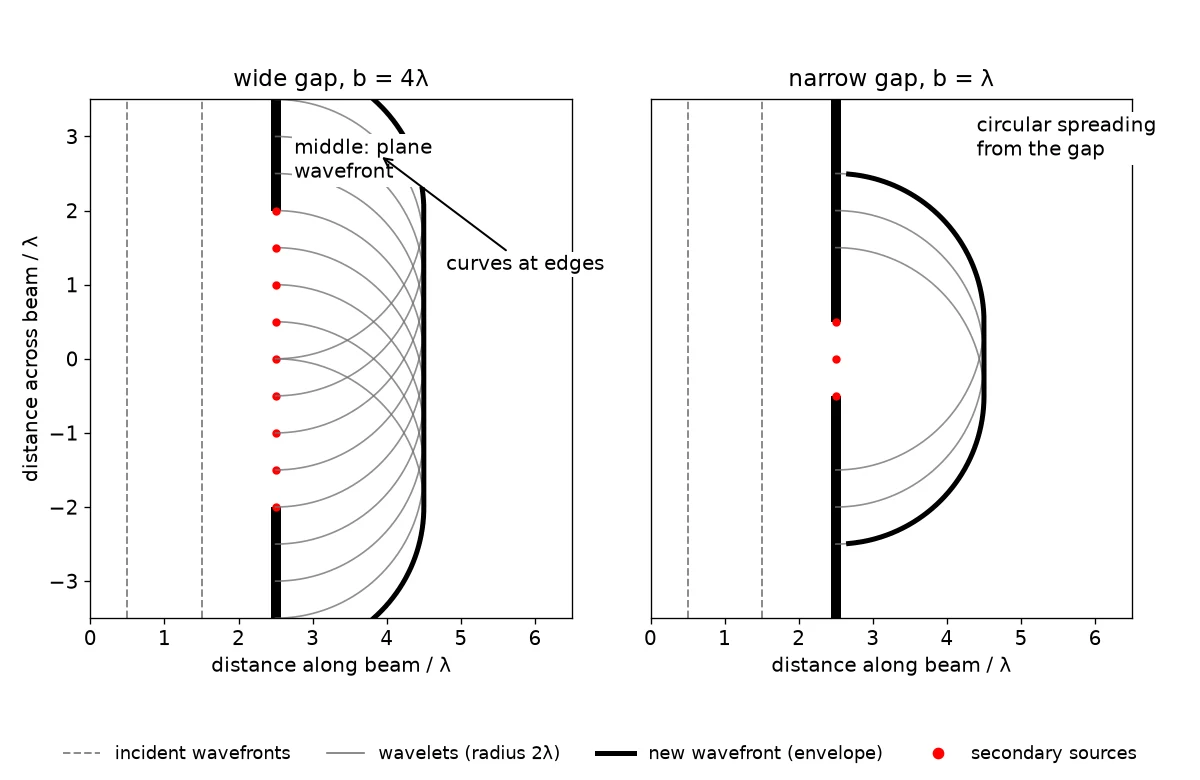
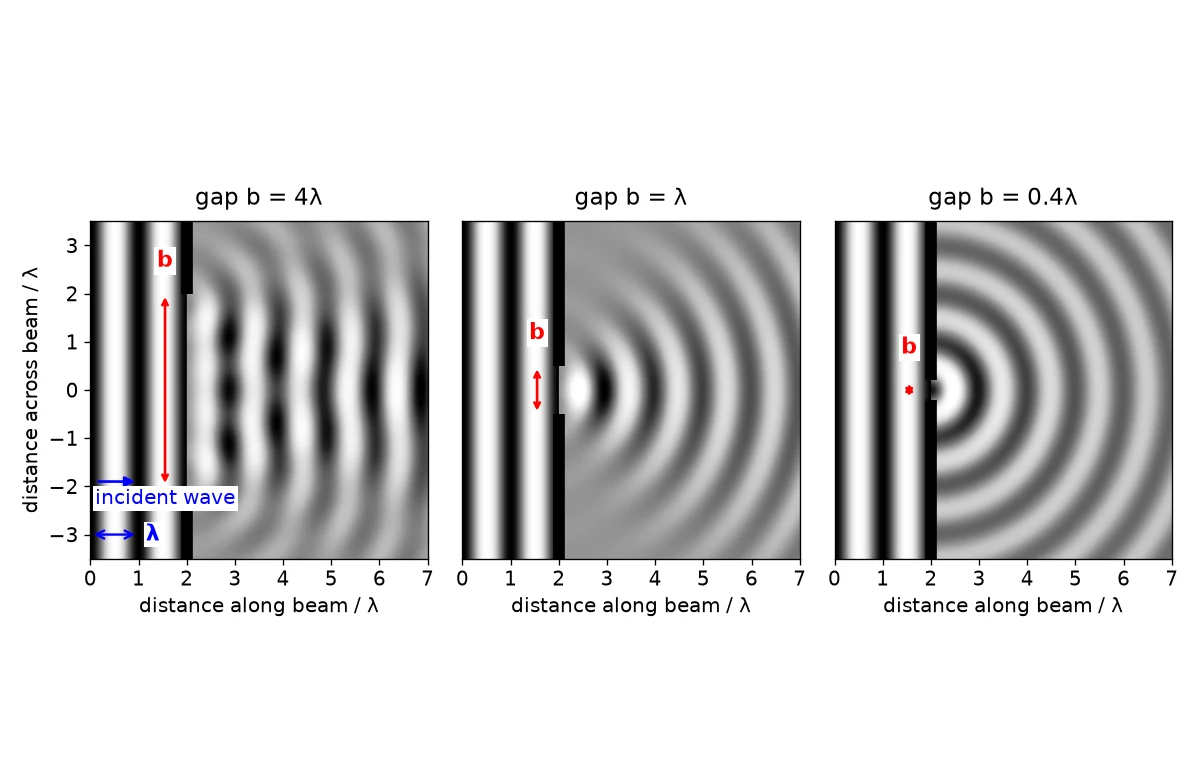
Diffraction is most pronounced when the size of the opening is comparable to the wavelength of the wave.
5
A slit that is much wider than the wavelength lets the wave pass nearly straight through, with only a small spreading at its edges.
6
A slit that is about the same size as the wavelength spreads the wave strongly.
◀ Previous2 / 3Next ▶
Huygens construction: secondary wavelets from points in a wide gap form a plane middle wavefront with curved edges; a narrow gap gives a circular arc
What diffraction is
 ⤢ Enlarge
What diffraction is
Because sound has a wavelength of about a metre or less, it diffracts around doorways,
while light, with a wavelength of about 500 nm, diffracts only through very narrow openings.
◀ Previous3 / 3
1The single-slit diffraction pattern2The single-slit diffraction pattern3The single-slit diffraction pattern4The single-slit diffraction pattern5The single-slit diffraction pattern
The single-slit diffraction pattern
The single-slit diffraction pattern
When monochromatic light of wavelength λ is incident on a narrow slit of width a, a pattern of bright and dark bands is seen on a screen placed a distance L away.
1 / 5Next ▶
The single-slit diffraction pattern
1
Each point of the slit acts as a source of wavefronts.
2
Wavefronts from different points of the slit travel different distances to a point on the screen,
3
and they interfere constructively or destructively depending on their path length difference.
4
The pattern is therefore an interference pattern produced by a single opening.
5
The amount of interference between two wavefronts depends on their path length difference, Δ. For a wavefront travelling from the edges of the slit at an angle θ to the normal to the slit, the path length difference between the edges is
6
Δ = a sinθ
◀ Previous2 / 5Next ▶
The single-slit diffraction pattern
1
where a is the slit width in metres (m) and θ is the angle between the direction of propagation and the normal to the opening.
2
When Δ is equal to a whole number of wavelengths, the wavefronts from the two halves of the slit cancel, and a dark band is formed.
3
The condition for a dark band is therefore
4
a
5
sin
6
θ
◀ Previous3 / 5Next ▶
The single-slit diffraction pattern
The single-slit diffraction pattern
=
mλ
, where
m
= ±1, ±2, ±3, and so on.
The central region, with
◀ Previous4 / 5Next ▶
Three panels of plane waves meeting a barrier with gaps of 4λ, λ and 0.4λ, showing increasing spreading as the gap narrows
The single-slit diffraction pattern
 ⤢ Enlarge
The single-slit diffraction pattern
= 0, is the brightest band and lies in the middle of the screen.
◀ Previous5 / 5
1Position of the minima on the screen2Position of the minima on the screen3Position of the minima on the screen
Position of the minima on the screen
Position of the minima on the screen
For small angles
where θ is less than about 10°, the small-angle approximation can be used. It relates the angle, the slit width and the distance to the screen to the distance ym from the middle of the central bright fringe to the mth order of minimum brightness on the screen:
ym = mλL/a
where ym is the distance on the screen in metres (m), m is the order of the minimum, λ is the wavelength in metres, L is the distance from the slit to the screen in metres and a is the slit width in metres.
1 / 3Next ▶
Position of the minima on the screen
Position of the minima on the screen
The formula shows that the dark bands are farther apart when the wavelength is larger, when the screen is farther away, or when the slit is narrower.
A narrower slit spreads the pattern wider.
The diffraction pattern produced by a wave passing through an opening depends on the shape of the opening.
A slit gives a series of bright and dark bands along a line
while a circular opening gives a pattern of concentric rings.
The pattern therefore contains information about the physical properties of the opening and of the wave,
and it can be used to determine the width of a slit when the wavelength is known.
◀ Previous2 / 3Next ▶
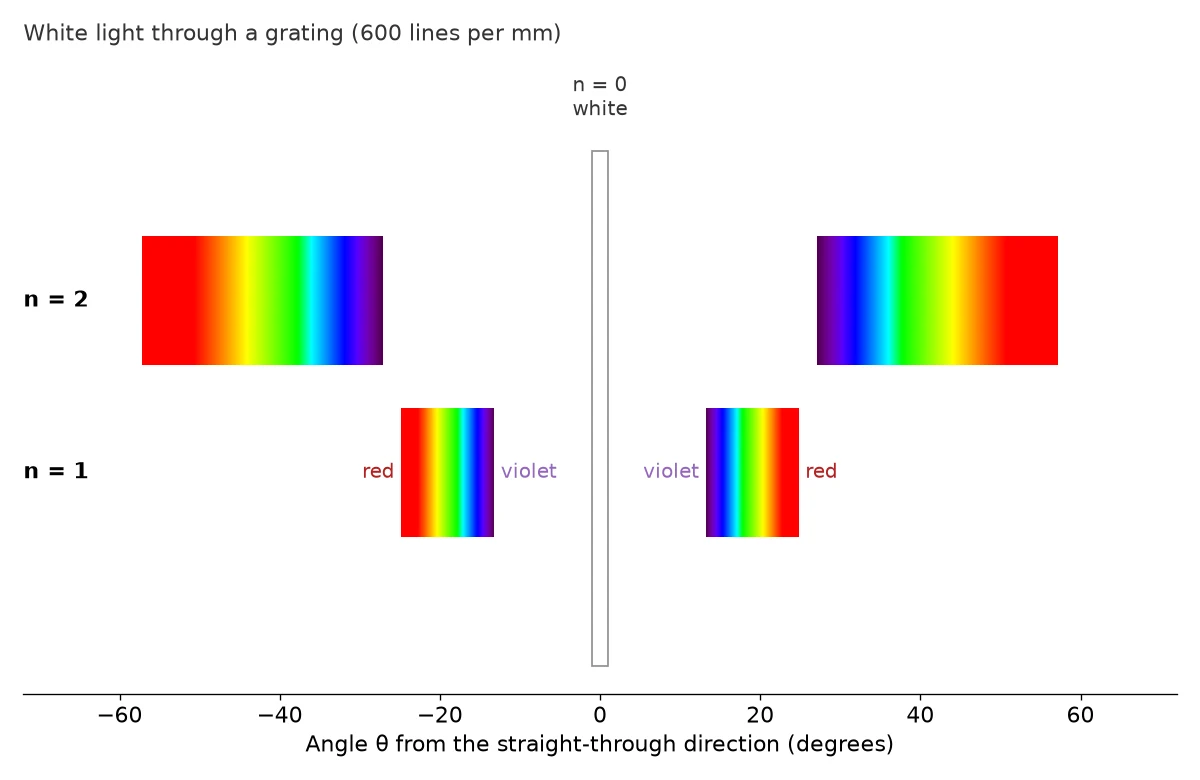
Angular positions of the white-light central maximum and the first and second orders for a 600 lines per mm grating, showing violet nearest the centre and red furthest.
Position of the minima on the screen
◀ Previous3 / 3
1Example 1: Position of the first dark band · Example 2: Angl2Example 3: Effect of changing the slit width
Key terms
| Term | Meaning |
|---|---|
| Diffraction | The spreading of a wave around the edges of an obstacle or through an opening. |
| Single-slit diffraction | The pattern of bright and dark bands formed when a wave passes through one narrow opening. |
| Path length difference (Δ) | The difference in distance travelled by two wavefronts to a common point, which determines whether they interfere constructively or destructively. |
| Minimum (dark band) | A position on a diffraction pattern where wavefronts from the opening cancel, giving zero or very low intensity. |
| Central bright fringe | The bright region at the centre of a diffraction pattern, lying directly in line with the opening. |
| Small-angle approximation | The approximation that sinθ ≈ θ (in radians) and tanθ ≈ sinθ, valid for angles less than about 10°. |
1Avoid these mistakes2Avoid these mistakes3Avoid these mistakes4Avoid these mistakes5Avoid these mistakes