Curriculum
AP PHYSICS 2
9. Thermodynamics
0/13
10. Electric Force, Field, and Potential
0/15
11. Electric Circuits
0/17
-
11. Electric Circuits
 Preview
-
11.1 Electric Current
Preview
-
11.1 Electric Current - Check yourself
 Preview
-
11.2 Simple Circuits
Preview
-
11.2 Simple Circuits - Check yourself
Preview
-
11.3 Resistance, Resistivity, and Ohm’s Law
Preview
-
11.3 Resistance, Resistivity, and Ohm’s Law - Check yourself
Preview
-
11.4 Electric Power
Preview
-
11.4 Electric Power - Check yourself
Preview
-
11.5 Compound Direct Current (DC) Circuits
Preview
-
11.5 Compound Direct Current (DC) Circuits - Check yourself
Preview
-
11.6 Kirchhoff’s Loop Rule
Preview
-
11.6 Kirchhoff’s Loop Rule - Check yourself
Preview
-
11.7 Kirchhoff’s Junction Rule
Preview
-
11.7 Kirchhoff’s Junction Rule - Check yourself
Preview
-
11.8 Resistor-Capacitor (RC) Circuits
Preview
-
11.8 Resistor-Capacitor (RC) Circuits - Check yourself
Preview
12. Magnetism and Electromagnetism
0/9
13. Geometric Optics
0/9
14. Waves, Sound, and Physical Optics
0/19
15. Modern Physics
0/17
Text lesson
11.1 Electric Current
11.1 Electric Current — AP PHYSICS 2: ALGEBRA-BASED notes: You will be able to describe how electric charge moves through a conductor, calculate current from the charge that passes a point in a given time, and state the direction of conventional current in a circuit.
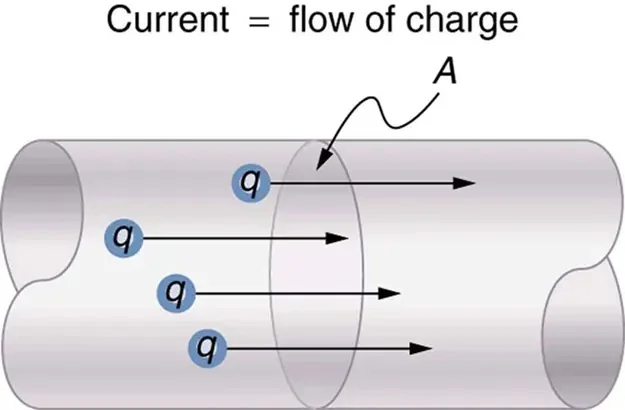
If a charge ΔQ passes a cross-section in a time interval Δt, the average current is I = ΔQ/Δt.
Here I is the current in amperes (A), ΔQ is the charge in coulombs (C), and Δt is the time in seconds (s).
One ampere is one coulomb of charge passing a cross-section each second, so 1 A = 1 C/s.
Rearranging the equation gives ΔQ = IΔt.
The charge that passes through a wire is therefore the area under a graph of current against time.
If the current is steady, the charge is simply the current multiplied by the time.
Current is a measure of how much charge moves, not of how fast the charges move.
Charge carriers in a metal may move slowly and still produce a large current if there are many of them in the wire and if they all pass the same cross-section.
A battery supplies an emf, written as ε, which is measured in volts (V).
The emf is the potential difference the battery would supply if it had no internal resistance, and it pushes charge around the circuit from the terminal of higher potential towards the terminal of lower potential through the external circuit.
If the current in a section of wire is zero, the net motion of the charge carriers in that section is also zero.
The individual charge carriers in a conductor are never at rest, because thermal motion makes them move at high speeds in random directions.
Emf
Their random velocities cancel on average, so no net charge crosses a cross-section when the current is zero.
When there is a current, the random motion of each carrier is superimposed on a small average drift in the direction set by the electric field.
This drift is the source of the net charge flow.
It is much slower than the random motion of the carriers, which is why a current can appear in a wire the moment a switch closes even though the carriers themselves move slowly.
The direction of a current is a convention about the direction of flow along a wire.
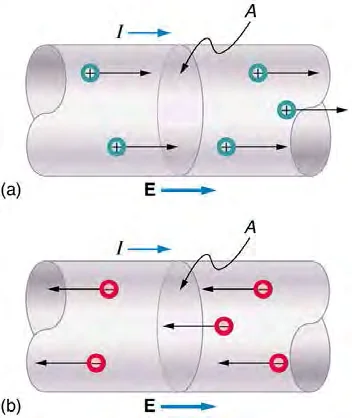
The direction of conventional current is the direction in which a positive charge would move in the circuit.
This convention was chosen before the electron was discovered, and it is used in all circuit diagrams unless otherwise specified.
Conventional current flows from the positive terminal of a battery, through the external circuit, back to the negative terminal.
In most common circuits, the current is actually produced by the movement of electrons, which are negative charge carriers.
Electrons move in the opposite direction to conventional current.
The physical result is the same, because a flow of electrons in one direction gives the same current as a flow of positive charge in the opposite direction.
Question
A wire carries a steady current of 0.50 A for 4.0 minutes. Find the charge that passes a cross-section of the wire in this time
1
The time must be in seconds, so Δt = 4.0 min × 60 s/min = 240 s.
2
Using ΔQ = IΔt gives ΔQ = (0.50 A)(240 s) = 120 C
Answer
120 C. (Note: the charge is 120 C; not 60 C; the time conversion is the step most often missed.)
Question
A current of 2.0 A flows in a wire. Find the number of electrons that pass a cross-section each second. The charge of an electron has magnitude e = 1.60 × 10⁻¹⁹ C.
1
In one second the charge passing is ΔQ = (2.0 A)(1.0 s) = 2.0 C.
2
The number of electrons is N = ΔQ/e = 2.0 C/(1.60 × 10−19 C) = 1.25 × 10¹⁹.
Answer
1.25 × 10¹⁹ electrons per second, to three significant figures.
Question
A charge of 90 C passes a point in a wire in 30 s. Find the average current, and state its direction if the charge is carried by electrons moving to the right
1
I = ΔQ/Δt = 90 C/30 s = 3.0 A.
2
Electrons moving to the right constitute a conventional current flowing to the left
Answer
3.0 A, directed to the left (opposite to the electron motion)
Q = charge (C)
I = current (A)
t = time (s)
Confusing current with the speed of the charge carriers.
A current can be large even when each carrier moves slowly, because the current depends on how much charge crosses a cross-section per second.
Stating that current is a vector and giving it a direction in space.
Current has a direction along a wire, but it is not a vector quantity.
Giving electrons as the direction of conventional current
In common circuits electrons move opposite to conventional current.
Saying that charge carriers are at rest when the current is zero.
Their random thermal motion continues; only the net motion is zero.
Using the number of electrons directly as a charge in coulombs.
Convert the number of electrons to charge using e = 1.60 × 10⁻¹⁹ C before finding the current.
Avoid
Forgetting to convert minutes or hours to seconds before using ΔQ = IΔt, which gives an answer that is off by a factor of 60 or 3600.