Curriculum
AP PHYSICS 2
9. Thermodynamics
0/13
10. Electric Force, Field, and Potential
0/15
11. Electric Circuits
0/17
12. Magnetism and Electromagnetism
0/9
13. Geometric Optics
0/9
14. Waves, Sound, and Physical Optics
0/19
-
14. Waves, Sound, and Physical Optics
 Preview
-
14.1 Properties of Wave Pulses and Waves
Preview
-
14.1 Properties of Wave Pulses and Waves - Check yourself
 Preview
-
14.2 Periodic Waves
Preview
-
14.2 Periodic Waves - Check yourself
Preview
-
14.3 Boundary Behavior of Waves and Polarization
Preview
-
14.3 Boundary Behavior of Waves and Polarization - Check yourself
Preview
-
14.4 Electromagnetic Waves
Preview
-
14.4 Electromagnetic Waves - Check yourself
Preview
-
14.5 The Doppler Effect
Preview
-
14.5 The Doppler Effect - Check yourself
Preview
-
14.6 Wave Interference and Standing Waves
Preview
-
14.6 Wave Interference and Standing Waves - Check yourself
Preview
-
14.7 Diffraction
Preview
-
14.7 Diffraction - Check yourself
Preview
-
14.8 Double-Slit Interference and Diffraction Gratings
Preview
-
14.8 Double-Slit Interference and Diffraction Gratings - Check yourself
Preview
-
14.9 Thin-Film Interference
Preview
-
14.9 Thin-Film Interference - Check yourself
Preview
15. Modern Physics
0/17
Text lesson
14.4 Electromagnetic Waves
14.4 Electromagnetic Waves — AP PHYSICS 2: ALGEBRA-BASED notes: You will be able to describe the structure of an electromagnetic wave as mutually perpendicular oscillating electric and magnetic fields, explain why it needs no medium, use c = fλ with c = 3.00 × 10⁸ m/s to find an unknown wavelength or frequency, and place the categories of the electromagnetic spectrum, including the colours of visible light, in order of wavelength.
1Structure of an electromagnetic wave2Structure of an electromagnetic wave3Structure of an electromagnetic wave
1No medium is needed2No medium is needed3No medium is needed
1Wavelength, frequency and the speed of light2Wavelength, frequency and the speed of light3Wavelength, frequency and the speed of light
1The electromagnetic spectrum2The electromagnetic spectrum3The electromagnetic spectrum
The electromagnetic spectrum
The electromagnetic spectrum
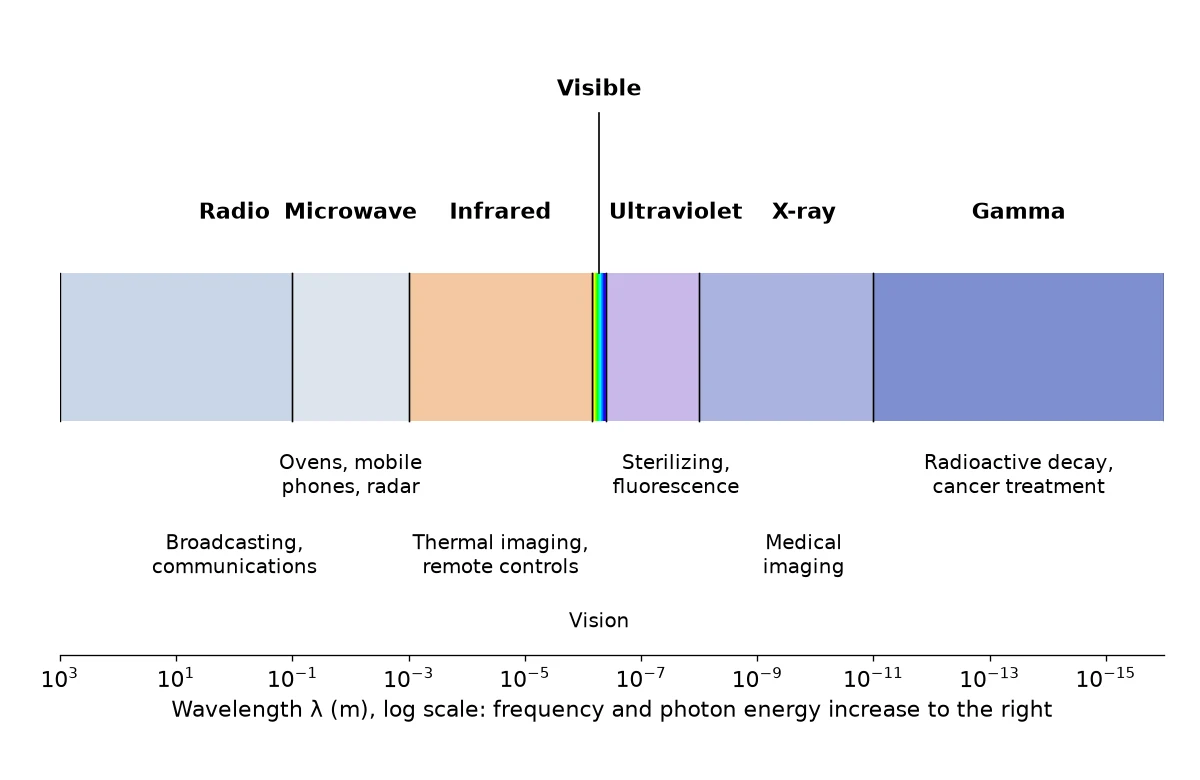
Electromagnetic waves are classified by their wavelengths.
1 / 3Next ▶
The electromagnetic spectrum
1
In order of decreasing wavelength, spanning a range from kilometres to picometres, the categories are radio waves, microwaves, infrared, visible light, ultraviolet, X-rays and gamma rays.
2
Radio waves have the longest wavelengths and the lowest frequencies, and gamma rays have the shortest wavelengths and the highest frequencies.
3
The boundaries between the categories are not sharp, and the exact ranges are not required for AP Physics 2.
4
Visible light is the part of the spectrum that the human eye detects, and it is also called light.
5
The colours of visible light, in order of decreasing wavelength, are red, orange, yellow, green, blue and violet.
6
Light of a single colour has a single frequency and wavelength.
◀ Previous2 / 3Next ▶
Labelled logarithmic wavelength spectrum from radio to gamma rays, with the visible band shown in colour and typical uses below each region
The electromagnetic spectrum
 ⤢ Enlarge
The electromagnetic spectrum
Sometimes the term light is used for all electromagnetic waves
which are collectively referred to as electromagnetic radiation.
◀ Previous3 / 3
1Example 1: Wavelength of an FM radio wave · Example 2: Frequ2Example 3: Wavelength of an X-ray
Key terms
| Term | Meaning |
|---|---|
| Electromagnetic wave | A transverse wave made of mutually perpendicular oscillating electric and magnetic fields that needs no medium to propagate. |
| Speed of light (c) | The speed of all electromagnetic waves in a vacuum, equal to 3.00 × 10⁸ m/s. |
| Plane wave | A wave whose wavefronts are flat planes, perpendicular to the direction of propagation. |
| Wavefront | A surface on which all points of a wave have the same phase. |
| Electromagnetic spectrum | The full range of electromagnetic waves, classified by their wavelengths or frequencies. |
| Visible light | The part of the electromagnetic spectrum that the human eye can detect, from red to violet. |
| Electromagnetic radiation | A collective name for electromagnetic waves of all wavelengths. |
| Gamma ray | The category of electromagnetic wave with the shortest wavelengths and the highest frequencies. |
1Avoid these mistakes2Avoid these mistakes3Avoid these mistakes