Curriculum
AP PHYSICS 2
9. Thermodynamics
0/13
10. Electric Force, Field, and Potential
0/15
11. Electric Circuits
0/17
12. Magnetism and Electromagnetism
0/9
-
12. Magnetism and Electromagnetism
 Preview
-
12.1 Magnetic Fields
Preview
-
12.1 Magnetic Fields - Check yourself
 Preview
-
12.2 Magnetism and Moving Charges
Preview
-
12.2 Magnetism and Moving Charges - Check yourself
Preview
-
12.3 Magnetism and Current-Carrying Wires
Preview
-
12.3 Magnetism and Current-Carrying Wires - Check yourself
Preview
-
12.4 Electromagnetic Induction and Faraday’s Law
Preview
-
12.4 Electromagnetic Induction and Faraday’s Law - Check yourself
Preview
13. Geometric Optics
0/9
14. Waves, Sound, and Physical Optics
0/19
15. Modern Physics
0/17
Text lesson
12.4 Electromagnetic Induction and Faraday’s Law
12.4 Electromagnetic Induction and Faraday’s Law — AP PHYSICS 2: ALGEBRA-BASED notes: You will be able to calculate magnetic flux, use Faraday’s law and Lenz’s law to find the size and direction of an induced emf, and find the emf induced in a conducting rod moving on rails in a uniform magnetic field.
1
It depends on the magnitude of the field, on the size of the area, and on the angle between the field and the area.
2
Only the component of the field perpendicular to the cross-sectional area contributes to the flux.
3
The magnetic flux through a surface is Φ = BA cosθ.
4
Here Φ is the flux in webers (Wb), B is the magnetic field in tesla (T), A is the area in square metres (m2), and θ is the angle between the magnetic field and the area vector.
5
The area vector is perpendicular to the plane of the surface, and for a closed surface it is directed outward.
6
One weber equals one tesla square metre, 1 Wb = 1 T·m2.
7
The flux is proportional to the magnitude of the field component perpendicular to the surface and to the area of the surface.
8
When the field is perpendicular to the plane of the loop, θ = 0 and the flux is greatest.
9
When the field is parallel to the plane of the loop, θ = 90° and the flux is zero.
10
The sign of the flux shows whether the field is parallel or antiparallel to the area vector.
11
A field antiparallel to the area vector gives a negative flux.
Faraday’s law describes the relationship between a changing magnetic flux and the emf it induces in a system.
An emf is induced whenever the flux through a circuit changes, whether the field strength changes, the area of the circuit changes, or the angle between the field and the area changes.
The induced emf is ε = −NΔΦ/Δt, where ε is in volts (V), N is the number of turns in the coil, and ΔΦ/Δt is the rate of change of flux in webers per second.
The emf depends on the rate at which the flux changes, not on the size of the flux itself.
A large but constant flux induces no emf.
A small flux that changes quickly induces a large emf.
On a graph of flux against time, the induced emf is proportional to the slope of the graph.
Where the flux graph is flat the emf is zero, and where the graph is steep the emf is large.
An emf can be induced by changing the magnetic field, by changing the area of a circuit that lies in the field, or by changing the orientation of the circuit.
In each case the same law applies, because only the change in flux matters.
1
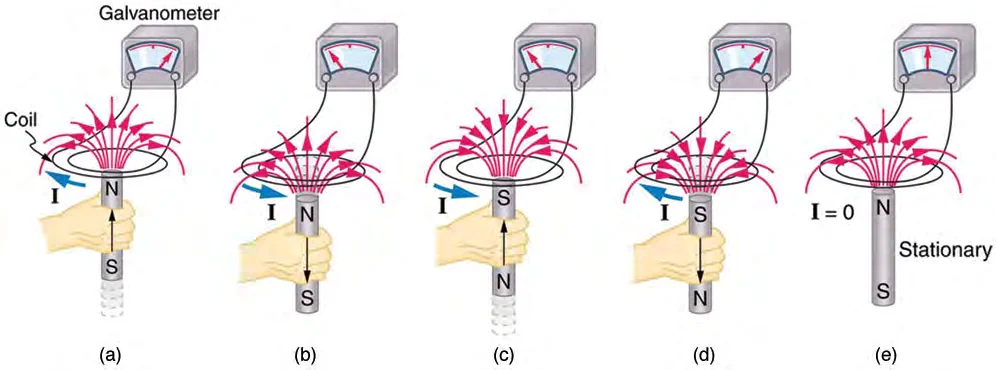
Lenz’s law gives the direction of an induced emf.
2
The induced emf drives a current that creates a magnetic field, and this induced field opposes the change in magnetic flux that caused it.
3
The minus sign in Faraday’s law expresses this opposition.
4
If the flux through a loop is increasing, the induced current produces a field that points opposite to the external field through the loop.
5
If the flux is decreasing, the induced current produces a field in the same direction as the external field, so that the flux is partly maintained.
6
Once the direction of the induced field is known, the right-hand rule for a current loop gives the direction of the induced current.
7
Lenz’s law is a consequence of conservation of energy.
8
If the induced current aided the change in flux, the change would increase by itself and energy would be created from nothing.
9
The opposition of the induced field means that work must be done to produce the induced current, and this work becomes electrical energy.
10
To apply Lenz’s law, find whether the flux is increasing or decreasing, decide the direction the induced field must have to oppose that change, and then use the right-hand rule to find the current that creates that field.
1
The rails and the rod form a circuit whose area changes as the rod moves.
2
Suppose the rod has length L, moves at speed v perpendicular to a field B, and the field is perpendicular to the plane of the circuit.
3
In a time Δt the rod moves a distance vΔt, so the area increases by L(vΔt).
4
The change in flux is ΔΦ = BL(vΔt).
5
Substituting into Faraday’s law gives the derived equation ε = BLv.
6
This is the motional emf.
7
The magnitude of the emf is largest when the rod moves perpendicular to the field, and it is zero if the rod moves parallel to the field.
8
If the circuit has a total resistance R, the induced current is I = ε/R = BLv/R.
9
By Lenz’s law this current produces a force on the rod that opposes its motion.
10
The magnitude of this force is F = ILB = B2L2v/R.
11
An external agent must supply a force at least this large to keep the rod moving at constant speed.
Example 1
Magnetic flux through a tilted loop
1
The angle between the field and the area vector is θ = 60°. Φ = BA cosθ = (0.50 T)(0.020 m2)(cos 60°) = (0.50)(0.020)(0.50) Wb = 5.0 × 10⁻³ Wb.
2
What the symbols mean Φ = magnetic flux (Wb) · B = magnetic flux density (T) · A = area at right angles to the field (m2)
Answer
5.0 × 10⁻³ Wb.
Example 2
Emf from a changing field
1
The change in flux per turn is ΔΦ = AΔB cos 0° = (0.010 m2)(0.60 T − 0.20 T)(1) = 4.0 × 10⁻³ Wb.
2
Then |ε| = N|ΔΦ|/Δt = (100)(4.0 × 10⁻³ Wb)/(0.50 s) = 0.80 V.
Answer
0.80 V. The sign in Faraday’s law shows that the induced current opposes the increase in flux
Example 3
Current and force for a rod on rails
1
ε = BLv = (0.50 T)(0.30 m)(2.0 m/s) = 0.30 V.
2
The current is I = ε/R = 0.30 V/0.060 Ω = 5.0 A.
3
The force on the rod is F = ILB = (5.0 A)(0.30 m)(0.50 T) = 0.75 N.
Answer
The emf is 0.30 V, the current is 5.0 A and the magnetic force is 0.75 N. By Lenz’s law the force on the rod is opposite to its velocity, so an applied force of at least 0.75 N is needed to keep it moving at constant speed.
Example 4
Direction of an induced current
1
The flux through the coil is increasing, so the induced field must oppose it and point back toward the magnet.
2
A current that circulates counterclockwise as seen by the observer produces a field that points toward the observer, which is toward the magnet.
3
By the right-hand rule, the current is counterclockwise.
Answer
The induced current flows counterclockwise, as seen by an observer on the side of the magnet, so that the induced field opposes the approaching north pole.
Using the size of the flux instead of its rate of change
A constant flux, however large, induces no emf.
Forgetting the angle in Φ = BA cosθ
The angle is measured from the normal to the plane of the loop, so a field parallel to the plane gives zero flux.
Stating that the induced current opposes the magnetic field rather than the change in flux
Lenz’s law refers to the change in flux.
Giving the force on a rod on rails in the same direction as its motion
The magnetic force opposes the motion.
Using ε = BLv for a rod moving parallel to the field
In that case the flux does not change and no emf is induced.
Avoid
Omitting the number of turns N when the coil has more than one turn