Curriculum
AP PHYSICS 2
9. Thermodynamics
0/13
10. Electric Force, Field, and Potential
0/15
-
10. Electric Force, Field, and Potential
 Preview
-
10.1 Electric Charge and Electric Force
Preview
-
10.1 Electric Charge and Electric Force - Check yourself
 Preview
-
10.2 Conservation of Electric Charge and the Process of Charging
Preview
-
10.2 Conservation of Electric Charge and the Process of Charging - Check yourself
Preview
-
10.3 Electric Fields
Preview
-
10.3 Electric Fields - Check yourself
Preview
-
10.4 Electric Potential Energy
Preview
-
10.4 Electric Potential Energy - Check yourself
Preview
-
10.5 Electric Potential
Preview
-
10.5 Electric Potential - Check yourself
Preview
-
10.6 Capacitors
Preview
-
10.6 Capacitors - Check yourself
Preview
-
10.7 Conservation of Electric Energy
Preview
-
10.7 Conservation of Electric Energy - Check yourself
Preview
11. Electric Circuits
0/17
12. Magnetism and Electromagnetism
0/9
13. Geometric Optics
0/9
14. Waves, Sound, and Physical Optics
0/19
15. Modern Physics
0/17
Text lesson
10.1 Electric Charge and Electric Force
10.1 Electric Charge and Electric Force — AP PHYSICS 2: ALGEBRA-BASED notes: You will be able to describe the electric force between charged objects, calculate the magnitude and direction of that force with Coulomb’s law, compare electric and gravitational forces, and account for the effect of a material’s electric permittivity on the force.
1Electric charge and its carriers2Electric charge and its carriers3Electric charge and its carriers
1Coulomb’s law2Coulomb’s law3Coulomb’s law4Coulomb’s law5Coulomb’s law6Coulomb’s law
Coulomb’s law
Coulomb’s law
Coulomb’s law describes the electrostatic force between two point charges.
1 / 6Next ▶
Coulomb’s law
1
The force is directly proportional to the magnitude of each charge and inversely proportional to the square of the distance between them:
2
F
3
=
4
k
5
|
6
q
◀ Previous2 / 6Next ▶
Coulomb’s law
1
1
2
2
3
|/
4
r
5
.
6
Here
◀ Previous3 / 6Next ▶
Coulomb’s law
Coulomb’s law
is the magnitude of the force in newtons (N),
and
are the charges in coulombs (C),
is the separation of the charges in metres (m),
and k = 9.0 × 10⁹ N·m2/C2 is the Coulomb constant.
The direction of the electric force is along the line joining the two charges.
◀ Previous4 / 6Next ▶
Coulomb’s law
1
Two charges of the same sign repel each other, and two charges of opposite sign attract each other.
2
The force that object 1 exerts on object 2 is equal in magnitude and opposite in direction to the force that object 2 exerts on object 1,
3
which is Newton’s third law applied to electric forces.
4
Because the force is a vector, the direction must be stated separately from the magnitude. In calculations, the magnitude of the force is found from the absolute values of the charges, and the sign of the charges is then used only to decide whether the force is attractive or repulsive.
◀ Previous5 / 6Next ▶
Two side-by-side panels: like charges pushing apart with outward arrows, unlike charges pulling together with inward arrows
Coulomb’s law
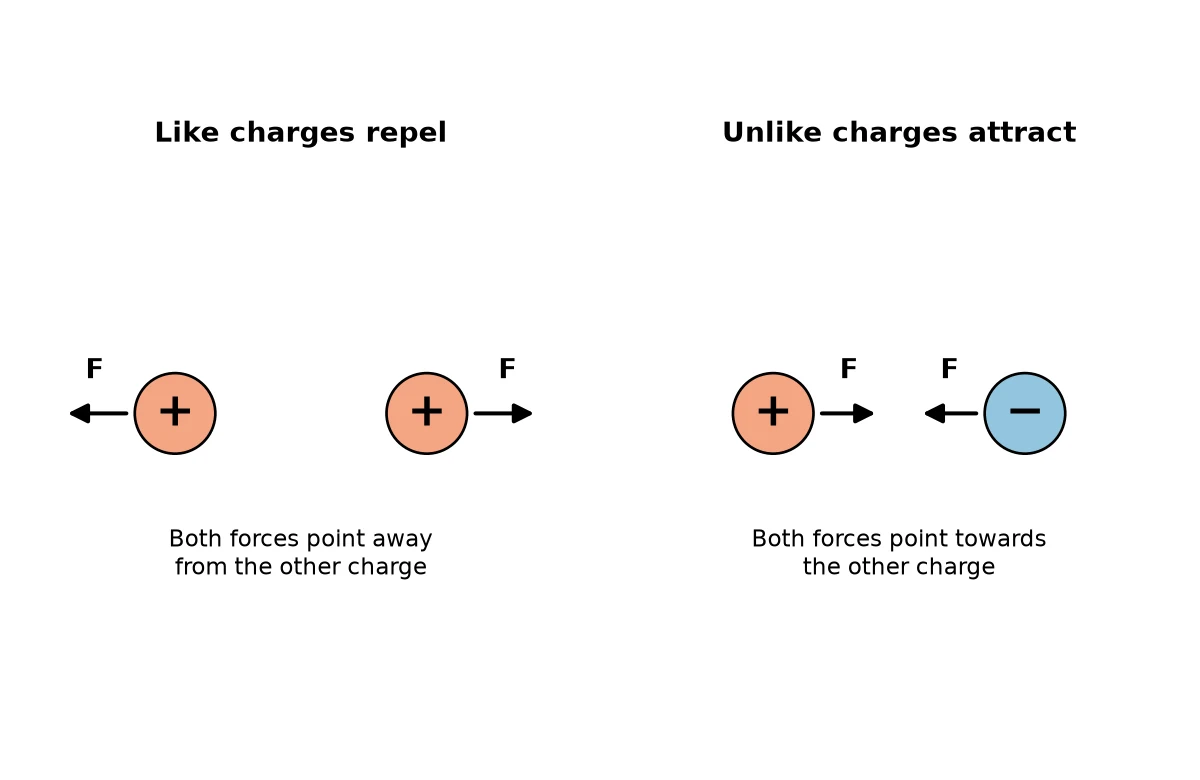
◀ Previous6 / 6
About this chapter: A child touches a plastic slide and the hair stands on end. Sliding stripped electrons from the child’s body, so the hair strands carry the same positive charge and repel one another.
Electric forces in everyday objects
 ⤢ Enlarge
Electric forces in everyday objects
Electric forces act between the electrons and nuclei of all atoms and molecules. Their combined effect gives the familiar forces of everyday life. The normal force that a table exerts on a book, the friction between two surfaces and the tension in a string all arise from electric interactions between particles at the atomic scale.
Because the number of particle interactions in a macroscopic object is very large, it is more convenient to describe these effects with contact forces such as the normal force, friction and tension, rather than by summing every electric interaction.
1Electric and gravitational forces compared2Electric and gravitational forces compared3Electric and gravitational forces compared4Electric and gravitational forces compared5Electric and gravitational forces compared
1Electric permittivity of matter2Electric permittivity of matter3Electric permittivity of matter4Electric permittivity of matter
1Forces from several charges2Forces from several charges
1Example 1: Force between two point charges · Example 2: Elec2Worked examples3Worked examples4Worked examples5Worked examples6Example 3: Net force from three charges on a line7Example 3: Net force from three charges on a line8Example 3: Net force from three charges on a line9Example 3: Net force from three charges on a line10Example 3: Net force from three charges on a line
Key terms
| Term | Meaning |
|---|---|
| Electric charge | A fundamental property of matter that is either positive or negative and gives rise to electric forces, measured in coulombs. |
| Elementary charge (e) | The magnitude of the charge of one electron or proton, 1.60 × 10⁻¹⁹ C. |
| Point charge | A model of a charged object whose physical size is negligible in the situation being analysed. |
| Coulomb’s law | The law stating that the electrostatic force between two point charges is F = k|q1q2|/r2. |
| Coulomb constant (k) | The constant 9.0 × 10⁹ N·m2/C2 that appears in Coulomb’s law in a vacuum. |
| Electric permittivity | A measure of how strongly a material or medium becomes polarised in the presence of an electric field. |
| Polarisation | The separation of positive and negative charge within a material caused by an external electric field. |
| Conductor | A material in which charge carriers move easily through the material. |
| Insulator | A material in which charge carriers cannot move easily through the material. |
| Contact force | A nonfundamental force, such as the normal force, friction or tension, that results from electric interactions between particles. |
1Avoid these mistakes2Avoid these mistakes3Avoid these mistakes