Curriculum
AP PHYSICS 2
9. Thermodynamics
0/52
10. Electric Force, Field, and Potential
0/6211. Electric Circuits
0/6811.3.1Resistance as opposition to charge flow11.3.2Resistivity and the geometry of a conductor11.3.3Resistivity and temperature11.3.4Ohm’s law and ohmic materials11.3.5Finding resistance from an I–V graph11.3.6Resistors and thermal energy11.3.7Worked examples11.3.8Key terms11.3.9Avoid these mistakes
11.5.1Series and parallel connections11.5.2Equivalent resistance of resistors in series11.5.3Equivalent resistance of resistors in parallel11.5.4Analysing a combined circuit11.5.5Real batteries and internal resistance11.5.6Ideal and nonideal ammeters and voltmeters11.5.7Worked examples11.5.8Key terms11.5.9Avoid these mistakes
12. Magnetism and Electromagnetism
0/3813. Geometric Optics
0/4214. Waves, Sound, and Physical Optics
0/751.1Describing any wave1.2Transverse and longitudinal waves, and electromagnetic waves1.3Boundaries, intensity and motion of sources1.4Superposition, beats and standing waves1.5Diffraction and interference of light1.6How the topics connect1.7Key equations of Unit 141.8Key terms1.9Avoid these mistakes
14.1.1Waves transfer energy, not matter14.1.2Wave pulses and continuous periodic waves14.1.3Mechanical and electromagnetic waves and the medium14.1.4Speed of waves on a string and in a medium14.1.5Transverse and longitudinal waves14.1.6Amplitude, loudness and energy14.1.7Worked examples14.1.8Key terms14.1.9Avoid these mistakes
15. Modern Physics
0/65
Text lesson
14. Waves, Sound, and Physical Optics
14. Waves, Sound, and Physical Optics
Describing any wave
Describing any wave
- Describing any wave3Describing any wave4Describing any wave5Describing any wave
- Describing any wave
- Describing any wave
- A wave transfers energy from one location to another without transferring matter between them (topic 14.1).
- A continuous periodic wave is described by its frequency
- f
- , its period
- T
- 1 / 5Next ▶
- Describing any wave
- = 1/
- , its wavelength
- λ
- and its amplitude
- A
- ,
- ◀ Previous, 2 / 5Next ▶
- Describing any wave
- Describing any wave
- and the speed of the wave is v = fλ (topic 14.2).
- The amplitude is independent of the period and the frequency
- while the energy increases with the amplitude and with the frequency.
- A wave on a string travels at
- v
- ◀ Previous, 3 / 5Next ▶
- Describing any wave
- Describing any wave
- = √(
- F
- /
- μ
- )
- so its speed depends on the medium and not on the source.
- ◀ Previous, 4 / 5Next ▶
- Describing any wave
- Mechanical waves need a medium, and electromagnetic waves travel through a vacuum at
- c
- = 3.00 × 10
- m/s.
- ◀ Previous, 5 / 5
14. Waves, Sound, and Physical Optics · 1 / 9
Transverse and longitudinal waves, and electromagnetic waves
Transverse and longitudinal waves, and electromagnetic waves
- Transverse and longitudinal waves, and electromagnetic waves · Transverse and longitudinal waves, and electromagnetic waves
- Transverse and longitudinal waves, and electromagnetic waves
- The disturbance of a transverse wave is perpendicular to its direction of propagation, and the disturbance of a longitudinal wave is parallel to it (topic 14.1).
- Transverse and longitudinal waves, and electromagnetic waves
Only transverse waves can be polarized
- which restricts their oscillation to one plane and reduces the intensity of the wave (topic 14.3).
- Electromagnetic waves are transverse waves of oscillating electric and magnetic fields,
- and their wavelengths place them in the order of the spectrum from radio waves to gamma rays, with visible light between infrared and ultraviolet (topic 14.4).
14. Waves, Sound, and Physical Optics · 2 / 9
Boundaries, intensity and motion of sources
Boundaries, intensity and motion of sources
- Boundaries, intensity and motion of sources3Boundaries, intensity and motion of sources
- Boundaries, intensity and motion of sources
- Boundaries, intensity and motion of sources
- When a wave meets a boundary it is partly transmitted and partly reflected.
- The frequency is the same on both sides
- so the change in speed changes the wavelength.
- A reflected wave is inverted when the wave enters a medium in which its speed decreases (topic 14.3).
- 1 / 3Next ▶
- Boundaries, intensity and motion of sources
- The intensity of a wave is the average power per unit area,
- I
- =
- P
- /
- A
- ◀ Previous, 2 / 3Next ▶
- Boundaries, intensity and motion of sources
- Boundaries, intensity and motion of sources
- .
- The Doppler effect shows that the observed frequency depends on the relative velocity of the source and the observer: it is higher than the rest frequency when the source approaches and lower when it recedes (topic 14.5).
- ◀ Previous, 3 / 3
14. Waves, Sound, and Physical Optics · 3 / 9
Superposition, beats and standing waves
Superposition, beats and standing waves
- Superposition, beats and standing waves3Superposition, beats and standing waves
- Superposition, beats and standing waves
- Superposition, beats and standing waves
- When waves overlap, their displacements add
- which is superposition, and the result is constructive or destructive interference (topic 14.6).
- 1 / 3Next ▶
- Superposition, beats and standing waves
- Two waves of slightly different frequency produce beats at the frequency |
- f
- −
- |.
- ◀ Previous, 2 / 3Next ▶
- Superposition, beats and standing waves
- Waves confined to a region and travelling in opposite directions form standing waves with nodes and antinodes,
- and the boundary conditions decide the allowed harmonics.
- For a string fixed at both ends,
- 4or an open pipe, fn = nv/(2L)
- for a region with a node at one end and an antinode at the other, only odd harmonics appear, with fn = nv/(4L).
- ◀ Previous, 3 / 3
14. Waves, Sound, and Physical Optics · 4 / 9
Diffraction and interference of light
Diffraction and interference of light
- Diffraction and interference of light3Diffraction and interference of light4Diffraction and interference of light
- Diffraction and interference of light
- Diffraction and interference of light
- Diffraction is the spreading of a wave through an opening, and it is most pronounced when the opening is comparable to the wavelength (topic 14.7).
- A single slit of width
- a
- has dark bands where
- sin
- 1 / 4Next ▶
- Diffraction and interference of light
- θ
- =
- mλ
- .
- Two slits separated by
- ◀ Previous, 2 / 4Next ▶
- Diffraction and interference of light
- Diffraction and interference of light
- d
- produce bright maxima where
- , superimposed on the single-slit envelope,
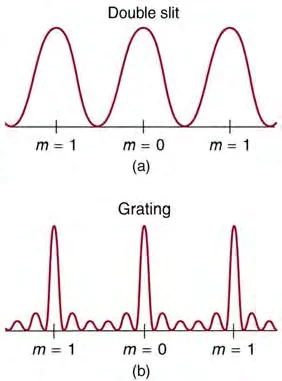
- and a diffraction grating gives the same maxima with much sharper peaks (topic 14.8).
- Young’s double-slit experiment showed that light is a wave.
- ◀ Previous, 3 / 4Next ▶
- Double-slit fringes compared with the much sharper maxima from a grating.
- Diffraction and interference of light
- ⤢ Enlarge
- Diffraction and interference of light
- Thin films reflect light from two surfaces,
- and the phase change of each reflection, together with the film thickness and wavelength, decides whether the reflected light is brighter or darker (topic 14.9).
- ◀ Previous, 4 / 4
14. Waves, Sound, and Physical Optics · 5 / 9
How the topics connect
How the topics connect
- How the topics connect
- How the topics connect
- The unit builds from one idea.
- Topics 14.1 and 14.2 give the language of waves: speed, frequency, wavelength, amplitude and the transverse or longitudinal character of the disturbance.
- 5Topic 14.3 applies this language to what happens at a boundary, and topic 14.4 applies it to electromagnetic waves
- which need no medium.
- 1 / 2Next ▶
- How the topics connect
- Topic 14.5 shows that the frequency a receiver measures depends on motion, and topic 14.6 shows how overlapping and confined waves combine.
- Topics 14.7 to 14.9 use the same interference condition, a path difference compared with the wavelength, to explain the patterns seen with light.
- Each new pattern is therefore a variation of the path difference and phase rules introduced earlier in the unit.
- ◀ Previous, 2 / 2
14. Waves, Sound, and Physical Optics · 6 / 9
Key equations of Unit 14
Key equations of Unit 14
- Key equations of Unit 14
| Equation | Symbols and SI units | Topic |
|---|---|---|
| v = fλ = λ/T; T = 1/f | v wave speed (m/s); f frequency (Hz); λ wavelength (m); T period (s) | 14.2 |
| y(x, t) = A sin[2π(x/λ − t/T)] | y displacement (m); A amplitude (m); x position (m); t time (s) | 14.2 |
| v = √(FT/μ), with μ = m/ℓ | FT tension (N); μ mass per unit length (kg/m) | 14.1 |
| I = P/A | I intensity (W/m2); P average power (W); A area perpendicular to propagation (m2) | 14.3 |
| c = fλ, with c = 3.00 × 10⁸ m/s | c speed of light in a vacuum (m/s); f (Hz); λ (m) | 14.4 |
| fbeat = |f1 − f2| | fbeat, f1, f2 frequencies (Hz) | 14.6 |
| λn = 2L/n; fn = nv/(2L) (both ends fixed or open) | L length of region (m); n = 1, 2, 3 (harmonic number) | 14.6 |
| fn = nv/(4L), for n = 1, 3, 5 (node at one end, antinode at the other) | n odd harmonic number; L (m); v (m/s) | 14.6 |
| a sin θ = mλ (single-slit minima); Δ = a sin θ | a slit width (m); θ angle (degrees or radians); m = ±1, ±2, … (no zero) | 14.7 |
| ym = mλL/a (single slit, small angles) | ym distance from centre (m); L screen distance (m) | 14.7 |
| d sin θ = mλ (double-slit and grating maxima) | d slit separation (m); m = 0, ±1, ±2, … | 14.8 |
| ym = mλL/d; Δy = λL/d (small angles) | Δy fringe spacing (m); d (m); L (m) | 14.8 |
| 2nt = mλ and 2nt = (m + ½)λ (thin film, normal incidence; the first applies when both or neither reflection is inverted) | n index of refraction (no unit); t film thickness (m); λ vacuum wavelength (m) | 14.9 |
| t = λ/(4n) (simplest antireflection coating) | t coating thickness (m); λ vacuum wavelength (m) | 14.9 |
14. Waves, Sound, and Physical Optics · 7 / 9
Key terms
Key terms
- Key terms
| Term | Meaning |
|---|---|
| Superposition | The principle that the displacement of overlapping waves is the sum of their individual displacements. |
| Standing wave |
|
| Diffraction | The spreading of a wave around the edges of an obstacle or through an opening. |
| Doppler effect | The change in observed frequency caused by the relative motion of a source and an observer. |
| Polarization | The restriction of the oscillation of a transverse wave to a single plane. |
| Thin film |
|
14. Waves, Sound, and Physical Optics · 8 / 9
Avoid these mistakes
Avoid these mistakes
Avoid these mistakes2→Avoid these mistakes3Avoid these mistakes
Avoid these mistakes
Avoid this
- Using the wrong formula for the same situation.Avoid this
- The slit separation d belongs to bright maxima of a double slit or grating, and the slit width a belongs to the dark bands of a single slit.Avoid this
Avoid this
- Assuming that the frequency changes at a boundary or when a wave enters a new medium.Avoid this
- The frequency stays the same, and the wavelength and speed change.Avoid this
1 / 3Next ▶
Avoid these mistakes
Avoid this
- Using the even-harmonic formula for a region with a node at one end and an antinode at the other.
Only odd harmonics are possible there.Avoid this
Avoid this
- Applying the thin-film condition without first deciding how many reflections are inverted,Avoid this
- which determines whether the constructive condition has m or (m + ½).Avoid this
Avoid this
◀ Previous, 2 / 3Next ▶
Avoid these mistakes
- Mixing up the Doppler shift with a change in the source’s emitted frequency.Avoid this
- The source’s rest frequency does not change; only the observed frequency does.Avoid this
◀ Previous, 3 / 3
14. Waves, Sound, and Physical Optics · 9 / 9
Well done! You finished this lesson
What would you like to do next?