Curriculum
AP PHYSICS 2
9. Thermodynamics
0/13
10. Electric Force, Field, and Potential
0/15
-
10. Electric Force, Field, and Potential
 Preview
-
10.1 Electric Charge and Electric Force
Preview
-
10.1 Electric Charge and Electric Force - Check yourself
 Preview
-
10.2 Conservation of Electric Charge and the Process of Charging
Preview
-
10.2 Conservation of Electric Charge and the Process of Charging - Check yourself
Preview
-
10.3 Electric Fields
Preview
-
10.3 Electric Fields - Check yourself
Preview
-
10.4 Electric Potential Energy
Preview
-
10.4 Electric Potential Energy - Check yourself
Preview
-
10.5 Electric Potential
Preview
-
10.5 Electric Potential - Check yourself
Preview
-
10.6 Capacitors
Preview
-
10.6 Capacitors - Check yourself
Preview
-
10.7 Conservation of Electric Energy
Preview
-
10.7 Conservation of Electric Energy - Check yourself
Preview
11. Electric Circuits
0/17
12. Magnetism and Electromagnetism
0/9
13. Geometric Optics
0/9
14. Waves, Sound, and Physical Optics
0/19
15. Modern Physics
0/17
Text lesson
10.6 Capacitors
10.6 Capacitors — AP PHYSICS 2: ALGEBRA-BASED notes: You will be able to describe a parallel-plate capacitor, calculate its capacitance and the field between its plates, find the energy stored in it, and explain how a dielectric changes its capacitance and the fields inside it.
1The parallel-plate capacitor2The parallel-plate capacitor3The parallel-plate capacitor
The parallel-plate capacitor
The parallel-plate capacitor
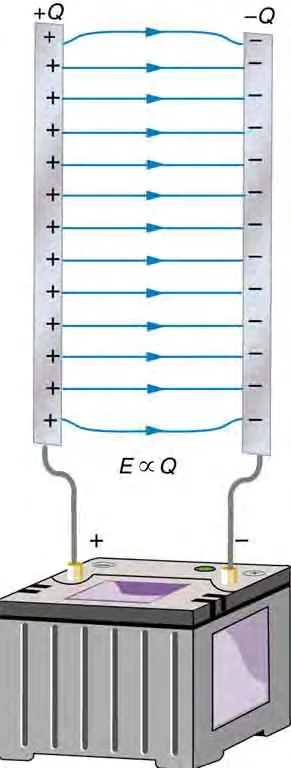
A parallel-plate capacitor consists of two separated parallel conducting surfaces that can hold equal amounts of charge with opposite signs.
1 / 3Next ▶
The parallel-plate capacitor
1
When a capacitor is charged, one plate has charge +
2
Q
3
and the other has charge −
4
so the net charge of the capacitor as a whole is zero.
5
The charge
6
is the magnitude of the charge on either plate.
◀ Previous2 / 3Next ▶
Parallel-plate capacitors: field, potential and capacitance: Field lines run straight between the plates of a charged parallel-plate capacitor.
The parallel-plate capacitor
 ⤢ Enlarge
The parallel-plate capacitor
The charges on the plates create a potential difference between them. The charges are held apart by the gap, and the energy needed to separate them is stored in the electric field between the plates.
◀ Previous3 / 3
1Capacitance2Capacitance3Capacitance
1The electric field between the plates2The electric field between the plates3The electric field between the plates4The electric field between the plates
1Energy stored in a capacitor2Energy stored in a capacitor
1Dielectrics2Dielectrics
1Example 1: Capacitance of a parallel-plate capacitor · Examp2Example 3: Inserting a dielectric with constant charge3Worked examples4Worked examples5Worked examples6Worked examples7Worked examples
Key terms
| Term | Meaning |
|---|---|
| Parallel-plate capacitor | Two separated parallel conducting surfaces that hold equal and opposite charges. |
| Capacitance (C) | The ratio of the charge on each plate to the potential difference between the plates, measured in farads. |
| Farad (F) | The unit of capacitance, equal to one coulomb per volt. |
| Electric permittivity of free space (ε0) | The constant 8.85 × 10⁻¹² F/m that describes the electric properties of free space. |
| Dielectric | An insulating material placed between the plates of a capacitor that is polarised by the field and increases the capacitance. |
| Dielectric constant (κ) | A number, equal to 1 for a vacuum, that gives the factor by which a dielectric increases the capacitance. |
| Edge effects | Changes in the electric field near the edges of the plates, which are ignored in the parallel-plate model unless stated otherwise. |
| Energy stored in a capacitor (UC) | The work done to separate the charge on the capacitor, equal to ½QΔV. |
| Induced field in a dielectric | A field produced inside a dielectric by its polarisation, which points opposite to the field between the plates. |
1Avoid these mistakes2Avoid these mistakes3Avoid these mistakes4Avoid these mistakes5Avoid these mistakes