Curriculum
AP PHYSICS 2
9. Thermodynamics
0/13
10. Electric Force, Field, and Potential
0/15
11. Electric Circuits
0/17
12. Magnetism and Electromagnetism
0/9
13. Geometric Optics
0/9
14. Waves, Sound, and Physical Optics
0/19
15. Modern Physics
0/17
-
15. Modern Physics
 Preview
-
15.1 Quantum Theory and Wave-Particle Duality
Preview
-
15.1 Quantum Theory and Wave-Particle Duality - Check yourself
 Preview
-
15.2 The Bohr Model of Atomic Structure
Preview
-
15.2 The Bohr Model of Atomic Structure - Check yourself
Preview
-
15.3 Emission and Absorption Spectra
Preview
-
15.3 Emission and Absorption Spectra - Check yourself
Preview
-
15.4 Blackbody Radiation
Preview
-
15.4 Blackbody Radiation - Check yourself
Preview
-
15.5 The Photoelectric Effect
Preview
-
15.5 The Photoelectric Effect - Check yourself
Preview
-
15.6 Compton Scattering
Preview
-
15.6 Compton Scattering - Check yourself
Preview
-
15.7 Fission, Fusion, and Nuclear Decay
Preview
-
15.7 Fission, Fusion, and Nuclear Decay - Check yourself
Preview
-
15.8 Types of Radioactive Decay
Preview
-
15.8 Types of Radioactive Decay - Check yourself
Preview
Text lesson
15.6 Compton Scattering
15.6 Compton Scattering — AP PHYSICS 2: ALGEBRA-BASED notes: You will be able to describe Compton scattering as a collision between a photon and a free electron, apply conservation of energy and momentum to find the change in wavelength of a scattered photon from the scattering angle, and explain why this result is evidence that light is made of discrete photons.
1Compton scattering as a collision2Compton scattering as a collision3Compton scattering as a collision
Compton scattering as a collision
Compton scattering as a collision
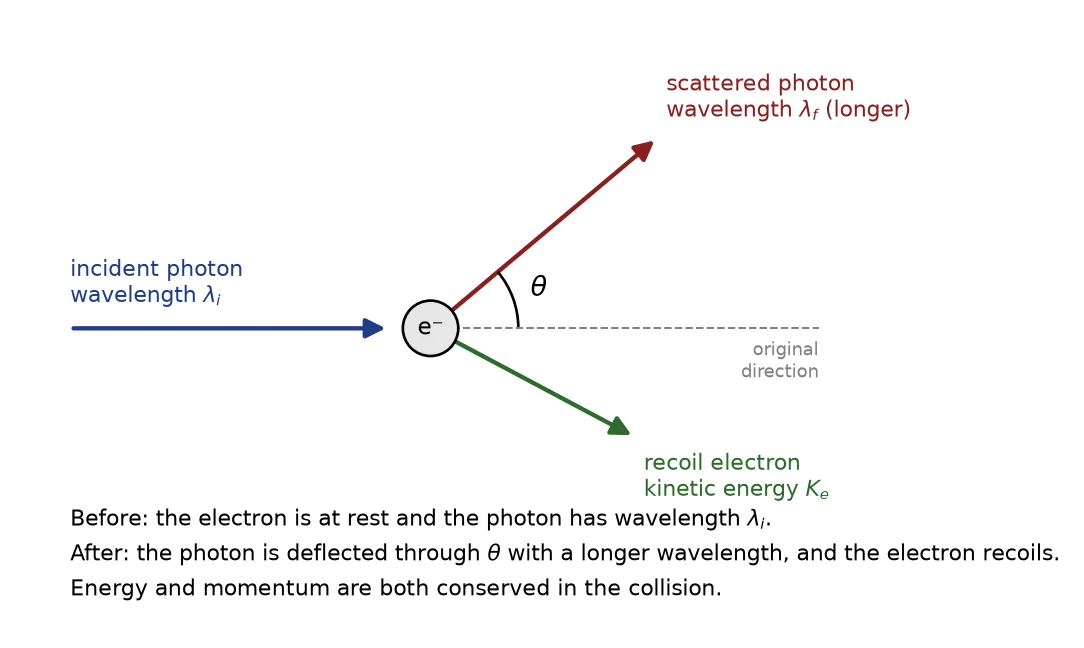
In Compton scattering, a photon interacts with a free electron
which is an electron that is not bound tightly to an atom and so can be treated as initially at rest.
1 / 3Next ▶
Compton scattering as a collision
1
The photon transfers part of its energy and momentum to the electron and is scattered in a new direction.
2
The photon that emerges has lower energy and a longer wavelength than the incoming photon.
3
The size of this change depends on the direction in which the photon is scattered.
4
Classical wave theory cannot account for this result. A wave scattered by an electron would keep the same frequency
so the wavelength shift that is observed is evidence that light behaves as a stream of particles.
◀ Previous2 / 3Next ▶
Compton scattering geometry: incident photon, electron at rest, scattered photon at angle θ and recoil electron.
Compton scattering as a collision
◀ Previous3 / 3
1Treating the photon as a particle2Treating the photon as a particle
1The change in wavelength2The change in wavelength3The change in wavelength4The change in wavelength
The change in wavelength
1
Applying conservation of energy and momentum gives the change in wavelength of the photon in terms of the scattering angle θ
which is the angle between the directions of the incoming and scattered photons:
2
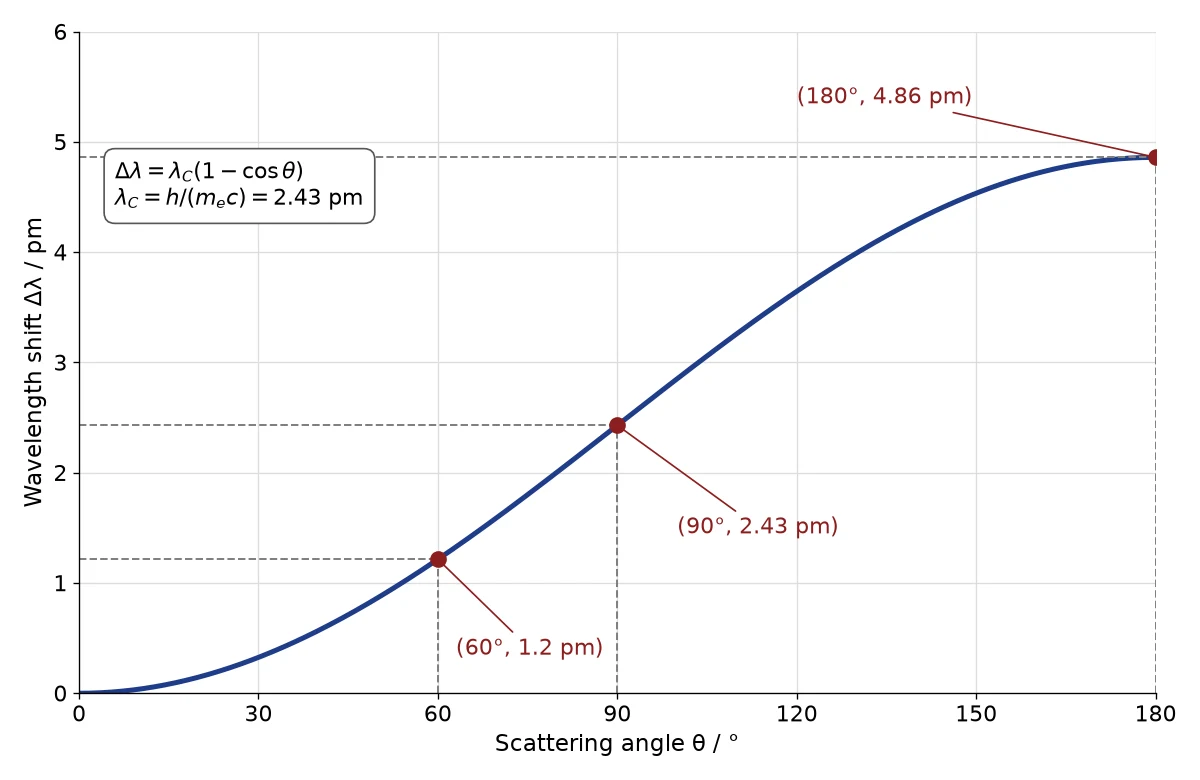
λ′ − λ = Δλ = (h/(mec))(1 − cos θ)
3
Here λ is the incoming wavelength, λ′ is the scattered wavelength, me = 9.11 × 10⁻³¹ kg is the mass of the electron, and c = 3.00 × 10⁸ m/s.
1 / 4Next ▶
The change in wavelength
The change in wavelength
The quantity
h
/(
m
e
c
◀ Previous2 / 4Next ▶
The change in wavelength
1
) = 2.43 × 10
2
-12
3
m is a constant called the Compton wavelength of the electron.
4
The change in wavelength depends on the scattering angle only.
5
It does not depend on the incoming wavelength or on the material that the photon strikes.
6
The change is zero when θ = 0°, and it is largest when θ = 180°
where Δλ = 2 × 2.43 × 10-12 m = 4.86 × 10⁻¹² m. Because Δλ is always greater than or equal to zero, the scattered photon never has a shorter wavelength than the incoming photon.
◀ Previous3 / 4Next ▶
Graph of wavelength shift Δλ against scattering angle θ, rising from 0 at 0° to 4.86 pm at 180°.
The change in wavelength
 ⤢ Enlarge
The change in wavelength
Compton scattering provides evidence that light is a collection of discrete, quantized energy packets called photons. The photon model predicts the measured wavelength shift, and the wave model does not.
◀ Previous4 / 4
1Example 1: Scattering through 90° · Example 2: Energy transf2Worked examples3Worked examples4Worked examples5Example 3: Scattering through 180°
Key terms
| Term | Meaning |
|---|---|
| Compton scattering | The scattering of a photon by a free electron, in which the scattered photon has lower energy and longer wavelength than the incoming photon. |
| Free electron | An electron that is not bound tightly to an atom and can be treated as initially at rest in a collision. |
| Scattering angle (θ) | The angle between the directions of the incoming photon and the scattered photon. |
| Photon momentum | The momentum of a photon, p = h/λ = E/c. |
| Compton wavelength of the electron | The constant h/(mec) = 2.43 × 10⁻¹² m that sets the scale of the wavelength shift. |
| Conservation of momentum | The principle that the total momentum of the photon and electron is the same before and after the collision, in both directions. |
| Recoil electron | The electron that gains momentum and kinetic energy when it is struck by a photon. |
1Avoid these mistakes2Avoid these mistakes3Avoid these mistakes