Curriculum
AP PHYSICS 2
9. Thermodynamics
0/13
10. Electric Force, Field, and Potential
0/15
-
10. Electric Force, Field, and Potential
 Preview
-
10.1 Electric Charge and Electric Force
Preview
-
10.1 Electric Charge and Electric Force - Check yourself
 Preview
-
10.2 Conservation of Electric Charge and the Process of Charging
Preview
-
10.2 Conservation of Electric Charge and the Process of Charging - Check yourself
Preview
-
10.3 Electric Fields
Preview
-
10.3 Electric Fields - Check yourself
Preview
-
10.4 Electric Potential Energy
Preview
-
10.4 Electric Potential Energy - Check yourself
Preview
-
10.5 Electric Potential
Preview
-
10.5 Electric Potential - Check yourself
Preview
-
10.6 Capacitors
Preview
-
10.6 Capacitors - Check yourself
Preview
-
10.7 Conservation of Electric Energy
Preview
-
10.7 Conservation of Electric Energy - Check yourself
Preview
11. Electric Circuits
0/17
12. Magnetism and Electromagnetism
0/9
13. Geometric Optics
0/9
14. Waves, Sound, and Physical Optics
0/19
15. Modern Physics
0/17
Text lesson
10.7 Conservation of Electric Energy
10.7 Conservation of Electric Energy — AP PHYSICS 2: ALGEBRA-BASED notes: You will be able to calculate the change in electric potential energy of a charged object that moves between points of different potential, apply conservation of energy to find changes in kinetic energy and speed, and sketch and interpret energy graphs for a charge in an electric field.
The change is given by ΔU = qΔV.
Here ΔU is the change in electric potential energy in joules (J), q is the charge of the object in coulombs (C), including its sign, and ΔV = Vfinal − Vinitial is the change in electric potential in volts (V).
The sign of the charge matters.
A positive charge moving toward lower potential loses electric potential energy, because ΔV is negative and q is positive.
A negative charge moving toward higher potential also loses electric potential energy, because ΔV is positive and q is negative.
In both cases the object-field system loses electric potential energy and the energy appears as kinetic energy of the object.
The electron-volt is a convenient unit of energy for atomic processes.
One electron-volt is the energy gained by an electron when it moves through a potential difference of 1 V, so 1 eV = 1.60 × 10⁻¹⁹ J.
The change in kinetic energy equals the negative of the change in electric potential energy: ΔK = −ΔU = −qΔV.
This is consistent with the conservation of energy, because the energy lost by the potential energy of the system is gained as kinetic energy of the object.
For an object that starts from rest, the kinetic energy after moving through a potential difference is ½mv2 = −qΔV.
Energy conserved
The speed is then v = √(−2qΔV/m).
Here m is the mass of the object in kilograms (kg) and v is its speed in metres per second (m/s).
When an external force moves a charged object against the electric force, the work done by the external force equals the increase in electric potential energy of the system, so the object does not gain kinetic energy if it moves slowly.
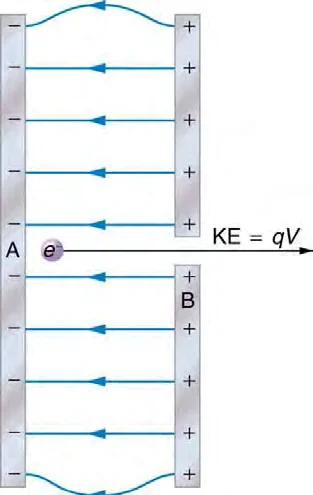
Its electric potential energy changes linearly with its position along the field, because the potential changes linearly with distance.
If the object is released from rest, its kinetic energy increases linearly and its potential energy decreases linearly by the same amount, so the sum of the two stays constant.
A sketch of kinetic energy and potential energy against position for a positive charge released from rest in a uniform field shows the potential energy decreasing in a straight line while the kinetic energy rises in a straight line.
The two lines are mirror images, and their sum is a horizontal line at the total energy.
Question
An electron is released from rest and accelerates through a potential difference of 500 V, moving from a point of low potential to a point of high potential. Find the change in its electric potential energy, and its final speed. The electron mass is 9.11 × 10⁻³¹ kg.
1
The charge of the electron is q = −1.60 × 10⁻¹⁹ C and ΔV = +500 V.
2
The change in potential energy is ΔU = qΔV = (−1.60 × 10⁻¹⁹ C)(+500 V) = −8.0 × 10⁻¹⁷ J.
3
The kinetic energy gained is therefore +8.0 × 10⁻¹⁷ J.
4
The speed is v = √(2 × 8.0 × 10−17 J/9.11 × 10−31 kg) = 1.3 × 10⁷ m/s.
Answer
The potential energy decreases by 8.0 × 10⁻¹⁷ J, and the electron’s final speed is 1.3 × 10⁷ m/s.
Question
A proton (charge +1.60 × 10⁻¹⁹ C, mass 1.67 × 10⁻²⁷ kg) is released from rest at a point where the potential is 120 V. It moves to a point where the potential is 20 V. Find the change in its electric potential energy and its speed at the second point.
1
The change in electric potential is ΔV = 20 V − 120 V = −100 V.
2
The change in potential energy is ΔU = (+1.60 × 10⁻¹⁹ C)(−100 V) = −1.6 × 10⁻¹⁷ J.
3
The kinetic energy gained is +1.6 × 10⁻¹⁷ J, so the speed is v = √(2 × 1.6 × 10−17 J/1.67 × 10−27 kg) = 1.4 × 10⁵ m/s.
Answer
The potential energy decreases by 1.6 × 10⁻¹⁷ J, and the proton’s speed is 1.4 × 10⁵ m/s. The proton moves toward lower potential, which is the direction of the field.
Question
A charge of −3.0 μC is moved slowly from point A, where the potential is +40 V, to point B, where the potential is +10 V. Find the change in electric potential energy of the charge and the work done by the external force.
1
The change in potential is ΔV = +10 V − (+40 V) = −30 V.
2
The change in potential energy is ΔU = (−3.0 × 10⁻⁶ C)(−30 V) = +9.0 × 10⁻⁵ J.
3
The electric force does work −ΔU = −9.0 × 10⁻⁵ J on the charge, so an external force must do +9.0 × 10⁻⁵ J of work to move it slowly, with no change in kinetic energy.
Answer
The electric potential energy increases by 9.0 × 10⁻⁵ J, and the external force does +9.0 × 10⁻⁵ J of work on the charge. The negative charge moves toward lower potential, which is against the electric force that would push it toward higher potential.
Using the magnitude of the charge in ΔU = qΔV
The sign of the charge determines the sign of the change in potential energy.
Assuming that a charge always gains kinetic energy when it moves.
A positive charge released from rest gains kinetic energy only when it moves toward lower potential, and a negative charge released from rest gains it only when it moves toward higher potential.
Reversing the sign of ΔV.
It is the final potential minus the initial potential, so a move to lower potential gives a negative ΔV.
Confusing the work done by the electric force with the work done by an external force.
They are equal in magnitude and opposite in sign.
Drawing the potential energy graph of a released charge as rising.
For a charge released from rest in a field, potential energy falls while kinetic energy rises.
Avoid
Forgetting to convert the electron-volt into joules, or using electron-volts in the kinetic energy equation with SI masses and speeds.