Curriculum
AP PHYSICS 2
9. Thermodynamics
0/13
10. Electric Force, Field, and Potential
0/15
11. Electric Circuits
0/17
12. Magnetism and Electromagnetism
0/9
13. Geometric Optics
0/9
14. Waves, Sound, and Physical Optics
0/19
15. Modern Physics
0/17
-
15. Modern Physics
 Preview
-
15.1 Quantum Theory and Wave-Particle Duality
Preview
-
15.1 Quantum Theory and Wave-Particle Duality - Check yourself
 Preview
-
15.2 The Bohr Model of Atomic Structure
Preview
-
15.2 The Bohr Model of Atomic Structure - Check yourself
Preview
-
15.3 Emission and Absorption Spectra
Preview
-
15.3 Emission and Absorption Spectra - Check yourself
Preview
-
15.4 Blackbody Radiation
Preview
-
15.4 Blackbody Radiation - Check yourself
Preview
-
15.5 The Photoelectric Effect
Preview
-
15.5 The Photoelectric Effect - Check yourself
Preview
-
15.6 Compton Scattering
Preview
-
15.6 Compton Scattering - Check yourself
Preview
-
15.7 Fission, Fusion, and Nuclear Decay
Preview
-
15.7 Fission, Fusion, and Nuclear Decay - Check yourself
Preview
-
15.8 Types of Radioactive Decay
Preview
-
15.8 Types of Radioactive Decay - Check yourself
Preview
Text lesson
15.2 The Bohr Model of Atomic Structure
15.2 The Bohr Model of Atomic Structure — AP PHYSICS 2: ALGEBRA-BASED notes: You will be able to describe the structure of an atom and use nuclear notation, apply the Coulomb and centripetal force equations to an electron in a circular orbit, and explain with a standing-wave argument why an electron in an atom can occupy only certain energy states.
1Structure of the atom and nuclear notation2Structure of the atom and nuclear notation
1The Bohr model: electrons in circular orbits2The Bohr model: electrons in circular orbits
1Standing waves and allowed energy states2Standing waves and allowed energy states
Standing waves and allowed energy states
1
The Bohr model alone does not explain why only certain orbits are allowed.
2
The standing-wave model of the electron gives this explanation.
3
An electron behaves as a wave with de Broglie wavelength λ = h/(mv).
4
For the electron to form a stable standing wave around the nucleus, the circumference of its orbit must be an integer multiple of its wavelength:
1 / 2Next ▶
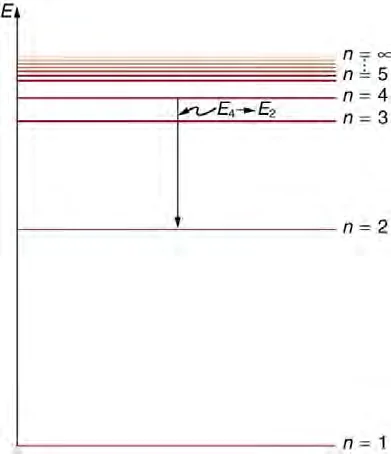
Energy-level diagram with discrete levels and a transition between two of them. Image: OpenStax, College Physics for AP Courses, CC BY 4.0.
Standing waves and allowed energy states
 ⤢ Enlarge
1
2πr = nλ, with n = 1, 2, 3, …
2
Here n is the principle quantum number, a whole number that labels the allowed orbit. Combining this condition with λ = h/(mv) gives mvr = nh/(2π)
so only certain values of the orbital radius and speed are possible. Each allowed orbit corresponds to one discrete energy state of the electron.
3
The standing-wave model explains the existence of specific allowed energy states. It does not describe orbitals, orbital shapes or probability functions
which are beyond the scope of this course. The analysis of electron structure in AP Physics 2 is limited to energy levels.
4
For hydrogen, the allowed energy states are given by En = −13.6 eV/n2. The negative sign shows that the electron is bound to the nucleus. The state with n = 1 is the ground state
which has the lowest energy.
◀ Previous2 / 2
1Example 1: Nuclear notation for an ion · Example 2: Coulomb 2Example 3: Checking the standing-wave condition
Key terms
| Term | Meaning |
|---|---|
| Atomic number (Z) | The number of protons in a nucleus, which identifies the element. |
| Mass number (A) | The total number of protons and neutrons in a nucleus. |
| Isotopes | Atoms of the same element that have different numbers of neutrons, and so different mass numbers. |
| Ion | An atom with a nonzero net electric charge because it has gained or lost electrons. |
| Bohr model | A model of the atom in which electrons move in circular orbits around a central nucleus under the electric force. |
| Coulomb force | The electric force between two charges, F = k|q1q2|/r2. |
| Standing wave | A wave pattern that does not travel, formed when a whole number of wavelengths fits around a closed path. |
| Principle quantum number (n) | A whole number, 1, 2, 3, …, that labels an allowed orbit and its energy state. |
| Ground state | The lowest-energy state of an atom, which corresponds to n = 1 for hydrogen. |
1Avoid these mistakes2Avoid these mistakes3Avoid these mistakes