Curriculum
AP PHYSICS 2
9. Thermodynamics
0/13
10. Electric Force, Field, and Potential
0/15
-
10. Electric Force, Field, and Potential
 Preview
-
10.1 Electric Charge and Electric Force
Preview
-
10.1 Electric Charge and Electric Force - Check yourself
 Preview
-
10.2 Conservation of Electric Charge and the Process of Charging
Preview
-
10.2 Conservation of Electric Charge and the Process of Charging - Check yourself
Preview
-
10.3 Electric Fields
Preview
-
10.3 Electric Fields - Check yourself
Preview
-
10.4 Electric Potential Energy
Preview
-
10.4 Electric Potential Energy - Check yourself
Preview
-
10.5 Electric Potential
Preview
-
10.5 Electric Potential - Check yourself
Preview
-
10.6 Capacitors
Preview
-
10.6 Capacitors - Check yourself
Preview
-
10.7 Conservation of Electric Energy
Preview
-
10.7 Conservation of Electric Energy - Check yourself
Preview
11. Electric Circuits
0/17
12. Magnetism and Electromagnetism
0/9
13. Geometric Optics
0/9
14. Waves, Sound, and Physical Optics
0/19
15. Modern Physics
0/17
Text lesson
10.3 Electric Fields
10.3 Electric Fields — AP PHYSICS 2: ALGEBRA-BASED notes: You will be able to define the electric field as force per unit charge, calculate the field of a point charge and the net field of several charges, represent fields with vector maps and field lines, and describe the field of charged conductors and insulators.
The electric field at a given point is the ratio of the electric force exerted on a test charge at that point to the charge of the test charge: E = FE/q.
Here E is the electric field in newtons per coulomb (N/C), FE is the electric force in newtons (N), and q is the test charge in coulombs (C).
The electric field is a vector, and its direction is the direction of the force on a positive test charge.
Electric field
A test charge is a point charge small enough that its presence does not significantly affect the electric field in its vicinity.
Because the field is defined as force per unit charge, it does not depend on the size of the test charge, only on the charges that produce the field.
Because E = FE/q, the force on any charge q in a field is FE = qE. If q is negative, the force points opposite to the field.
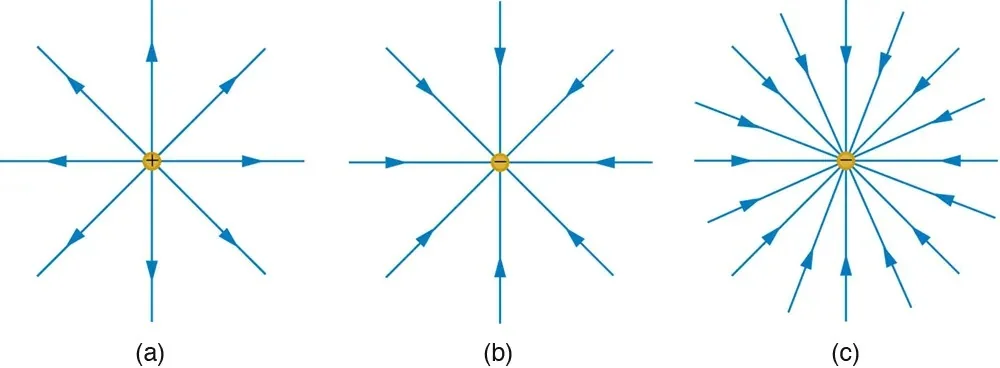
A positive charge is a source of field lines that point outward, and a negative charge is a sink of field lines that point inward.
The field points away from isolated positive charges and toward isolated negative charges.
Combining Coulomb’s law with the definition of the field gives the field of a point charge: E = k|q|/r2.
Here E is the magnitude of the field in N/C, q is the charge that produces the field in coulombs, and r is the distance from the charge in metres.
The field magnitude falls off with the square of the distance, and its direction is radially away from a positive charge or toward a negative charge.
This is the principle of superposition.
For AP Physics 2, you should be able to find the net field from up to four charged objects.
For more charges, the calculation is allowed only when the arrangement has high symmetry.
Superposition
To add fields, find the component of each field along each axis, with the sign given by its direction, and then combine the components.
The magnitude of the net field is the square root of the sum of the squares of its components, and its direction is given by the angle that these components make with an axis.
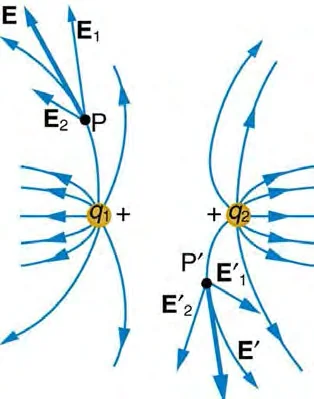
Each arrow points in the direction of the field at its location, and longer arrows mark stronger fields.
An electric field line diagram is a simplified version of a field map.
Field lines start on positive charges and end on negative charges.
The tangent to a field line at any point gives the direction of the field there, and the lines are drawn closer together where the field is stronger.
Field lines never cross, because the field has only one direction at each point.
In a uniform field, the lines are parallel and evenly spaced.
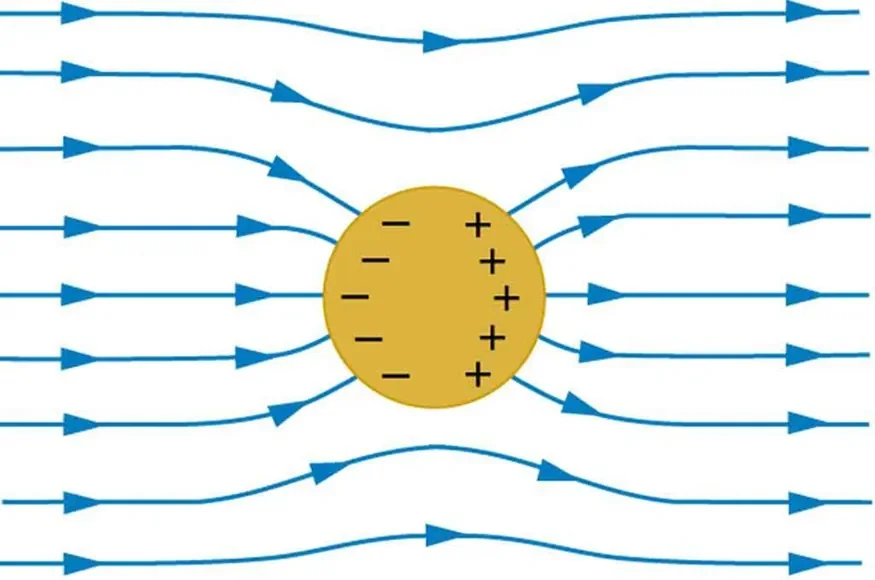
If the field inside were not zero, the free charges in the conductor would move until it was.
At the surface of a charged conductor, the electric field is perpendicular to the surface.
For an isolated sphere with a spherically symmetric charge distribution, the field outside the sphere is the same as the field of a point charge with the same net charge placed at the centre of the sphere.
Equilibrium
This allows a charged sphere to be treated as a point charge when calculating fields and forces outside it.
In an insulator in electrostatic equilibrium, the excess charge is distributed throughout the interior as well as at the surface, and the electric field within the insulator may have a nonzero value.
For AP Physics 2, field inside an insulator is treated only qualitatively.
Question
Find the magnitude and direction of the electric field at a point 0.50 m from an isolated point charge of +2.0 μC
1
E = k
Answer
7.2 × 10⁴ N/C, directed radially away from the positive charge.
Question
A uniform electric field of 4.0 × 10³ N/C points due east. An electron (charge −1.60 × 10⁻¹⁹ C, mass 9.11 × 10⁻³¹ kg) is placed in the field. Find the force on the electron and its acceleration.
1
The force is F = qE.
2
Its magnitude is (1.60 × 10⁻¹⁹ C)(4.0 × 10³ N/C) = 6.4 × 10⁻¹⁶ N.
3
Because the electron is negative, the force points opposite to the field, which is due west.
4
The acceleration is a = F/m = (6.4 × 10⁻¹⁶ N)/(9.11 × 10−31 kg) = 7.0 × 10¹⁴ m/s2.
Answer
The force is 6.4 × 10⁻¹⁶ N due west, and the acceleration is 7.0 × 10¹⁴ m/s2, also due west.
Question
A charge of +4.0 nC is at (0.30 m, 0) and a charge of −2.0 nC is at (0, 0.40 m). Find the net electric field at the origin.
1
The field from the positive charge has magnitude E1 = (9.0 × 10⁹)(4.0 × 10⁻⁹)/(0.30)2 = 400 N/C.
2
It points away from the positive charge, so its components are E1x = −400 N/C and E1y = 0.
3
The field from the negative charge has magnitude E2 = (9.0 × 10⁹)(2.0 × 10⁻⁹)/(0.40)2 = 113 N/C, and it points toward the negative charge, so its components are E2x = 0 and E2y = +113 N/C.
4
The net field has components Ex = −400 N/C and Ey = +113 N/C.
5
Its magnitude is √[(400)2 + (113)2] = 4.2 × 10² N/C.
Answer
The net field is 4.2 × 10² N/C, pointing left and up, at about 16° above the −x axis.
Giving the direction of the field toward a negative test charge.
The field direction is always the direction of the force on a positive test charge, so the force on a negative charge is opposite to the field.
Adding the magnitudes of two field vectors without components.
Fields from different charges can point in different directions, so each must be resolved into components before they are added.
Saying that the electric field inside a solid conductor is nonzero at equilibrium.
The excess charge sits on the surface, and the field inside is zero.
Drawing field lines that cross, or that start and end on the same charge.
Field lines start on positive charges and end on negative charges, and they never cross.
Assuming that a charged sphere produces a field that depends on its size.
Outside an isolated spherically symmetric sphere, its field equals that of a point charge at its centre.
Avoid
Using r as the distance from the origin of the coordinate system when the question asks for the distance from a particular charge.