Curriculum
AP PHYSICS 2
9. Thermodynamics
0/13
-
9. Thermodynamics
 Preview
-
9.1 Kinetic Theory of Temperature and Pressure
Preview
-
9.1 Kinetic Theory of Temperature and Pressure - Check yourself
 Preview
-
9.2 The Ideal Gas Law
Preview
-
9.2 The Ideal Gas Law - Check yourself
Preview
-
9.3 Thermal Energy Transfer and Equilibrium
Preview
-
9.3 Thermal Energy Transfer and Equilibrium - Check yourself
Preview
-
9.4 The First Law of Thermodynamics
Preview
-
9.4 The First Law of Thermodynamics - Check yourself
Preview
-
9.5 Specific Heat and Thermal Conductivity
Preview
-
9.5 Specific Heat and Thermal Conductivity - Check yourself
Preview
-
9.6 Entropy and the Second Law of Thermodynamics
Preview
-
9.6 Entropy and the Second Law of Thermodynamics - Check yourself
Preview
10. Electric Force, Field, and Potential
0/15
11. Electric Circuits
0/17
12. Magnetism and Electromagnetism
0/9
13. Geometric Optics
0/9
14. Waves, Sound, and Physical Optics
0/19
15. Modern Physics
0/17
Text lesson
9.4 The First Law of Thermodynamics
9.4 The First Law of Thermodynamics — AP PHYSICS 2: ALGEBRA-BASED notes: You will be able to describe the internal energy of a system, apply the first law of thermodynamics with heat and work to a closed system, and identify and interpret isovolumetric, isothermal, isobaric and adiabatic processes on a PV diagram.
1Internal energy of a system2Internal energy of a system
The first law of thermodynamics
The first law of thermodynamics
The first law of thermodynamics is a statement of conservation of energy for a thermodynamic system. It accounts for energy that enters or leaves the system by heating, cooling and work. For an isolated system
which exchanges neither energy nor matter with its surroundings, the total energy is constant.
For a closed system
which can exchange energy but not matter with its surroundings, the change in internal energy is the sum of the energy transferred by heating and the work done on the system: ΔU = Q + W. Here ΔU is the change in internal energy in joules (J), Q is the energy transferred to the system by heating in joules (positive if the system gains energy by heat, negative if it loses energy by heat), and W is the work done on the system in joules (positive if work is done on the system, negative if the system does work on its surroundings).
Work done on a system by a constant or average external pressure that changes the volume of the system is W = −PΔV.
Here P is the external pressure in pascals (Pa), and ΔV = Vfinal − Vinitial is the change in volume in cubic metres (m3).
When a gas expands, ΔV is positive and W is negative
so the gas does work on its surroundings and loses internal energy.
When a gas is compressed, ΔV is negative and W is positive.
1PV diagrams and the work done by a gas2PV diagrams and the work done by a gas
PV diagrams and the work done by a gas
PV diagrams and the work done by a gas
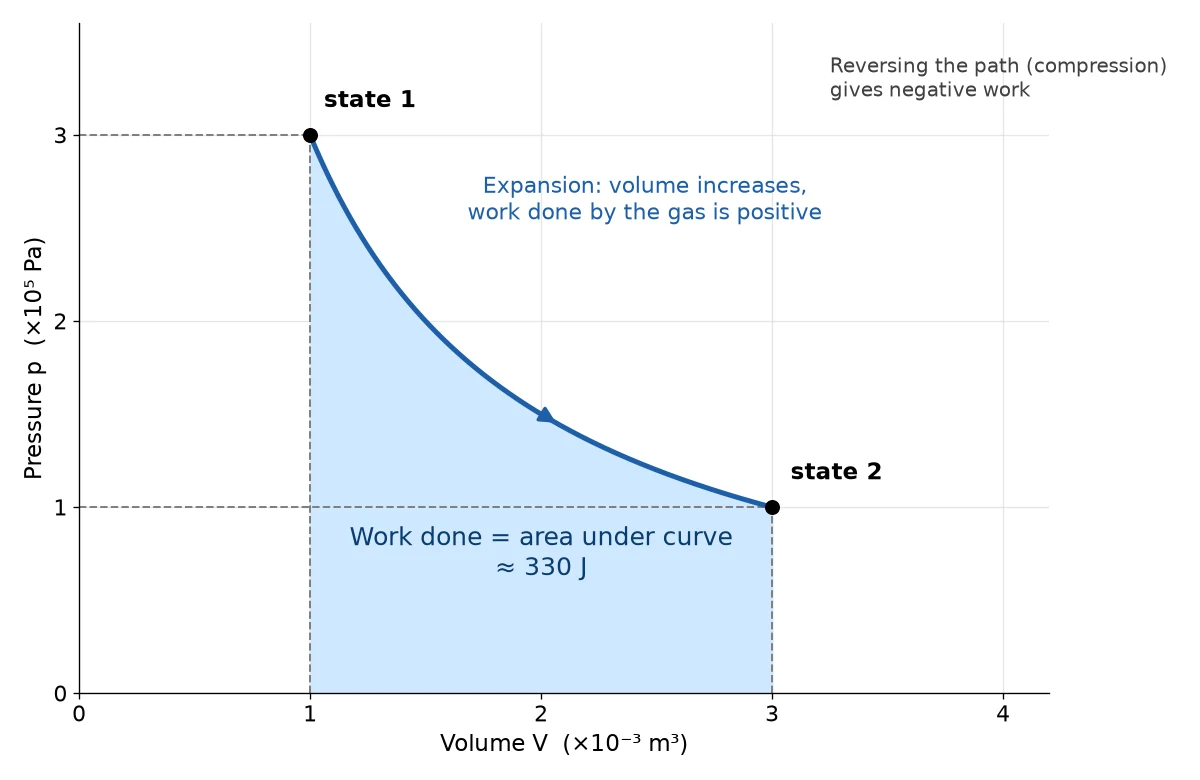
A pressure–volume (PV) diagram shows the states of a gas during a thermodynamic process.
Each point on the diagram is one state, and the path between two points shows how the gas changed.
The work done on the gas during a change of volume equals the negative of the area under the curve on a PV diagram, measured between the initial and final volumes.
An expansion has a curve moving to the right and the area under it is the work done by the gas
a compression moves to the left and the area is the work done on the gas.
A line of constant temperature on a PV diagram is called an isotherm. For an ideal gas, PV is proportional to temperature
so isotherms are curves in which PV is constant. An isotherm that lies further from the origin corresponds to a higher temperature.
If a gas is taken around a closed loop on a PV diagram and returns to its starting state, its internal energy change is zero. The net work done over the cycle is then equal to the net heat transferred, and it equals the area enclosed by the loop.
1 / 2Next ▶
A p-V curve falling from state 1 to state 2 with the area under the curve shaded to show the work done by the gas, about 330 J.
PV diagrams and the work done by a gas
◀ Previous2 / 2
1Special thermal processes2Special thermal processes
Special thermal processes
1
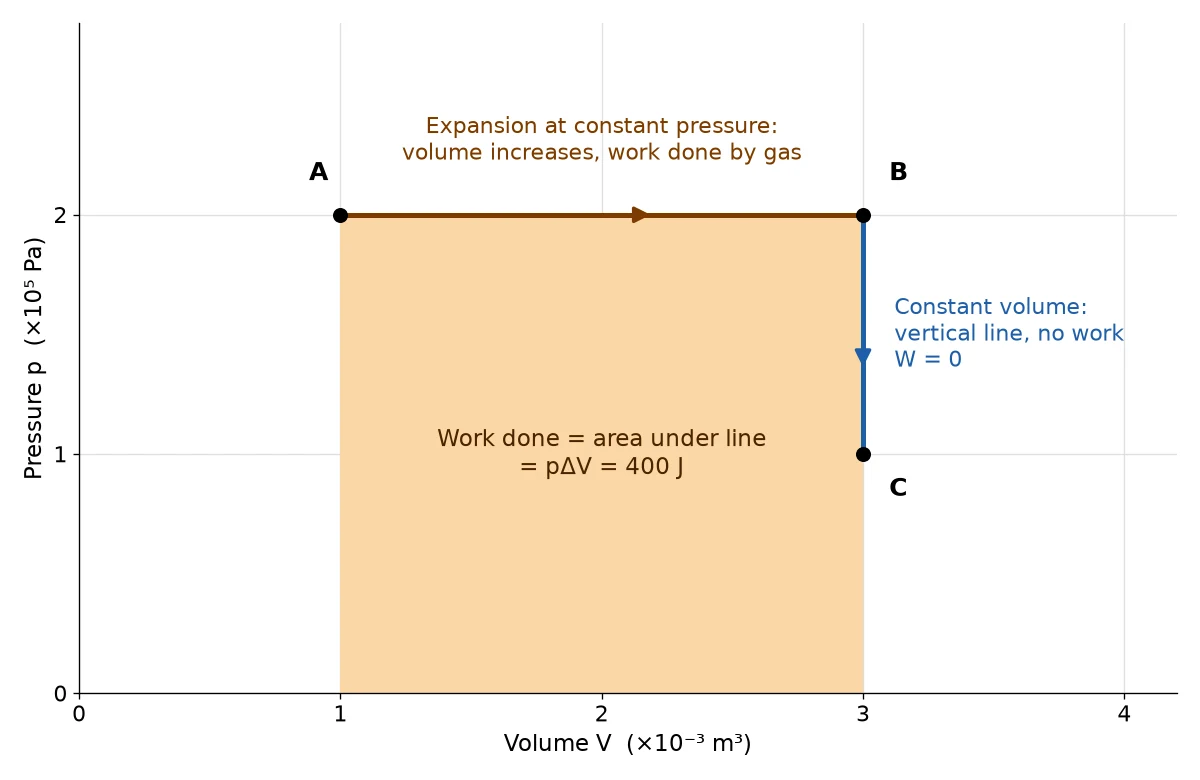
Four special processes appear in AP Physics 2. In an isovolumetric (isochoric) process, the volume is constant
so ΔV = 0 and W = 0. The first law then gives ΔU = Q, and all the heat entering the gas becomes internal energy.
2
In an isothermal process, the temperature is constant. For an ideal gas, a constant temperature means ΔU = 0
so Q = −W: the heat that enters the gas equals the work done by the gas.
3
In an isobaric process, the pressure is constant. The work is W = −PΔV
which is the area of a rectangle on a PV diagram, and the first law gives Q = ΔU − W.
4
In an adiabatic process, no energy is transferred by heating
so Q = 0. The first law becomes ΔU = W. If the gas is compressed adiabatically, work done on it raises its internal energy and therefore its temperature. If the gas expands adiabatically, it does work and its temperature falls.
1 / 2Next ▶
A p-V graph with a horizontal constant pressure line A to B shaded as work done, and a vertical constant volume line B to C with no shaded area.
Special thermal processes
◀ Previous2 / 2
1Example 1: Internal energy of a monatomic ideal gas2Example 2: Isobaric expansion3Example 3: Adiabatic compression of a gas
Key terms
| Term | Meaning |
|---|---|
| Internal energy (U) | The sum of the kinetic energy of the objects in a system and the potential energy of their configuration, measured in joules. |
| Thermodynamic system | The part of the universe chosen for analysis, such as a fixed amount of gas in a cylinder. |
| First law of thermodynamics | A statement of conservation of energy that gives the change in internal energy as ΔU = Q + W. |
| Isovolumetric (isochoric) process | A thermodynamic process at constant volume, for which W = 0. |
| Isothermal process | A thermodynamic process at constant temperature, for which ΔU = 0 for an ideal gas. |
| Isobaric process | A thermodynamic process at constant pressure, for which W = −PΔV. |
| Adiabatic process | A thermodynamic process in which no energy is transferred by heating, so Q = 0. |
| PV diagram | A graph of pressure against volume that represents the states and processes of a gas; the area under the curve gives the work. |
| Isotherm | A curve or line on a PV diagram representing a process at constant temperature. |
1Avoid these mistakes2Avoid these mistakes3Avoid these mistakes4Avoid these mistakes5Avoid these mistakes