Curriculum
AP PHYSICS 2
9. Thermodynamics
0/13
-
9. Thermodynamics
 Preview
-
9.1 Kinetic Theory of Temperature and Pressure
Preview
-
9.1 Kinetic Theory of Temperature and Pressure - Check yourself
 Preview
-
9.2 The Ideal Gas Law
Preview
-
9.2 The Ideal Gas Law - Check yourself
Preview
-
9.3 Thermal Energy Transfer and Equilibrium
Preview
-
9.3 Thermal Energy Transfer and Equilibrium - Check yourself
Preview
-
9.4 The First Law of Thermodynamics
Preview
-
9.4 The First Law of Thermodynamics - Check yourself
Preview
-
9.5 Specific Heat and Thermal Conductivity
Preview
-
9.5 Specific Heat and Thermal Conductivity - Check yourself
Preview
-
9.6 Entropy and the Second Law of Thermodynamics
Preview
-
9.6 Entropy and the Second Law of Thermodynamics - Check yourself
Preview
10. Electric Force, Field, and Potential
0/15
11. Electric Circuits
0/17
12. Magnetism and Electromagnetism
0/9
13. Geometric Optics
0/9
14. Waves, Sound, and Physical Optics
0/19
15. Modern Physics
0/17
Text lesson
9.5 Specific Heat and Thermal Conductivity
9.5 Specific Heat and Thermal Conductivity — AP PHYSICS 2: ALGEBRA-BASED notes: You will be able to calculate the energy needed to change the temperature of a material using its specific heat, and calculate the rate of energy transfer by conduction through a slab using its thermal conductivity and dimensions.
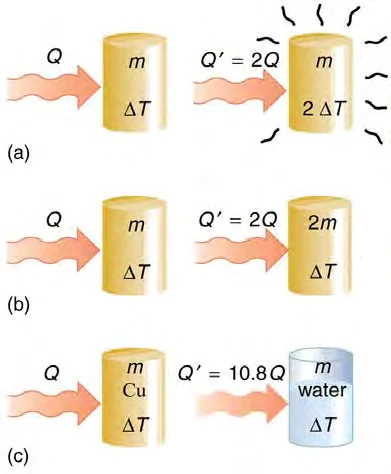
Specific heat is the property of a material that describes how much energy one kilogram of it must gain to raise its temperature by one kelvin.
The relation is Q = mcΔT, where Q is the energy transferred by heating in joules (J), m is the mass in kilograms (kg), c is the specific heat in joules per kilogram kelvin (J/(kg·K)), and ΔT is the change in temperature in kelvins (K).
A change of 1 K is numerically the same as a change of 1 °C, so ΔT can be taken in either unit.
A positive Q means the object gains energy and its temperature rises.
A negative Q means the object loses energy and its temperature falls.
The energy transferred to one object equals the energy lost by the other object when the two are in thermal contact and no energy is lost to the surroundings.
Specific heat is an intrinsic property of a material.
It depends on how the atoms of the material are arranged and how strongly they interact.
Water has a large specific heat, about 4186 J/(kg·K), which is why a large amount of energy must be removed from water before its temperature drops much.
Copper has a small specific heat, about 387 J/(kg·K), so a copper object changes temperature quickly when it is heated or cooled.
For AP Physics 2, specific heat is modelled as independent of temperature.
This allows you to use a single value of c across the whole temperature range in a question.
Water (liquid)4186
Ice2090
Aluminium900
Iron (steel)450
Glass840
Copper387
Specific heat c (J/(kg·K))
The rate of energy transfer by conduction through a slab of material depends on four things: the temperature difference across the slab, the thickness of the slab, the cross-sectional area of the slab and the thermal conductivity of the material.
In equation form, Q/Δt = kAΔT/L, where Q/Δt is the rate of energy transfer in watts (W), k is the thermal conductivity in watts per metre kelvin (W/(m·K)), A is the cross-sectional area in square metres (m2), ΔT is the temperature difference across the slab in kelvins (K), and L is the thickness of the slab in metres (m).
Thermal conductivity is an intrinsic property of a material that depends on how its atoms are arranged and interact.
Metals have large thermal conductivities because their free electrons carry energy quickly.
Air, foam and other insulators have small thermal conductivities, which is why they are used to slow energy transfer through walls and clothing.
The rate of conduction is directly proportional to the area and to the temperature difference, and it is inversely proportional to the thickness.
Doubling the thickness of a slab halves the rate; doubling the temperature difference doubles it.
Use Q = mcΔT when you need the total energy that changes the temperature of an object or the final temperature after two objects exchange energy.
Use Q/Δt = kAΔT/L when you need the rate of transfer through a slab, or the total energy transferred through the slab in a time interval, which is the rate multiplied by the time.
Two relations
When two objects of the same mass and material are in thermal contact, the energy lost by the hot object equals the energy gained by the cold object.
Write this as an equation with both sides and solve for the final temperature.
Question
Find the energy needed to heat 0.50 kg of water from 20.0 °C to 80.0 °C. The specific heat of water is 4186 J/(kg·K)
1
ΔT = 80.0 °C − 20.0 °C = 60.0 K.
2
Q = mcΔT = (0.50 kg)(4186 J/(kg·K))(60.0 K) = 1.26 × 10⁵ J.
Answer
1.26 × 10⁵ J.
Question
A 0.200 kg copper block at 90.0 °C is dropped into 0.200 kg of water at 20.0 °C in an insulated cup. Find the final equilibrium temperature. Specific heat: copper 387 J/(kg·K), water 4186 J/(kg·K).
1
Let the final temperature be T.
2
The energy lost by the copper equals the energy gained by the water: (0.200 kg)(387 J/(kg·K))(90.0 − T) = (0.200 kg)(4186 J/(kg·K))(T − 20.0).
3
Dividing both sides by 0.200 kg gives 387(90.0 − T) = 4186(T − 20.0).
4
Expanding 34 830 − 387T = 4186T − 83 720.
5
So 118 550 = 4573T, and T = 25.9 °C.
Answer
The final temperature is 25.9 °C. The copper cools by about 64 K and the water warms by about 6 K, because water has a much larger specific heat.
Question
A copper rod has a cross-sectional area of 2.0 × 10⁻⁴ m2 and a length of 0.25 m. Its ends are held at 100 °C and 50 °C. The thermal conductivity of copper is 390 W/(m·K). Find the rate of energy transfer through the rod and the energy transferred in 60 s.
1
ΔT = 100 °C − 50 °C = 50 K.
2
Q/Δt = kAΔT/L = (390 W/(m·K))(2.0 × 10−4 m2)(50 K)/(0.25 m) = 15.6 W.
3
Energy in 60 s = (15.6 W)(60 s) = 936 J.
Answer
The rate of transfer is 15.6 W, which is 16 W to two significant figures, and 9.4 × 10² J is transferred in 60 s.
Question
The rod in Example 3 is replaced by a rod of the same material and cross-sectional area, but with twice the length and with the temperature difference doubled to 100 K. Find the new rate of energy transfer relative to the original rate.
1
The ratio of the new rate to the old rate is (ΔTnew/ΔTold) × (Lold/Lnew) = (100 K/50 K) × (0.25 m/0.50 m) = 2 × 0.5 = 1.
Answer
The rate stays the same, 15.6 W. The doubled temperature difference exactly cancels the effect of the doubled length.
Using ΔT in the conduction equation as the final temperature.
The temperature difference is the difference between the two sides of the slab.
Forgetting that the thickness L is in metres when using k in W/(m·K)
A thickness in centimetres must be converted first.
Giving the energy from Q = mcΔT as a power
Energy is in joules; the rate of conduction is power in watts, found from Q/Δt.
Mixing up specific heat and thermal conductivity.
Specific heat governs how much energy changes temperature; thermal conductivity governs how fast energy moves through a material.
Assuming the final temperature of a mixture is the average of the two starting temperatures.
This is only true when the two objects have the same mass and specific heat.
Adding 273 to a temperature change before using it.
A change in temperature has the same numerical value in kelvins and degrees Celsius, so ΔT can be used directly in Q = mcΔT.