Curriculum
Course: AP PHYSICS 2
Login

Curriculum

AP PHYSICS 2

Text lesson

9.6 Entropy and the Second Law of Thermodynamics

9.6 Entropy and the Second Law of Thermodynamics — AP PHYSICS 2: ALGEBRA-BASED notes: You will be able to describe qualitatively how the entropy of an isolated or closed system changes over time, explain entropy as the spreading of energy, and predict the direction of spontaneous change toward thermodynamic equilibrium.

1The second law of thermodynamics2The second law of thermodynamics3The second law of thermodynamics
The second law of thermodynamics
The second law of thermodynamics states that the total entropy of an isolated system can never decrease.
It stays constant only when every process the system undergoes is reversible,
which means that the system could be returned to its original state with no net change in the surroundings.
Real processes are never perfectly reversible

so in practice the total entropy of an isolated system increases.
This law gives the direction of time for physical processes.
A glass dropped on a floor breaks, and the pieces never spontaneously reassemble.
1 / 3Next ▶
The second law of thermodynamics
1

Heat moves from hot to cold, and a hot cup of tea never gains thermal energy from the cool room around it.
2

Each of these events is a spontaneous change in one direction, and the second law explains that direction.
3

The law does not say that the entropy of every object can only increase.
4

A part of a system can lose entropy if another part gains more

so the total is the quantity that cannot decrease.
◀ Previous2 / 3Next ▶
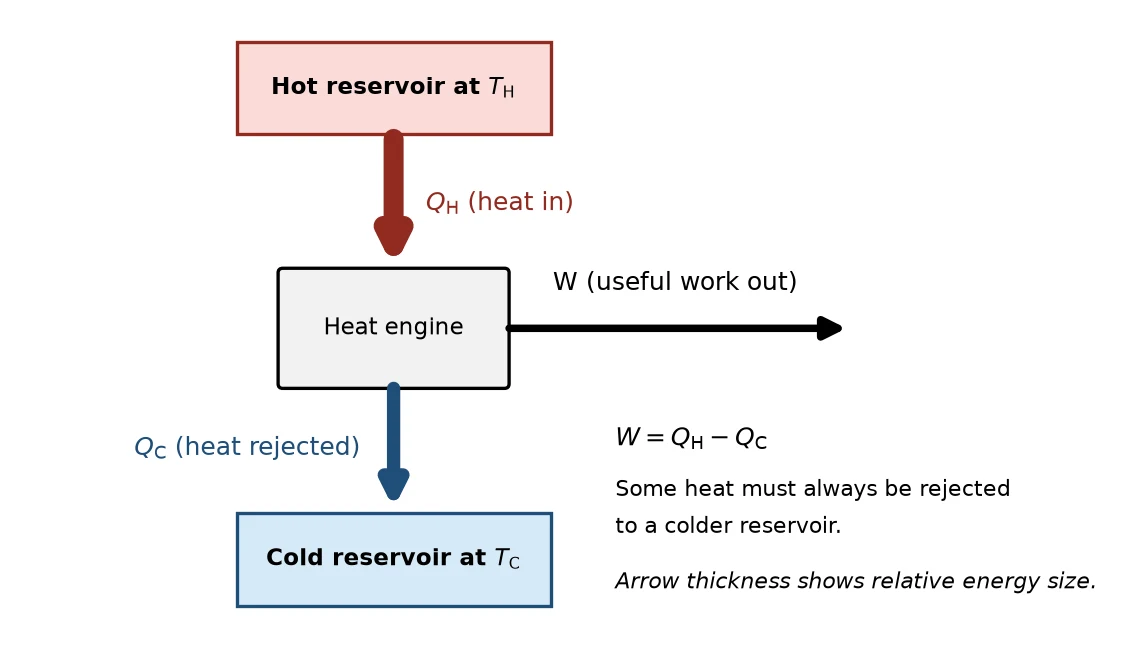
Heat engine energy-flow diagram: heat in from hot reservoir, useful work out, heat rejected to cold reservoir
The second law of thermodynamics
◀ Previous3 / 3
1Entropy as the spreading of energy2Entropy as the spreading of energy
Entropy as the spreading of energy
Entropy can be described qualitatively as the tendency of energy to spread out,
or as the unavailability of part of a system’s energy to do work.
A concentrated, localised store of energy, such as a hot spot or a compressed gas, is a low-entropy state.
When that energy spreads over more particles or more space, the entropy is higher and less of the energy remains available to do useful work.
Localised energy will tend to disperse and spread out.
A hot object in a cold room gradually spreads its energy into the air.
1 / 2Next ▶
Entropy as the spreading of energy
1

A gas confined in one half of a box spreads throughout the whole box when a barrier is removed.
2

In both cases the energy is still present

but it is distributed in a way that makes it harder to use.
3

Entropy is a state function.
4

This means that the entropy of a system depends only on its present state or configuration, not on the path by which it reached that state.
5

Two samples of the same gas at the same volume, temperature and pressure have the same entropy whatever their history.
◀ Previous2 / 2
Thermodynamic equilibrium and maximum entropy
1

Maximum entropy occurs when a system is in thermodynamic equilibrium. At equilibrium, there is no further net change in the properties of the system, and its energy is spread as uniformly as the constraints allow. For two objects in thermal contact, equilibrium means equal temperatures

for a gas, equilibrium means a uniform pressure and temperature throughout the container.
2

An isolated system spontaneously moves toward thermodynamic equilibrium

because that state has a higher entropy than any non-equilibrium state. Once equilibrium is reached, the entropy of the isolated system stays at its maximum valuebecause no further spontaneous change can increase it.
1Entropy of closed and isolated systems2Entropy of closed and isolated systems3Entropy of closed and isolated systems
Entropy of closed and isolated systems
An isolated system exchanges neither energy nor matter with its surroundings.
The entropy of an isolated system never decreases.
A closed system exchanges energy but not matter with its surroundings.
The entropy of a closed system can decrease

because energy can be transferred out of the system, lowering its energy spread.
However, the entropy of the surroundings receiving that energy will increase,
and the total entropy of the closed system plus its surroundings does not decrease.
1 / 3Next ▶
Entropy of closed and isolated systems
1

The change in a system’s entropy is determined by its interactions with its surroundings.
2

When a system exchanges energy with its surroundings, the surroundings usually gain entropy as the energy spreads into them.
3

A freezer lowers the entropy of the water in its tray by removing energy from it,
4

but the energy removed is released into the kitchen,
5

where the entropy rises by a greater amount.
6

This is why the total entropy still increases overall.
◀ Previous2 / 3Next ▶
Entropy of closed and isolated systems
The second law is qualitative in AP Physics 2.
You should be able to decide whether the entropy of a given system or the total entropy increases, decreases or stays the same,
and justify your answer with the ideas of energy spreading and equilibrium.
You do not need to calculate entropy changes numerically.
◀ Previous3 / 3
1Example 1: Hot coffee in a cool room2Example 2: Gas released into an evacuated region3Example 3: Water freezing in a closed freezer4Example 3: Water freezing in a closed freezer
Example 1: Hot coffee in a cool room
A cup of coffee at 90 °C sits in a room at 20 °C. Treat the coffee and the room together as an isolated system. Explain why the entropy of the isolated system increases as the coffee cools to 20 °C.
Working: Initially the energy is concentrated in the hot coffee.
Energy flows from the 90 °C coffee into the 20 °C room

so the energy spreads over the much larger room.
The coffee’s entropy decreases,

because it loses energy and its temperature falls,but the room’s entropy increases by a larger amount,because it receives the same energy at a lower temperature and spreads it over far more particles.
The total entropy of coffee plus room increases.
Answer: The total entropy of the isolated system increases. The reverse process, in which the room cools and the coffee heats itself to 90 °C, does not occur spontaneously.
1 / 4Next ▶
Example 2: Gas released into an evacuated region
1

A gas is confined to one half of a sealed, insulated box. The other half is a vacuum. A barrier is removed, and the gas spreads through the whole box. Is the entropy of the gas greater after the barrier is removed, and does the answer depend on how the gas reached its final state?
2

Working: The gas is confined to a smaller region before the barrier is removed

which is a more localised state.
3

After the barrier is removed, the gas occupies the whole box, and its molecules can be arranged in many more ways

so the entropy is higher.
4

Entropy is a state function,

so the entropy of the gas depends only on the final volume and state of the gas, not on whether the expansion happened quickly and irreversibly.
5

Answer: The entropy of the gas is greater after the barrier is removed. Its value depends only on the final state, and the spreading into the full box is a spontaneous, irreversible change.
◀ Previous2 / 4Next ▶
Example 3: Water freezing in a closed freezer
1

A tray of liquid water at 0 °C is placed in a freezer and freezes into ice at 0 °C. Consider the water alone as a closed system. Explain whether its entropy can decrease, and state how the total entropy of the water and its surroundings changes.
2

Working: Energy leaves the water as it freezes

so the water is a closed system losing energy.
3

Its entropy decreases

because its energy is becoming less spread out as it becomes a more ordered solid.
4

The surroundings receive this energy at the kitchen or room temperature,

which is above 0 °C,and that energy spreads into a much larger volume of air.
5

The entropy of the surroundings increases.
6

Overall, the total entropy of the water plus its surroundings increases, as the second law requires.
◀ Previous3 / 4Next ▶
Example 3: Water freezing in a closed freezer
Answer: The entropy of the water can decrease

because it is a closed system that loses energybut the total entropy of the water and surroundings increases.
◀ Previous4 / 4
Key terms
Term Meaning
Entropy A measure of the tendency of energy to spread out and of the unavailability of part of a system’s energy to do work.
Second law of thermodynamics The statement that the total entropy of an isolated system can never decrease, and is constant only for reversible processes.
Isolated system A system that exchanges neither energy nor matter with its surroundings.
Closed system A system that exchanges energy but not matter with its surroundings.
Reversible process A process that can be reversed so that the system and surroundings return to their original states with no net change elsewhere.
Irreversible process A spontaneous process, such as heat flow from hot to cold, that does not return to its starting state without outside influence.
State function A property, such as entropy, whose value depends only on the current state of the system and not on the path taken to reach it.
Thermodynamic equilibrium The state in which a system has no further net spontaneous change and has maximum entropy for its constraints.
Spontaneous change A change that occurs in a system without outside intervention, such as heat flowing from a hot object to a cold object.
1Avoid these mistakes2Avoid these mistakes3Avoid these mistakes
Avoid these mistakes
1Avoid this
Saying that entropy always increases for every object.Avoid this
The second law applies to the total entropy of an isolated system; a part of a system can lose entropy.Avoid this
2Avoid this
Applying the second law to a closed system and concluding that its entropy must increase.Avoid this
A closed system can lose entropy when energy leaves it, but the surroundings must gain at least as much.Avoid this
1 / 3Next ▶
Avoid these mistakes
3Avoid this
Describing entropy as just disorder with no reference to the spreading of energy.Avoid this
Use the energy-spreading and availability ideas, which are the AP Physics 2 description.Avoid this
4Avoid this
Thinking that a process is reversible because energy is conserved.Avoid this
Energy conservation does not make a process reversible; heat flow from hot to cold is irreversible even though energy is conserved.Avoid this
◀ Previous2 / 3Next ▶
Avoid these mistakes
5Avoid this
Believing that the entropy of a gas depends on how fast it expanded. Entropy is a state function, so only the initial and final states matter.Avoid this
6Avoid this
Thinking that a system at equilibrium can still increase its entropy spontaneously.Avoid this
At thermodynamic equilibrium the entropy is at its maximum for the constraints, so no further spontaneous increase occurs.Avoid this
◀ Previous3 / 3
Accepted payment methods