Curriculum
AP PHYSICS 2
9. Thermodynamics
0/13
10. Electric Force, Field, and Potential
0/15
11. Electric Circuits
0/17
-
11. Electric Circuits
 Preview
-
11.1 Electric Current
Preview
-
11.1 Electric Current - Check yourself
 Preview
-
11.2 Simple Circuits
Preview
-
11.2 Simple Circuits - Check yourself
Preview
-
11.3 Resistance, Resistivity, and Ohm’s Law
Preview
-
11.3 Resistance, Resistivity, and Ohm’s Law - Check yourself
Preview
-
11.4 Electric Power
Preview
-
11.4 Electric Power - Check yourself
Preview
-
11.5 Compound Direct Current (DC) Circuits
Preview
-
11.5 Compound Direct Current (DC) Circuits - Check yourself
Preview
-
11.6 Kirchhoff’s Loop Rule
Preview
-
11.6 Kirchhoff’s Loop Rule - Check yourself
Preview
-
11.7 Kirchhoff’s Junction Rule
Preview
-
11.7 Kirchhoff’s Junction Rule - Check yourself
Preview
-
11.8 Resistor-Capacitor (RC) Circuits
Preview
-
11.8 Resistor-Capacitor (RC) Circuits - Check yourself
Preview
12. Magnetism and Electromagnetism
0/9
13. Geometric Optics
0/9
14. Waves, Sound, and Physical Optics
0/19
15. Modern Physics
0/17
Text lesson
11. Electric Circuits
Unit 11 Electric Circuits — AP PHYSICS 2: ALGEBRA-BASED notes: You will be able to connect the eight topics of Unit 11 by explaining how a potential difference drives a current, how resistance and power depend on the circuit elements, how series and parallel connections are simplified, how Kirchhoff’s rules follow from conservation laws, and how capacitors charge and discharge in RC circuits.
1Current and the driving potential difference2Current and the driving potential difference
1Circuits, elements and schematics2Circuits, elements and schematics
Circuits, elements and schematics
Circuits, elements and schematics
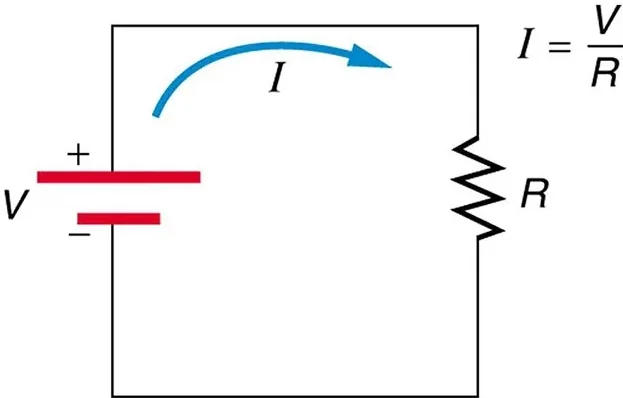
A circuit is a set of closed electrical loops made from elements such as wires, batteries, resistors, bulbs, capacitors, switches, ammeters and voltmeters (topic 11.2).
1 / 2Next ▶
Circuit schematics and standard symbols: Schematic of a battery connected across a resistor, with current leaving the positive terminal.
Circuits, elements and schematics
 ⤢ Enlarge
Circuits, elements and schematics
A closed circuit allows charge to flow, an open circuit does not, and a short circuit allows charge to flow with no change in potential difference.
Circuit schematics use standard symbols, and the physical arrangement of the elements determines how the circuit behaves.
All schematics in this course use conventional current unless stated otherwise.
◀ Previous2 / 2
1Resistance, resistivity and power2Resistance, resistivity and power3Resistance, resistivity and power4Resistance, resistivity and power5Resistance, resistivity and power
1Simplifying combinations of resistors2Simplifying combinations of resistors3Simplifying combinations of resistors4Simplifying combinations of resistors
Kirchhoff’s rules · Kirchhoff’s rules
Kirchhoff’s rules
Kirchhoff’s loop rule states that the sum of the potential differences across all elements in any closed loop is zero
because energy is conserved as charge moves around the loop (topic 11.6).
Kirchhoff’s rules
Kirchhoff’s junction rule states that the total current entering a junction equals the total current leaving it,
because charge is conserved (topic 11.7).
Together the two rules allow the currents and potential differences in any circuit with several branches to be found by solving a set of linear equations.
1Capacitors and RC circuits2Capacitors and RC circuits3Capacitors and RC circuits4Capacitors and RC circuits
Key equations
| Equation | Meaning | Topic |
|---|---|---|
| I = ΔQ/Δt | Current as the rate of charge flow (A) | 11.1 |
| ΔV = IR | Ohm’s law for an ohmic element (V) | 11.3 |
| R = ρL/A | Resistance of a uniform conductor (Ω) | 11.3 |
| P = IΔV = I2R = ΔV2/R | Electric power (W) | 11.4 |
| E = Pt | Energy transferred by an element (J) | 11.4 |
| Req = R1 + R2 + … | Resistors in series (Ω) | 11.5 |
| 1/Req = 1/R1 + 1/R2 + … | Resistors in parallel (Ω) | 11.5 |
| ΔVterminal = ε − Ir | Terminal potential difference of a real battery (V) | 11.5 |
| Σ ΔV = 0 | Kirchhoff’s loop rule (V) | 11.6 |
| ΣIin = ΣIout | Kirchhoff’s junction rule (A) | 11.7 |
| 1/Ceq = 1/C1 + 1/C2 + … | Capacitors in series (F) | 11.8 |
| Ceq = C1 + C2 + … | Capacitors in parallel (F) | 11.8 |
| Q = CΔV, U = ½C(ΔV)2 | Charge and stored energy of a capacitor (C, J) | 11.8 |
| τ = RC | Time constant of an RC circuit (s) | 11.8 |
1How the topics connect2How the topics connect3How the topics connect
Key terms
| Term | Meaning |
|---|---|
| Electric current (I) | The rate at which charge passes a cross-sectional area of a wire, measured in amperes. |
| Emf (ε) | The potential difference that drives charge through a circuit, measured in volts. |
| Resistance (R) | A measure of the degree to which an object opposes the movement of electric charge, in ohms. |
| Resistivity (ρ) | A property of a material that quantifies how strongly it opposes charge movement, in ohm metres. |
| Electric power (P) | The rate at which a circuit element transfers, converts or dissipates energy, in watts. |
| Equivalent resistance | The single resistance that can replace a group of resistors without changing the current or potential difference in the rest of the circuit. |
| Kirchhoff’s loop rule | The rule that the sum of potential differences around any closed loop is zero, a consequence of conservation of energy. |
| Kirchhoff’s junction rule | The rule that the current entering a junction equals the current leaving it, a consequence of conservation of charge. |
| Time constant (τ) | The product RC of the resistance and capacitance in an RC circuit, which sets the rate of charging and discharging. |
| Steady state | The condition a circuit reaches after a long time, when quantities such as current stop changing. |
1Avoid these mistakes2Avoid these mistakes