Curriculum
AP PHYSICS 2
9. Thermodynamics
0/13
10. Electric Force, Field, and Potential
0/15
11. Electric Circuits
0/17
-
11. Electric Circuits
 Preview
-
11.1 Electric Current
Preview
-
11.1 Electric Current - Check yourself
 Preview
-
11.2 Simple Circuits
Preview
-
11.2 Simple Circuits - Check yourself
Preview
-
11.3 Resistance, Resistivity, and Ohm’s Law
Preview
-
11.3 Resistance, Resistivity, and Ohm’s Law - Check yourself
Preview
-
11.4 Electric Power
Preview
-
11.4 Electric Power - Check yourself
Preview
-
11.5 Compound Direct Current (DC) Circuits
Preview
-
11.5 Compound Direct Current (DC) Circuits - Check yourself
Preview
-
11.6 Kirchhoff’s Loop Rule
Preview
-
11.6 Kirchhoff’s Loop Rule - Check yourself
Preview
-
11.7 Kirchhoff’s Junction Rule
Preview
-
11.7 Kirchhoff’s Junction Rule - Check yourself
Preview
-
11.8 Resistor-Capacitor (RC) Circuits
Preview
-
11.8 Resistor-Capacitor (RC) Circuits - Check yourself
Preview
12. Magnetism and Electromagnetism
0/9
13. Geometric Optics
0/9
14. Waves, Sound, and Physical Optics
0/19
15. Modern Physics
0/17
Text lesson
11.2 Simple Circuits
11.2 Simple Circuits — AP PHYSICS 2: ALGEBRA-BASED notes: You will be able to describe the behaviour of a circuit by identifying its loops, classifying it as closed, open or short, and reading and drawing schematic diagrams that use the standard symbols for circuit elements.
A loop is a closed path along which charge can travel, and the circuit elements in it may include wires, batteries, resistors, lightbulbs, capacitors, switches, ammeters and voltmeters.
A battery supplies the energy, and the other elements transfer, store or measure that energy.
A closed electrical loop is a closed path through which charges may flow.
Charges move around the loop when there is a potential difference to drive them, and each element in the loop is connected end to end with the others.
Circuit
A single circuit element may be part of more than one electrical loop.
For example, a resistor that lies on both an outer loop and an inner loop of the same circuit is one element counted in both loops.
The loops must be identified before any analysis of the circuit can begin.
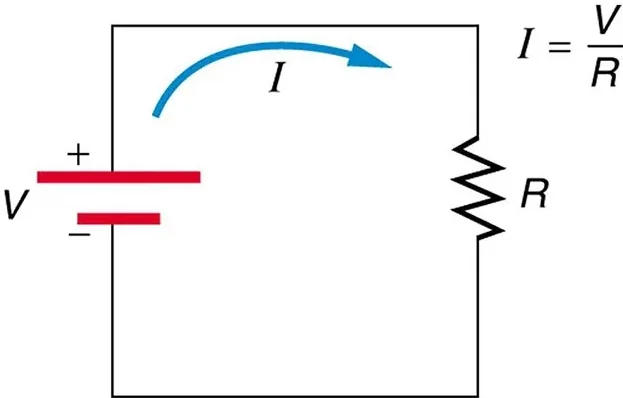
This means that every element is connected in an unbroken loop, so a current can exist when a potential difference is applied.
A closed circuit with a battery and a resistor carries a current, and the current depends on the potential difference and the resistance.
An open circuit is one in which charges would not be able to flow.
A break in the loop, such as an open switch, stops the flow of charge.
With an open switch in a battery circuit there is no current in any element, and the full emf of the battery appears across the open switch.
A short circuit is one in which charges would be able to flow with no change in potential difference.
Its defining feature is that the charges pass through a path of very low resistance, so the potential difference across that path is nearly zero while the current can become large.
A short circuit across a battery is dangerous because the current is limited only by the internal resistance of the battery and the resistance of the wires.
It uses standard symbols connected by straight lines to show how the elements are joined.
The properties of a circuit depend on the physical arrangement of its elements, so the schematic must show which elements are connected to which, not their real sizes or positions.
A battery is shown as a pair of long and short parallel lines, with the long line marking the positive terminal.
A bulb is a circle with a cross inside it.
A switch is drawn as a line that can be opened or closed.
A capacitor is two parallel lines of equal length.
Symbols
A resistor is a zigzag line or a rectangle.
An ammeter is a circle containing the letter A, and a voltmeter is a circle containing the letter V.
A variable element is shown by its standard symbol with a diagonal arrow drawn across it, as in a variable resistor.
The arrow shows that the value of the element can be changed.
Unless otherwise specified, all circuit schematics are drawn with conventional current, so the arrows and signs follow the direction of positive charge flow.
Question
A 6.0 V ideal battery is connected to a 3.0 Ω resistor and an open switch in a single loop. Describe the current in the resistor and the potential difference across the open switch.
1
The switch is open, so the loop is broken and charge cannot flow.
2
The current in the resistor is therefore zero.
3
The battery’s emf of 6.0 V has no current to drive, so the full potential difference of 6.0 V appears across the open switch, and no potential difference appears across the resistor.
Answer
The circuit is open. The current is 0 A, and the potential difference across the open switch is 6.0 V.
Question
A 6.0 V ideal battery is connected to a 3.0 Ω resistor R1. A second resistor R2 of 6.0 Ω is connected so that one loop goes through the battery and R1 only, and a second loop goes through R1 and R2 only, with R1 shared by both. Explain how many electrical loops contain R1, and state whether the circuit is closed.
1
A single element may be part of multiple loops.
2
R1 lies on the path of the outer loop, which goes through the battery, and it also lies on the path of the inner loop, which goes through R2.
3
So R1 belongs to two electrical loops, and it is counted once as a physical element.
4
Because charge can flow around each loop without a break, the circuit is closed.
Answer
R1 is part of two electrical loops, and the circuit is closed because charge can flow around each loop.
Question
A 1.5 V ideal battery is connected to a lamp, and a length of wire of negligible resistance is connected directly across the two terminals of the battery, bypassing the lamp. Classify the wire path and state the potential difference across it.
1
Charge can flow through the wire path with no change in potential difference, because the wire has negligible resistance.
2
This matches the definition of a short circuit.
3
The potential difference across the wire is therefore essentially zero.
4
The lamp is connected across the same two terminals as the wire, so it is short-circuited as well and has essentially zero potential difference across it; the current from the battery bypasses the lamp almost entirely.
Answer
The wire forms a short circuit, and the potential difference across it is essentially 0 V.
Calling a circuit closed simply because it contains a battery.
A circuit is closed only if charges can flow through an unbroken loop.
Assuming that an open switch leaves no potential difference across the circuit.
An open switch takes the full potential difference of the battery when no current flows elsewhere in the loop.
Confusing a short circuit with a path of high current in general.
A short circuit is a path with no change in potential difference; the current is large because the resistance is very small.
Treating a single element that sits on two paths as two separate elements.
One resistor can belong to two electrical loops and must be counted once.
Reading a schematic as a map of physical positions.
The schematic shows connections, so two elements drawn far apart may be in the same loop.
Avoid
Drawing the ammeter as a V or the voltmeter as an A, or drawing a battery with the long line at the negative terminal.