Curriculum
AP PHYSICS 2
9. Thermodynamics
0/13
10. Electric Force, Field, and Potential
0/15
11. Electric Circuits
0/17
12. Magnetism and Electromagnetism
0/9
13. Geometric Optics
0/9
-
13. Geometric Optics
 Preview
-
13.1 Reflection
Preview
-
13.1 Reflection - Check yourself
 Preview
-
13.2 Images Formed by Mirrors
Preview
-
13.2 Images Formed by Mirrors - Check yourself
Preview
-
13.3 Refraction
Preview
-
13.3 Refraction - Check yourself
Preview
-
13.4 Images Formed by Lenses
Preview
-
13.4 Images Formed by Lenses - Check yourself
Preview
14. Waves, Sound, and Physical Optics
0/19
15. Modern Physics
0/17
Text lesson
13.1 Reflection
13.1 Reflection — AP PHYSICS 2: ALGEBRA-BASED notes: You will be able to describe light as a ray, apply the law of reflection to a light ray at a surface, and distinguish specular reflection from diffuse reflection.
1Light as a ray2Light as a ray
1Ray diagrams2Ray diagrams
Ray diagrams
Ray diagrams
A ray diagram shows the path of light before and after it interacts with matter, such as a smooth surface, a mirror, a lens or the boundary between two transparent media.
1 / 2Next ▶
Stages of drawing a reflection ray diagram with normal and equal angles
Ray diagrams
 ⤢ Enlarge
Ray diagrams
Each ray is drawn as a straight line with an arrow that shows the direction of travel.
The arrows must be drawn in the direction the light actually moves, from the source toward the detector or observer.
At a reflecting surface, the normal is the line perpendicular to the surface at the point where the ray strikes it. It is drawn as a dashed line. All angles in reflection and refraction are measured from the normal, never from the surface itself. A ray diagram that measures angles from the surface will give the wrong answer.
◀ Previous2 / 2
1The law of reflection2The law of reflection3The law of reflection
The law of reflection
The law of reflection
The law of reflection states that the angle between the incident ray and the normal is equal to the angle between the reflected ray and the normal: θi = θr.
1 / 3Next ▶
The law of reflection
1
Here
2
θ
3
i
4
is the angle of incidence, the angle between the incident ray and the normal,
5
and θr is the angle of reflection, the angle between the reflected ray and the normal.
6
Both angles are measured in degrees (°).
◀ Previous2 / 3Next ▶
The law of reflection: A ray striking a surface at a point, with the angles of incidence and reflection measured from the perpendicular to the surface.
The law of reflection
 ⤢ Enlarge
The law of reflection
The incident ray, the reflected ray and the normal all lie in the same plane. The reflected ray stays in the medium from which the light came, and its speed and frequency are the same as those of the incident ray.
◀ Previous3 / 3
1Diffuse and specular reflection2Diffuse and specular reflection3Diffuse and specular reflection
Diffuse and specular reflection
Diffuse and specular reflection
Specular reflection is the reflection of light from a smooth surface.
1 / 3Next ▶
Diffuse and specular reflection
Diffuse and specular reflection
Because the normal to a smooth surface has almost the same direction over the area that the light strikes, parallel incident rays are reflected in parallel,
and the reflected light is uniform.
A plane mirror and a calm pool of water both give specular reflection
which is why they form clear images.
Diffuse reflection is the reflection of light from a rough surface.
Each small region of a rough surface has its own normal, and these normals point in many different directions.
Parallel incident rays are therefore reflected in many different directions.
◀ Previous2 / 3Next ▶
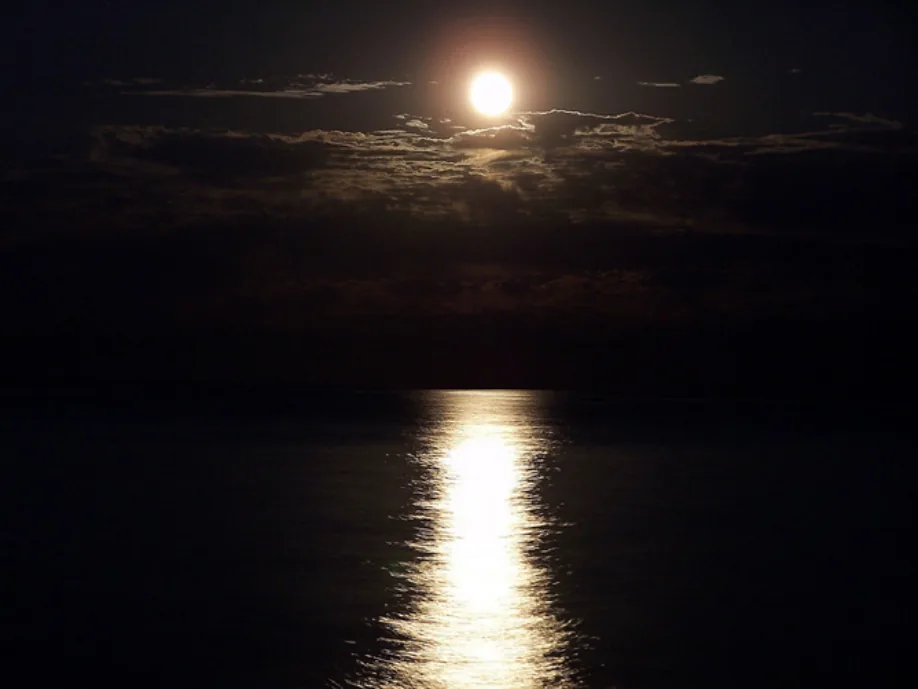
Reflection from smooth and rough surfaces: Moonlight spread across the surface of a lake because the water is shiny but uneven, so its reflection is diffused.
Diffuse and specular reflection
 ⤢ Enlarge
Diffuse and specular reflection
Each individual ray still obeys the law of reflection
the spreading of the light comes from the varying direction of the normal, not from a breakdown of the law.
A paper page or a painted wall looks equally bright from many directions because of diffuse reflection. A mirror looks bright only from a narrow range of directions because of specular reflection.
◀ Previous3 / 3
Using the law of reflection
1
If the angle between the reflected ray and the surface is known, the angle of incidence is found from the fact that the normal is perpendicular to the surface: θi = 90° − (angle between the reflected ray and the surface).
2
The angle between the incident ray and the reflected ray, measured at the point of reflection, is θi + θr = 2θi. The direction of the reflected ray therefore changes by 180° − 2θi from the direction of the incident ray.
3
If a plane mirror is rotated through an angle α while the incident ray stays fixed, the normal rotates through the same angle α, the angle of incidence changes by α, and the reflected ray turns through 2α. This result is useful in optical instruments that use a rotating mirror.
1Example 1: Angles from a plane mirror · Example 2: Finding t2Example 3: Rotating a mirror
Key terms
| Term | Meaning |
|---|---|
| Geometric optics | The study of light using rays, in which the wave nature of light is neglected. |
| Light ray | A straight line perpendicular to the wavefront of a light wave, pointing in the direction of travel of the wave. |
| Ray diagram | A drawing that shows the path of light rays before and after they interact with matter. |
| Normal | The line perpendicular to a surface at the point where a ray strikes it. |
| Angle of incidence (θi) | The angle between the incident ray and the normal. |
| Angle of reflection (θr) | The angle between the reflected ray and the normal. |
| Law of reflection | The rule that the angle of incidence is equal to the angle of reflection, θi = θr. |
| Specular reflection | Reflection of light from a smooth surface, in which parallel rays remain parallel after reflection. |
| Diffuse reflection | Reflection of light from a rough surface, in which parallel rays are reflected in many directions. |
| Coherent light | Light whose waves have a constant phase relationship, such as the light from a laser. |
1Avoid these mistakes2Avoid these mistakes3Avoid these mistakes