Curriculum
AP PHYSICS 2
9. Thermodynamics
0/13
10. Electric Force, Field, and Potential
0/15
11. Electric Circuits
0/17
12. Magnetism and Electromagnetism
0/9
13. Geometric Optics
0/9
-
13. Geometric Optics
 Preview
-
13.1 Reflection
Preview
-
13.1 Reflection - Check yourself
 Preview
-
13.2 Images Formed by Mirrors
Preview
-
13.2 Images Formed by Mirrors - Check yourself
Preview
-
13.3 Refraction
Preview
-
13.3 Refraction - Check yourself
Preview
-
13.4 Images Formed by Lenses
Preview
-
13.4 Images Formed by Lenses - Check yourself
Preview
14. Waves, Sound, and Physical Optics
0/19
15. Modern Physics
0/17
Text lesson
13.2 Images Formed by Mirrors
13.2 Images Formed by Mirrors — AP PHYSICS 2: ALGEBRA-BASED notes: You will be able to describe the image formed by a plane, concave or convex spherical mirror, locate that image with the mirror equation, and calculate its magnification and orientation.
1
Its focal point is an infinite distance from the mirror, because incident rays parallel to the principal axis are reflected as parallel rays that never meet.
2
Every image formed by a plane mirror is virtual, because the reflected rays only appear to come from a point behind the mirror.
3
The image formed by a plane mirror is upright and the same size as the object.
4
The distance between the image and the mirror is equal to the distance between the object and the mirror, with the image behind the mirror.
5
If an object is 2.5 m in front of a plane mirror, its image is 2.5 m behind the mirror, so the object and image are 5.0 m apart.
In this course, mirrors are limited to plane mirrors, convex spherical mirrors and concave spherical mirrors.
A spherical mirror has the shape of part of a sphere.
A concave mirror has its reflecting surface curved inward, toward the viewer.
Parallel incident rays that are close to the principal axis are reflected so that they converge at the focal point, so a concave mirror is a converging mirror.
A convex mirror has its reflecting surface curved outward, away from the viewer.
Parallel incident rays are reflected so that they diverge, and appear to come from a focal point behind the mirror.
A convex mirror is therefore a diverging mirror.
Its focal point is virtual.
The focal point of a spherical mirror lies on the principal axis, halfway between the surface of the mirror and its centre of curvature.
If the radius of curvature is R, the focal length is f = R/2.
The radius of curvature is measured in metres (m), and so is the focal length.
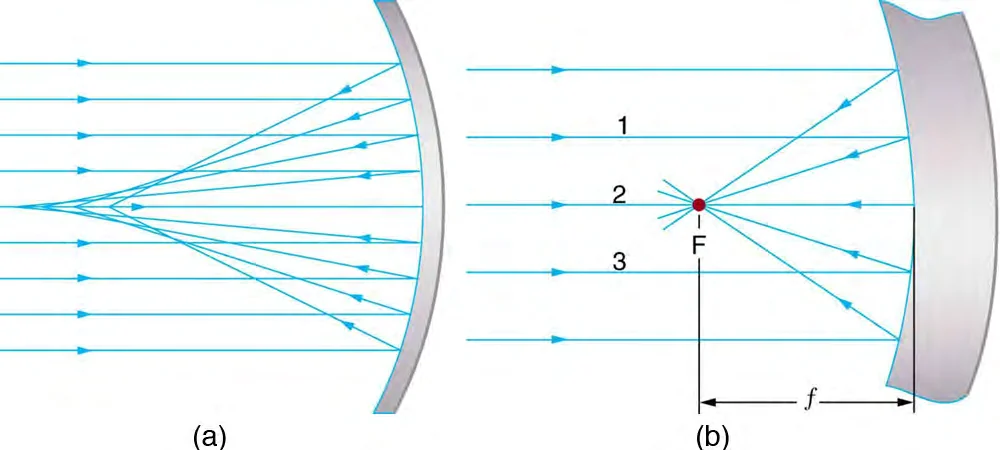
1
A real image is formed when light rays from one point are reflected and then actually meet at another point.
2
A real image can be displayed on a screen placed at the image position, and it is always in front of the mirror.
3
A virtual image is formed when reflected rays diverge so that, when extended backward, they appear to come from a common point.
4
A virtual image cannot be projected onto a screen, and it is located behind the mirror.
5
A plane mirror and a convex mirror always form virtual images.
1
Here so is the distance from the object to the mirror, si is the distance from the image to the mirror, and f is the focal length.
2
All three distances are in metres (m), or in centimetres if they are used consistently throughout a calculation.
3
Signs must be applied consistently. The table gives the convention used in this course.
f
Positive: Concave (converging) mirror; Negative: Convex (diverging) mirror
so
Positive: Real object in front of the mirror; Negative: Not used in this course
si
Positive: Real image in front of the mirror; Negative: Virtual image behind the mirror
hi
Positive: Upright image; Negative: Inverted image
The magnification of an image is the ratio of the height of the image to the height of the object: M = hi/ho.
Here ho is the object height and hi is the image height, both in metres (m).
Magnification is also given by M = −si/so.
The magnification is a pure number with no unit.
The sign of M shows the orientation of the image.
A positive value means the image is upright, and a negative value means it is inverted.
The size of M shows whether the image is enlarged (|M| greater than 1), the same size (|M| = 1) or reduced (|M| less than 1).
The absolute value of M equals the absolute value of si/so.
1
Three principal rays are normally used to locate an image.
2
The first ray is parallel to the principal axis, and after reflection it passes through the focal point of a concave mirror, or appears to come from the focal point of a convex mirror.
3
The second ray passes through the focal point and is reflected parallel to the principal axis.
4
The third ray strikes the centre of the mirror, where the principal axis meets the mirror, and is reflected at the same angle to the axis.
5
The image is where the reflected principal rays meet, or where they appear to meet.
6
For a concave mirror, the type of image depends on where the object is.
7
Beyond the centre of curvature, the image is real, inverted and reduced.
8
At the centre of curvature, the image is real, inverted and the same size.
9
Between the centre of curvature and the focal point, the image is real, inverted and enlarged.
10
Between the focal point and the mirror, the image is virtual, upright and enlarged.
11
A convex mirror always gives a virtual, upright and reduced image, wherever the object is placed.
Example 1
Concave mirror with a real image
1
1/si = 1/f − 1/so = 1/8.0 cm − 1/20 cm = (5 − 2)/40 cm = 3/40 cm, so si = 13.3 cm, a positive value, which means a real image in front of the mirror.
2
The magnification is M = −si/so = −13.3 cm/20 cm = −0.667.
3
The image height is hi = Mho = (−0.667)(10 cm) = −6.7 cm.
Answer
The image is 13 cm in front of the mirror (13.3 cm), real, inverted and reduced, with a height of 6.7 cm.
Example 2
Convex mirror
1
1/si = 1/f − 1/so = −1/15 cm − 1/30 cm = (−2 − 1)/30 cm = −3/30 cm, so si = −10 cm.
2
The negative sign shows a virtual image 10 cm behind the mirror.
3
The magnification is M = −(−10 cm)/30 cm = +0.333.
4
The image height is hi = (+0.333)(6.0 cm) = +2.0 cm.
Answer
The image is virtual, 10 cm behind the mirror, upright and reduced, with a height of 2.0 cm.
Example 3
Concave mirror with the object beyond the centre of curvature
1
The focal length is f = R/2 = 20 cm.
2
Then 1/si = 1/20 cm − 1/60 cm = (3 − 1)/60 cm = 2/60 cm, so si = 30 cm.
3
The magnification is M = −30 cm/60 cm = −0.50.
Answer
The image is real, 30 cm in front of the mirror, inverted and half the size of the object.
Using the sign convention for f from a lens
For mirrors a concave mirror has positive f and a convex mirror has negative f.
Calculating f as the radius of curvature
The focal length is half the radius of curvature, f = R/2.
Reading the sign of M as a size
The sign shows orientation (upright or inverted); the absolute value shows whether the image is enlarged or reduced.
Assuming a concave mirror always forms a real image
Objects placed between the focal point and the mirror produce virtual, upright, enlarged images.
Assuming a plane mirror image is smaller than the object or located at the mirror surface
The image is the same size and as far behind the mirror as the object is in front.
Avoid
Forgetting that a negative si means a virtual image behind the mirror, and then placing the image in front of the mirror