Curriculum
AP PHYSICS 2
9. Thermodynamics
0/13
10. Electric Force, Field, and Potential
0/15
11. Electric Circuits
0/17
12. Magnetism and Electromagnetism
0/9
13. Geometric Optics
0/9
14. Waves, Sound, and Physical Optics
0/19
-
14. Waves, Sound, and Physical Optics
 Preview
-
14.1 Properties of Wave Pulses and Waves
Preview
-
14.1 Properties of Wave Pulses and Waves - Check yourself
 Preview
-
14.2 Periodic Waves
Preview
-
14.2 Periodic Waves - Check yourself
Preview
-
14.3 Boundary Behavior of Waves and Polarization
Preview
-
14.3 Boundary Behavior of Waves and Polarization - Check yourself
Preview
-
14.4 Electromagnetic Waves
Preview
-
14.4 Electromagnetic Waves - Check yourself
Preview
-
14.5 The Doppler Effect
Preview
-
14.5 The Doppler Effect - Check yourself
Preview
-
14.6 Wave Interference and Standing Waves
Preview
-
14.6 Wave Interference and Standing Waves - Check yourself
Preview
-
14.7 Diffraction
Preview
-
14.7 Diffraction - Check yourself
Preview
-
14.8 Double-Slit Interference and Diffraction Gratings
Preview
-
14.8 Double-Slit Interference and Diffraction Gratings - Check yourself
Preview
-
14.9 Thin-Film Interference
Preview
-
14.9 Thin-Film Interference - Check yourself
Preview
15. Modern Physics
0/17
Text lesson
14.9 Thin-Film Interference
14.9 Thin-Film Interference — AP PHYSICS 2: ALGEBRA-BASED notes: You will be able to explain how a thin film produces interference between light reflected from its two surfaces, use the rule for phase changes on reflection to decide whether a film reflects constructively or destructively, apply the thin-film conditions at normal incidence to find a thickness or a wavelength, and explain colours in soap bubbles and oil films and the design of an antireflection coating.
1
A thin film is a layer of material whose thickness is comparable to the wavelength of the light, such as a soap bubble, a film of oil on water or the coating on a camera lens.
2
Light strikes the top surface of the film, and part of it is reflected there.
3
The rest enters the film, and part of that is reflected again from the lower surface.
4
The two reflected rays travel back out of the film, and they overlap.
5
Because the two reflected rays come from the same incident light, they can interfere.
6
The sum of the two waves is a single wave whose amplitude depends on how their phases compare when they meet.
7
The amount of constructive or destructive interference depends on the thickness of the film, the wavelength of the light, any phase shifts on reflection and the angle at which the light strikes the film.
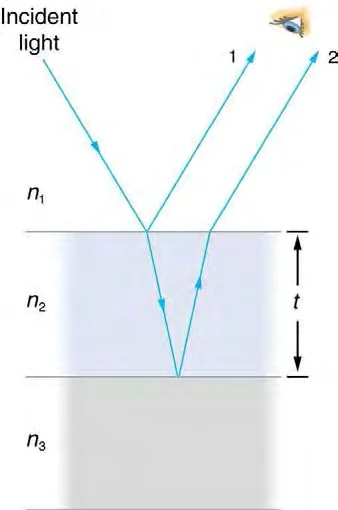
The phase of a reflected ray depends on the relative indices of refraction of the two media at the reflecting surface.
A reflected ray undergoes a phase change of 180° when it is reflected from a medium with a greater index of refraction than the medium in which it is travelling.
No phase change occurs when the ray is reflected from a medium with a lower index of refraction.
This is the same effect as the inversion of a reflected pulse on a string that meets a heavier string.
The phase of a wave does not change when it is refracted as it passes from one medium into another.
Only reflection can produce a phase change of 180° at a surface, so the two rays that interfere in a film can differ in phase because of the reflections, the path they travel in the film, or both.
1
For light at normal incidence, the path difference between the two reflected rays is the round trip through the film, which is 2t in the film, where t is the thickness.
2
In the film the wavelength is λ/n, where λ is the wavelength in vacuum and n is the index of refraction of the film.
3
Two conditions cover the usual cases.
4
If both reflections have a phase change of 180°, or neither does, the rays are in phase when the path difference in the film is a whole number of wavelengths: Constructive 2nt = mλ and destructive: 2nt = (m + ½)λ, for m = 0, 1, 2, and so on.
5
If only one of the two reflections has a phase change of 180°, the conditions are reversed: Constructive 2nt = (m + ½)λ and destructive: 2nt = mλ.
6
Here t is the thickness of the film in metres (m), n is the index of refraction of the film (a number without units) and λ is the wavelength of the light in a vacuum in metres.
7
The quantitative analysis is limited to light that is normal to the surface of the film.
1
A soap bubble is thin at its top and thicker below, and oil on water forms wedges of varying thickness.
2
At each thickness, a different wavelength satisfies the condition for constructive reflection, so the film appears to be coloured.
3
As the film thins or thickens, the colours move and change.
4
A film that is very thin reflects little visible light, and it appears dark.
5
A soap bubble has air on both sides of its film, so the reflection at its top surface, from air into the soap solution, has a phase change of 180°, and the reflection at its bottom surface has none.
6
Only one reflection is inverted, so the constructive conditions in the second set above apply.
An antireflection coating is a thin layer applied to a lens or a glass surface to reduce the reflected light.
The simplest coating has a thickness equal to one-quarter of the wavelength of the light in the coating, and its index of refraction is greater than that of air and less than that of the glass.
Both reflections then have a phase change of 180°, so the two reflected rays differ in phase only by the path through the coating.
The coating is designed so that they cancel each other, producing destructive interference, and so the reflected light is eliminated at the design wavelength.
A thickness of one-quarter of the wavelength in the coating gives a path difference of half a wavelength for the round trip, which is the destructive condition.
Example 1
Thickness of an antireflection coating
1
Both reflections have a phase change of 180°, so the destructive condition is 2nt = (m + ½)λ.
2
The minimum thickness is for m = 0: t = λ/(4n) = (550 × 10−9 m)/(4 × 1.38) = 9.96 × 10⁻⁸ m.
Answer
About 1.0 × 10² nm, or 100 nm, which is one-quarter of the wavelength in the coating.
Example 2
Colour reflected by a soap bubble
1
Only one reflection is inverted, so constructive interference occurs when 2nt = (m + ½)λ.
2
Here 2nt = 2(1.33)(290 nm) = 771 nm.
3
Then λ = 771/(m + ½).
4
For m = 0, λ = 1543 nm, which is infrared.
5
For m = 1, λ = 514 nm, which is green.
6
For m = 2, λ = 309 nm, which is ultraviolet.
Answer
514 nm, which is green, is the only visible wavelength reflected constructively, so the film appears green.
Example 3
Wavelength of minimum reflection from a coating
1
The destructive condition for a coating with both reflections inverted is 2nt = (m + ½)λ.
2
The lowest order is m = 0, so λ = 4nt = 4(1.38)(105 nm) = 579.6 nm.
3
The next value, for m = 1, is 193 nm, which is not visible.
Answer
About 580 nm, which is yellow-green, is the visible wavelength that is reflected least by this coating.
Applying the constructive and destructive conditions without checking the phase changes
The condition depends on whether one or both reflections are inverted, and two reversed conditions are easy to confuse.
Putting the wavelength in the film, λ/n, on the right-hand side of 2nt = mλ
The index is already on the left-hand side, so the right-hand side must use the vacuum wavelength λ.
Thinking that the phase changes when light is refracted into the film
Only reflection from a higher-index medium changes the phase by 180°.
Taking the thickness of an antireflection coating as one-quarter of the vacuum wavelength
The thickness is one-quarter of the wavelength in the coating, which is the vacuum wavelength divided by the index.
Assuming that a soap bubble has a phase change at both surfaces
Its bottom surface is reflected from a lower-index medium, so only the top reflection is inverted.