Curriculum
AP PHYSICS 2
9. Thermodynamics
0/13
10. Electric Force, Field, and Potential
0/15
11. Electric Circuits
0/17
12. Magnetism and Electromagnetism
0/9
13. Geometric Optics
0/9
14. Waves, Sound, and Physical Optics
0/19
15. Modern Physics
0/17
-
15. Modern Physics
 Preview
-
15.1 Quantum Theory and Wave-Particle Duality
Preview
-
15.1 Quantum Theory and Wave-Particle Duality - Check yourself
 Preview
-
15.2 The Bohr Model of Atomic Structure
Preview
-
15.2 The Bohr Model of Atomic Structure - Check yourself
Preview
-
15.3 Emission and Absorption Spectra
Preview
-
15.3 Emission and Absorption Spectra - Check yourself
Preview
-
15.4 Blackbody Radiation
Preview
-
15.4 Blackbody Radiation - Check yourself
Preview
-
15.5 The Photoelectric Effect
Preview
-
15.5 The Photoelectric Effect - Check yourself
Preview
-
15.6 Compton Scattering
Preview
-
15.6 Compton Scattering - Check yourself
Preview
-
15.7 Fission, Fusion, and Nuclear Decay
Preview
-
15.7 Fission, Fusion, and Nuclear Decay - Check yourself
Preview
-
15.8 Types of Radioactive Decay
Preview
-
15.8 Types of Radioactive Decay - Check yourself
Preview
Text lesson
15.1 Quantum Theory and Wave-Particle Duality
15.1 Quantum Theory and Wave-Particle Duality — AP PHYSICS 2: ALGEBRA-BASED notes: You will be able to describe how light and matter show both particle-like and wave-like behaviour, use E = hf and λ = h/p to calculate photon energies and de Broglie wavelengths, and decide when quantum theory is needed instead of classical mechanics.
1Why classical physics was not enough2Why classical physics was not enough
1Light as a wave and as photons2Light as a wave and as photons3Light as a wave and as photons4Light as a wave and as photons5Light as a wave and as photons
Light as a wave and as photons
Light as a wave and as photons
Light can be modelled as a wave, with frequency f and wavelength λ related by the speed of light: c = fλ
where c = 3.00 × 10⁸ m/s in free space.
1 / 5Next ▶
Light as a wave and as photons
Light as a wave and as photons
Light can also be modelled as a stream of discrete particles called photons.
A photon is a massless, electrically neutral particle.
Its energy is proportional to its frequency:
E = hf
What the symbols mean:
E = energy of one photon (J) · h = Planck constant (6.63 × 10
◀ Previous2 / 5Next ▶
Light as a wave and as photons
1
−34
2
J s) · f = frequency (Hz)
3
Here E is the energy of the photon in joules (J), f is the frequency in hertz (Hz), and h = 6.63 × 10⁻³⁴ J·s is Planck’s constant.
4
Because
5
E
6
=
◀ Previous3 / 5Next ▶
Light as a wave and as photons
1
hf
2
and
3
c
4
f
5
λ, a photon of short wavelength carries more energy than a photon of long wavelength.
6
Photons travel in straight lines unless they interact with matter, and each photon carries its whole energy in a single packet.
◀ Previous4 / 5Next ▶
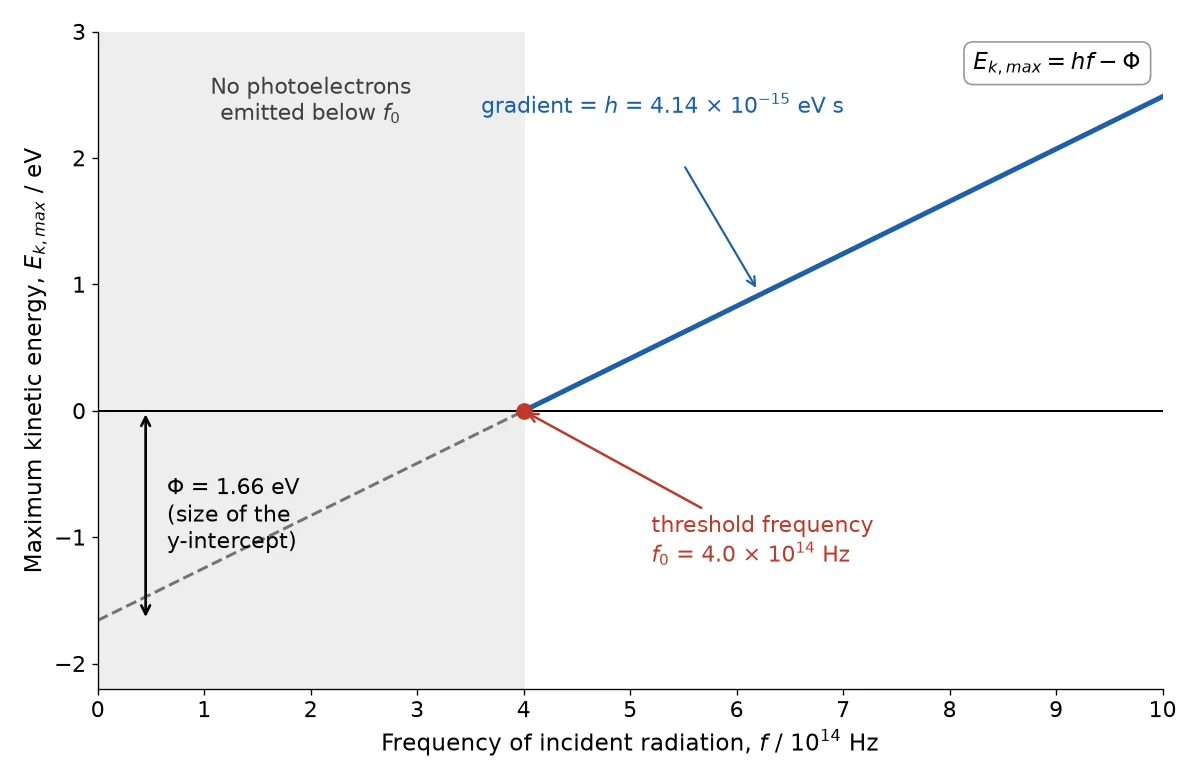
Graph of maximum photoelectron kinetic energy against frequency for sodium, with threshold frequency and work function marked
Light as a wave and as photons
 ⤢ Enlarge
Light as a wave and as photons
Both models are needed. Interference and diffraction are explained by the wave model
while the energy exchange in absorption and emission is explained by the photon model. Quantum theory states that light has both properties at the same time, and which property is seen depends on the experiment.
◀ Previous5 / 5
1The speed of light in a medium2The speed of light in a medium3The speed of light in a medium
1Particles with wave properties: the de Broglie wavelength2Particles with wave properties: the de Broglie wavelength3Particles with wave properties: the de Broglie wavelength4Particles with wave properties: the de Broglie wavelength
Particles with wave properties: the de Broglie wavelength
1
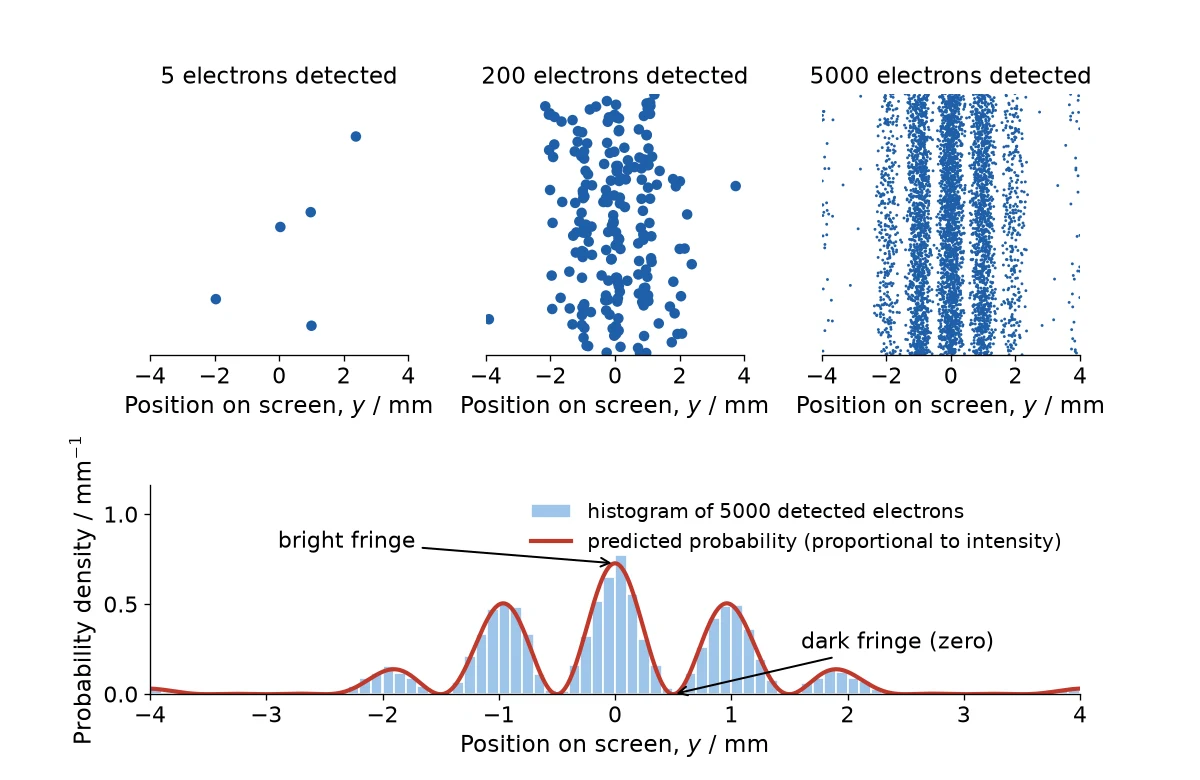
Particles, such as electrons, can also show wave properties. Electrons passing through two narrow slits produce an interference pattern similar to the pattern produced by light in Young’s double-slit experiment. The wave model of matter is quantified by the de Broglie wavelength of a particle:
2
λ = h/p = h/(mv)
3
What the symbols mean:
4
λ = de Broglie wavelength (m) · h = 6.63 × 10
5
−34
6
J s · p = momentum (kg m s
1 / 4Next ▶
Particles with wave properties: the de Broglie wavelength
1
−1
2
) · m = mass (kg) · v = speed (m s
3
)
4
Here λ is the de Broglie wavelength in metres, p = mv is the momentum of the particle in kg·m/s, m is its mass in kilograms, and v is its speed in metres per second.
◀ Previous2 / 4Next ▶
Particles with wave properties: the de Broglie wavelength
Particles with wave properties: the de Broglie wavelength
The de Broglie wavelength increases as the momentum decreases.
A heavy, fast object such as a thrown ball has a wavelength far too small to observe,
but a slow electron has a wavelength comparable to the spacing of atoms in a crystal.
Quantum theory is necessary to describe a system when the de Broglie wavelength of its particles is comparable to the size of the system. When the wavelength is much smaller than the system, classical mechanics gives a good approximation.
◀ Previous3 / 4Next ▶
Screen hits after 5, 200 and 5000 single electrons, with a histogram of 5000 hits matched to the predicted fringe probability curve
Particles with wave properties: the de Broglie wavelength
◀ Previous4 / 4
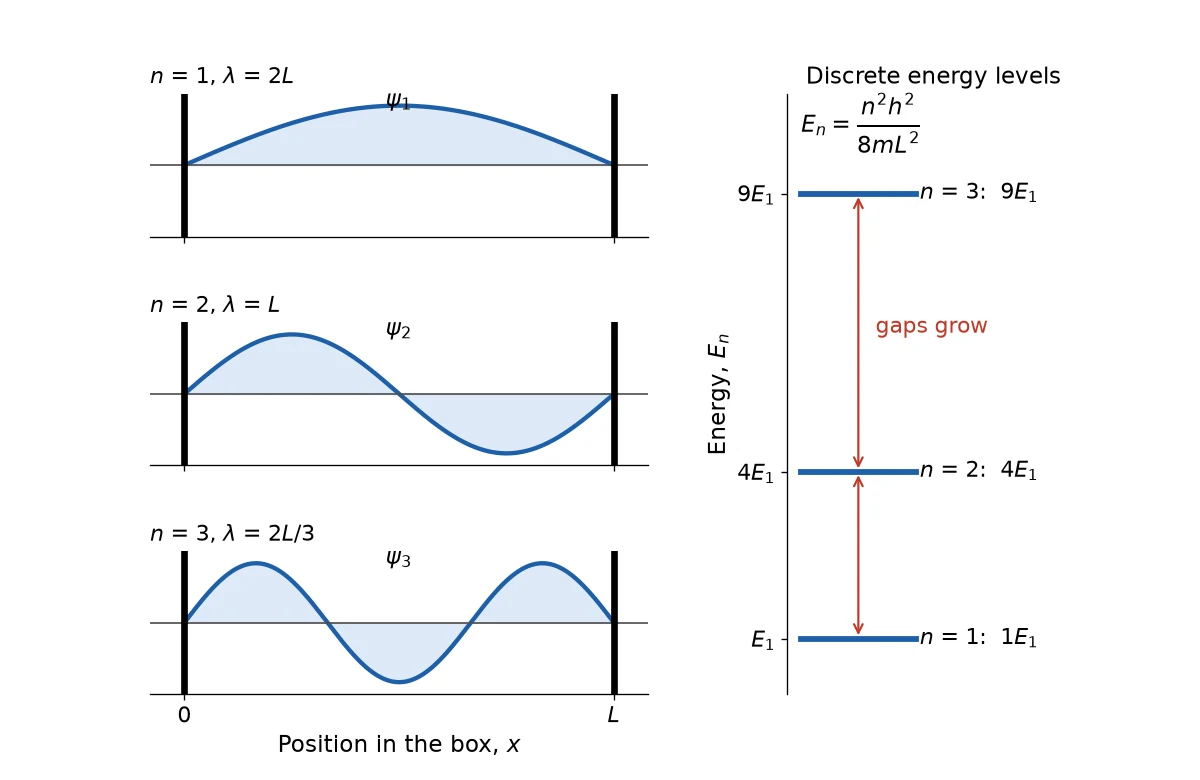
Left: standing-wave wavefunctions for n = 1, 2, 3 in a box of width L. Right: energy levels in the ratio 1:4:9
Quantized energy and momentum in bound systems
 ⤢ Enlarge
Quantized energy and momentum in bound systems
When a particle is held in a bound system, such as an electron bound to a nucleus, its energy and momentum cannot take any value. They can only take discrete, quantized values. This is why atoms have a set of allowed energy levels rather than a continuous range of energies. Topic 15.2 applies this idea to the hydrogen atom.
1Example 1: Energy of a photon of green light2Worked examples3Worked examples4Worked examples5Example 2: Speed of light in water · Example 3: de Broglie w
Key terms
| Term | Meaning |
|---|---|
| Photon | A massless, electrically neutral particle of light whose energy is proportional to its frequency, E = hf. |
| Planck’s constant (h) | The constant 6.63 × 10⁻³⁴ J·s that relates the energy of a photon to its frequency. |
| Index of refraction (n) | The ratio of the speed of light in free space to its speed in a medium, so that v = c/n. |
| Wave-particle duality | The property of light and matter that allows them to show both wave-like and particle-like behaviour. |
| de Broglie wavelength (λ) | The wavelength associated with a particle of momentum p, given by λ = h/p. |
| Quantized | Able to take only certain discrete values, such as the allowed energies of a bound system. |
| Electron volt (eV) | A unit of energy equal to 1.60 × 10⁻¹⁹ J, convenient for atomic-scale energies. |
| Double-slit experiment | An experiment in which waves or particles pass through two slits and form an interference pattern, showing wave properties. |
1Avoid these mistakes2Avoid these mistakes3Avoid these mistakes4Avoid these mistakes5Avoid these mistakes