Curriculum
AP PHYSICS 2
9. Thermodynamics
0/13
10. Electric Force, Field, and Potential
0/15
11. Electric Circuits
0/17
12. Magnetism and Electromagnetism
0/9
13. Geometric Optics
0/9
14. Waves, Sound, and Physical Optics
0/19
15. Modern Physics
0/17
-
15. Modern Physics
 Preview
-
15.1 Quantum Theory and Wave-Particle Duality
Preview
-
15.1 Quantum Theory and Wave-Particle Duality - Check yourself
 Preview
-
15.2 The Bohr Model of Atomic Structure
Preview
-
15.2 The Bohr Model of Atomic Structure - Check yourself
Preview
-
15.3 Emission and Absorption Spectra
Preview
-
15.3 Emission and Absorption Spectra - Check yourself
Preview
-
15.4 Blackbody Radiation
Preview
-
15.4 Blackbody Radiation - Check yourself
Preview
-
15.5 The Photoelectric Effect
Preview
-
15.5 The Photoelectric Effect - Check yourself
Preview
-
15.6 Compton Scattering
Preview
-
15.6 Compton Scattering - Check yourself
Preview
-
15.7 Fission, Fusion, and Nuclear Decay
Preview
-
15.7 Fission, Fusion, and Nuclear Decay - Check yourself
Preview
-
15.8 Types of Radioactive Decay
Preview
-
15.8 Types of Radioactive Decay - Check yourself
Preview
Text lesson
15.7 Fission, Fusion, and Nuclear Decay
15.7 Fission, Fusion, and Nuclear Decay — AP PHYSICS 2: ALGEBRA-BASED notes: You will be able to explain how the strong force, conservation laws and mass–energy equivalence constrain nuclear reactions, calculate the energy released by fission and fusion from a mass defect, and use the half-life and decay constant to predict the number of nuclei remaining in a radioactive sample and the age of a sample.
The strong force inside the nucleus
The strong force inside the nucleus
The protons and neutrons in a nucleus
which are collectively called nucleons, are held together by the strong force.
The strong force is exerted at nuclear scales and dominates the interactions between nucleons.
It is attractive between nucleons at very short distances, of the order of a few femtometres,
and it is strong enough to overcome the electric repulsion between the protons.
Its range is very short
so it acts only between nearby nucleons.
Because the strong force is so much stronger than the electric force at nuclear distances, a nucleus with many protons can remain bound. Adding too many neutrons or too many protons makes a nucleus unstable, and such a nucleus may release energy by changing its composition.
1Conservation laws and mass–energy equivalence2Conservation laws and mass–energy equivalence3Conservation laws and mass–energy equivalence
1Nuclear fission and fusion2Nuclear fission and fusion3Nuclear fission and fusion
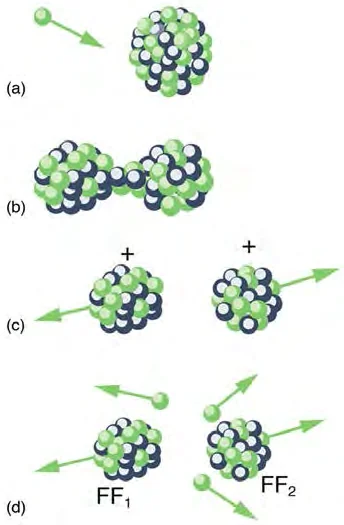
Stages of neutron-induced fission: a nucleus absorbs a neutron, deforms, and splits into two fragments with extra neutrons. Image: OpenStax, College Physics for AP Courses, CC BY 4.0.
Nuclear fission and fusion
 ⤢ Enlarge
Nuclear fission and fusion
Nuclear fusion is the process in which two or more smaller nuclei combine to form a larger nucleus, together with other subatomic particles. Fusion of light nuclei releases energy
because the product nucleus is more tightly bound per nucleon than the original light nuclei. The fusion of deuterium and tritium, for example, produces a helium nucleus and a neutron.
1 / 3Next ▶
Nuclear fission and fusion
1
Nuclear fission is the process in which the nucleus of an atom splits into two or more smaller nuclei, together with other subatomic particles such as neutrons.
2
Fission of a heavy nucleus such as uranium-235 releases energy,
3
because the product nuclei are more tightly bound per nucleon than the original heavy nucleus.
4
Fission may occur spontaneously or may require an energy input, depending on the binding energy of the nucleus.
5
A heavy nucleus with low binding energy per nucleon may split on its own,
6
while a more stable heavy nucleus requires an input of energy,
◀ Previous2 / 3Next ▶
Nuclear fission and fusion
Nuclear fission and fusion
such as the absorption of a neutron, before it can split.
Energy released in fission and fusion appears mainly as the kinetic energy of the products and as photons.
Both processes are governed by the same conservation laws as any other nuclear reaction.
◀ Previous3 / 3
1Radioactive decay and probability2Radioactive decay and probability3Radioactive decay and probability
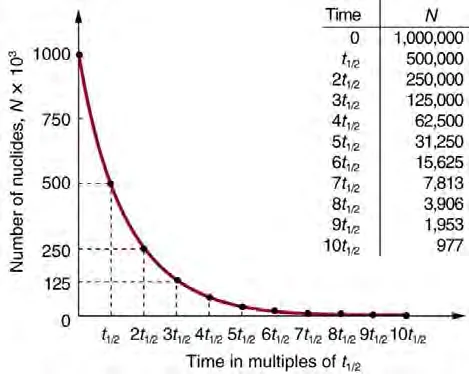
Exponential fall of the number of radioactive nuclei, halving with each half-life. Image: OpenStax, College Physics for AP Courses, CC BY 4.0.
Radioactive decay and probability
 ⤢ Enlarge
1
Radioactive decay is the spontaneous transformation of an unstable nucleus into one or more different nuclei, or into a lower energy level of the same nucleus.
2
The time at which an individual nucleus decays cannot be predicted.
3
However, the decay of a large sample can be described using probability,
because each nucleus has the same chance of decaying in a given time interval.
4
The half-life, t1/2, of a radioactive material is the time it takes for half of the initial number of radioactive nuclei to decay. Half-lives differ greatly between isotopes, from fractions of a second to billions of years. Each half-life, the number of nuclei remaining is halved
so after n half-lives the fraction remaining is (1/2)n.
5
The decay constant λ is related to the half-life by:
6
λ = ln 2/t1/2 = 0.693/t1/2
1 / 3Next ▶
Radioactive decay and probability
Radioactive decay and probability
Here λ is in units of inverse time, such as s-1, and t1/2 is in the same time units as the decay constant. The number of nuclei remaining after a time t is:
N = N0e−λt = N0(1/2)t/t1/2
What the symbols mean:
N = number of nuclei left after time t · N
0
= number at the start · λ = decay constant (s
◀ Previous2 / 3Next ▶
Radioactive decay and probability
Radioactive decay and probability
−1
) · t = time (s)
Here N0 is the initial number of nuclei and N is the number remaining at time t.
The two forms are equivalent.
This equation predicts the number of nuclei remaining after a period of time.
If the initial amount is known, the measured remaining amount gives the age of the material: t = (1/λ) ln(N0/N).
◀ Previous3 / 3
1Example 1: Energy released in fission · Example 2: Energy re2Example 3: Remaining nuclei after several half-lives · Examp
Key terms
| Term | Meaning |
|---|---|
| Strong force | The short-range force that holds nucleons together and dominates the interactions between nucleons at nuclear scales. |
| Nucleon number | The total number of protons and neutrons, which is conserved in every nuclear reaction. |
| Mass–energy equivalence | The relation E = mc2, which allows mass to be converted to energy and energy to mass. |
| Nuclear fusion | The process in which two or more smaller nuclei combine to form a larger nucleus and other particles. |
| Nuclear fission | The process in which a nucleus splits into two or more smaller nuclei and other particles. |
| Radioactive decay | The spontaneous transformation of an unstable nucleus into a different nucleus or into a lower energy state. |
| Half-life (t1/2) | The time for half of the initial number of radioactive nuclei to decay. |
| Decay constant (λ) | The constant that gives the probability of decay per unit time, with λ = ln 2/t1/2. |
1Avoid these mistakes2Avoid these mistakes3Avoid these mistakes